
Dela
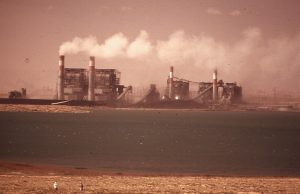
Photo: Navajo Mine is the sole supplier of the Four Corners Power Plant in New Mexico.
An environmental group met in Window Rock, Ariz. Monday to argue against keeping a Navajo Nation coal mine alive.
As KNAU’s Chris Clements reports, critics say it would ignore a nationwide transition away from fossil fuels.
Members of the group Diné Citizens Against Ruining Our Environment (CARE), like Devon Norberto, say the permit to extend the life of the Navajo Mine by 110 years is rushed.
“A lot of the concerns we heard were around that the community hadn’t been fully notified of this permit.”
The tribally owned Navajo Transitional Energy Company (N-TEC) operates the Navajo Mine in northwestern New Mexico and is pushing for its expansion.
Supporters of that proposal argue it is essential to the tribe’s economic stability and sovereignty, but Norberto says members of Burnham Chapter, a community near where coal would be mined, were not properly consulted.
“It would relocate some of the families within the leasing area that they are trying to mine at. It would force them to lose their grazing lands. It would remove them from their ancestral ties to the land.”
N-TEC did not immediately respond to a request for comment.
A federal agency tasked with approving the mine expansion is expected to release a decision in August.
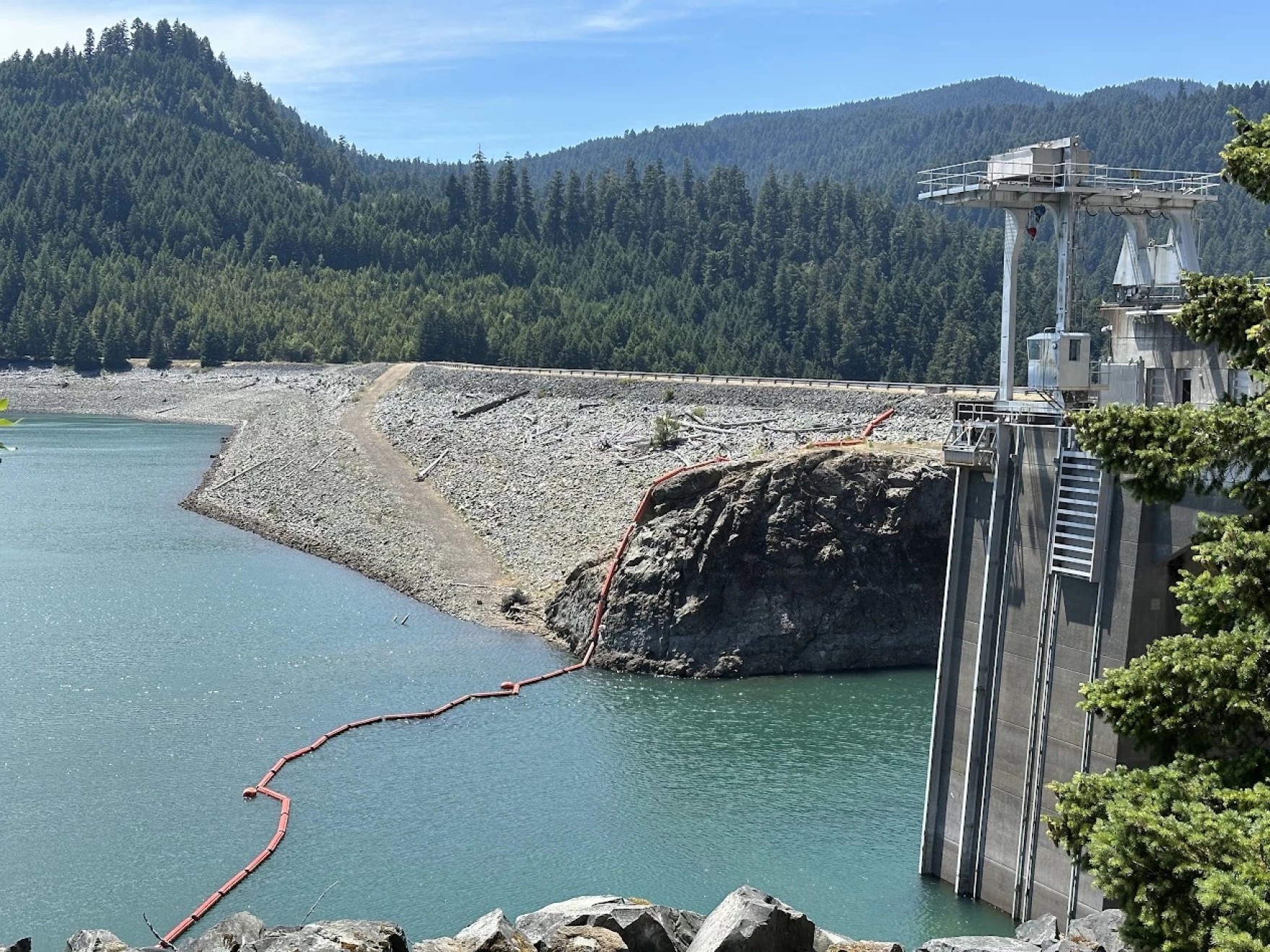
The 65-year-old Hills Creek Dam and Reservoir roughly four miles east of Oakridge, Oreg. as seen on June 24, 2026. (Photo: Brian Bull / KLCC)
Across the Pacific Northwest, tribes and conservationists are working to help the eel-like fish, the lamprey rebound.
As KLCC’s Brian Bull reports, dams have greatly diminished their numbers.
Recently near Oregon’s Coyote Creek, technicians with the Confederated Tribes of Warm Springs arrived with 100 lampreys in their truck.
Aldwin Keo introduced himself and his slithering cargo.
“They’re filter feeders, they clean out whatever is in the sediment, that’s where they stay for many years before they go out to the ocean.”
A group of Native educators and students helped release the prehistoric critters into the creek.
This is a practice called translocation, where adult fish are released in waterways above dams.
Courtney Golts, a lamprey biologist with the tribe, says dam development has had its impact.
“In the upper Willamette tributaries are areas that have been completely impassable to lamprey for decades, so these are reintroductions to areas that do not have Pacific lamprey, and as of today, they do.”
The Columbia River Inter-Tribal Fish Commission (CRITFC) says lamprey once teemed in the millions through the Columbia River Basin, but only 23,000 were recorded in 2010.
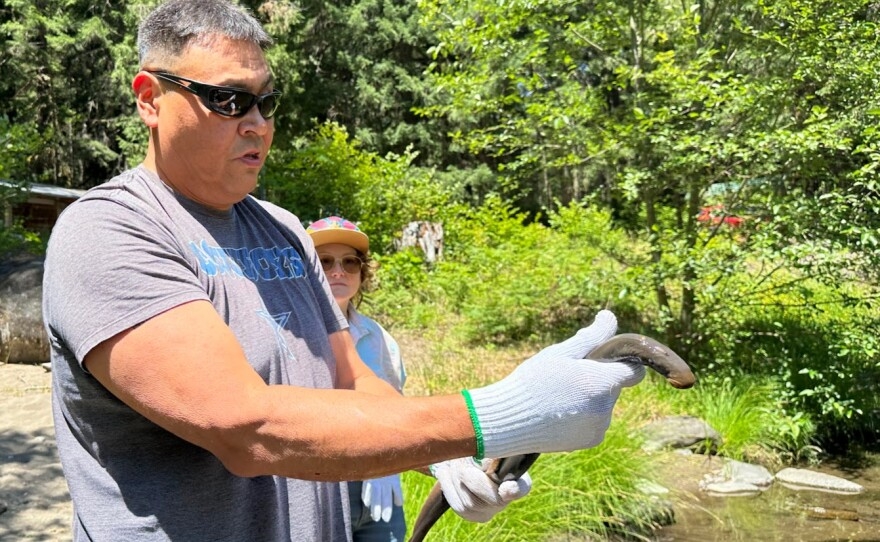
Jerrid Weaskus of the Nez Perce Tribe holds a lamprey before releasing it in a waterway near Hills Creek Dam on June 24, 2026. (Photo: Brian Bull / KLCC)
Raymond Ellenwood Jr. is a fisheries technician with the Nez Perce Tribe.
Near Oakridge, he and Jerrid Weaskus released more lamprey. The goal is to have adult lamprey stay and mate, creating little lampreys called ammocoetes.
“The ammocoetes, they burrow into the sand and the substrate and they’ll filter feed off the detritus in the river or stream. And what they’re doing is the adults are smelling the ammocoetes, that are upriver in those river systems. They’re telling them, ‘Hey that river system’s good. There’s good spawning habit. That’s where we want to go.'”
If all goes to plan, lamprey released here will start migrating to the Pacific Ocean around 2030, and come back as adults four years later.
“Wanna welcome you guys to our annual lamprey celebration.”
Recently in Oregon City, more than 1,200 people signed up for the annual Yakama Nation Willamette Falls Lamprey Celebration.
It is a day of music, presentations, even a lunch with grilled lamprey.
CRITFC’s Jeremy Five Crows says they have updated their plan to include a technical document for scientists, students, and resource managers, and a policy brief for lawmakers.
“The lamprey has been around 450 million years. We’re closer to a T-Rex than a T-Rex was to lamprey. That’s how far back they go, and so the thought of just in the past 100 years that we could drive something extinct that’s been on Earth for that long, is terrible.”
Get National Native News delivered to your inbox daily. Sign up for our daily newsletter today.
Download our NV1 Android or iOs App for breaking news alerts.
Check out today’s Native America Calling episode
Avsnitt sparat!
Du hittar sparade avsnitt på Mina sidor.
Kunde inte spara avsnitt
Något gick fel. Försök igen.