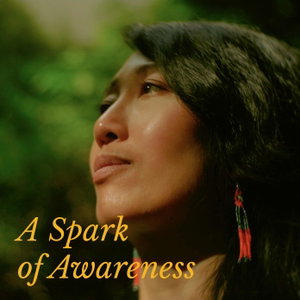
In this episode of A Spark of Awareness, I want to share something very personal: how forgiving my father became one of the deepest turning points in my life, my relationships, and my business.
We often look outside ourselves when something isn’t working. When a business struggles, we look at the market, the strategy, the economy, or our clients. When a relationship breaks down, we look at the other person. But sometimes the biggest shift doesn’t come from changing anything outside of us. It comes from understanding what is happening within us.
Over the past year, my business has expanded into new spaces, from working with people in technology and venture capital to conscious leadership and retreats. But I realized that for my work to make a quantum leap, I also had to make a quantum leap within myself.
No investor, coach, friend, or external opportunity could make that leap for me.
That realization became especially clear after a painful separation last year. I had spent much of my life believing that if I made good choices and had a good plan, I could keep things under control. Then a relationship I had invested deeply in ended, and many of the plans I had for my future disappeared with it.
I had to face the uncomfortable truth that I am not in control of everything. Instead of trying to rebuild the old plan, I began asking myself what my life and relationships had been trying to show me. What patterns was I repeating? What was happening inside me that was attracting certain experiences?
Through that process, I discovered something I had understood intellectually for years but had never fully embodied: I didn’t completely trust other people.
I had experienced betrayal and situations where I felt controlled, used, or taken advantage of. I had learned to rely primarily on myself. That had made me strong and independent, but it had also created a layer of protection around my heart. I could explain the pattern. I could analyze where it came from. But knowing something intellectually is very different from actually being free from it.
Eventually, I reached the source of it: my relationship with my father.
I realized that much of the resentment I had carried toward men in my life was connected to what I had experienced with him. I had felt controlled, unheard, and pressured to fulfill expectations that weren’t necessarily my own.
And for years, I had unconsciously been looking for something from other men that I had never received from him: acknowledgement and an apology.
At some point, I understood that I might never receive those words.
So I had to find another way to become free.
For me, forgiveness wasn’t an intellectual decision. It meant going back to the hurt itself and allowing myself to see my father differently—not only as my father, but as a young man who had left Vietnam at eighteen, lost many of his own dreams through war and displacement, and had to rebuild his life from almost nothing.
I began to see that he, too, had carried wounds, shame, disappointment, and a sense of failure that he didn’t necessarily have the tools to process. Some of what he carried had been passed on to me.
And I realized that I didn’t have to carry it anymore.
After one particularly deep period of inner work, I wrote my father an eleven-page letter containing everything I had never said. I eventually burned it. I didn’t need him to read it anymore. I needed those words to leave me.
Something shifted after that.
I felt less distrustful, less guarded, and more open to life. And perhaps most importantly, I stopped feeling that I needed external achievements to prove that I was worthy. I didn’t need to become a mother, build a huge company, become popular, or be recognized in order to feel that I was enough.
I began to feel that nothing was missing.
Happiness is what’s there when you remove the sense that something is missing in your life
— Naval Ravikant
And from that place, I started building differently.
Instead of asking, What can this business give me? recognition, success, money, popularity, validation…
I could ask, What does the world need? What am I here to create, of value for the world?
That distinction has changed the way I lead my work.
I can listen more deeply. I can change direction when something no longer feels relevant. I can allow my business to evolve without feeling that my identity or worth is attached to it.
Because I am not my business.
This is also why my work has been evolving toward conscious leadership, retreats, deeper human connection, and spaces where people can reconnect with themselves and others.
I see a growing need for this in a world where technology and AI can increasingly provide information and efficiency, while human beings are still searching for meaning, connection, love, and belonging.
So if you are trying to change something in your life or business, I invite you to look beyond the surface problem. Instead of only asking, What should I change externally?, ask yourself what might be underneath it.
Where did you first learn not to trust?
What are you still protecting yourself from?
What are you trying to prove? And what are you carrying that doesn’t actually belong to you?
Because sometimes the obstacle to your next level isn’t your strategy. It’s an old pattern still running underneath it.
For me, forgiving my father didn’t change him. It changed me. And because I changed, my relationship with my work, my relationships, my partnerships, and my future changed too.
That is the paradox I’ve experienced: sometimes the fastest way to create an external quantum leap is to stop forcing the outside world to change and have the courage to go deeper within.
The real transformation starts there.
Thanks for reading Rise and Play! Subscribe for free to receive new posts and support my work.
This is a public episode. If you would like to discuss this with other subscribers or get access to bonus episodes, visit riseandplay.substack.com