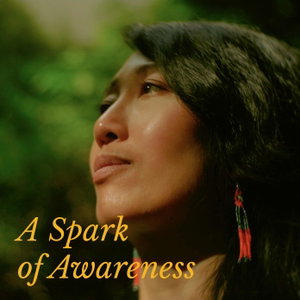
Welcome to a new episode of A Spark of Awareness.
This week, I want to talk about something that has been a major theme in my own entrepreneurial journey: business partnerships, co-founders, collaboration, and trust.
For a long time, I wore what I now recognize as the mask of the lone wolf.
“I’m better by myself. I know what to do. I don’t need anyone.”
I also wore the masks of the high achiever, the strong woman, and the person who could handle everything alone.
Maybe you recognize yourself in some of these.
The interesting thing is that these identities aren’t necessarily bad. At some point in our lives, they probably helped us. They became ways of protecting ourselves and creating a sense of safety. Being strong, independent and self-reliant can take us very far.
But what protects us at one stage of our life can become a limitation at another.
And that is what I have been discovering in my business.
When independence becomes a limitation
Over the past three years, I have become very good at building things independently.
I created a business where I own my time, choose who I work with, decide how I work and have a lot of control over where I put my energy.
There is a lot of freedom in that.
But I also started to see the other side of it.
I had become very comfortable being in charge, but I hadn’t learned equally well how to rely on others, receive support and build something with an equal.
There is a big difference between working with a team member and working with a true partner.
When you hire someone, there is still a hierarchy. You are ultimately the person making the decisions. You have authority, responsibility and control.
But with a business partner or co-founder, you have to meet each other as equals.
You can’t simply use authority or money to make things happen. You have to communicate, negotiate, trust, share responsibility and create something together.
And that has been one of my biggest personal and professional challenges.
The deeper question: Can I trust others?
This has made me look beyond business strategy.
Because the real question isn’t simply:
“Should I have a business partner?”
The deeper question is:
“Can I trust another person enough to build with them?”
And if not, why?
For me, this question has connected to a lot of deeper inner work around trust, control, boundaries and my relationship with power.
I realized that I had created a narrative that working with powerful people—particularly powerful men—could mean losing my own power.
So I protected myself by creating distance.
But that also meant I was limiting myself from collaborating with amazing people who had their own power, sovereignty and integrity.
The problem wasn’t necessarily other people.
It was my own capacity to trust, to collaborate and to remain grounded in myself while being in relationship with someone equally powerful.
That required me to rewrite an old story.
You can go faster alone. But can you go further together?
One of the biggest stories I had to examine was this:
“If I work with other people, I have to divide the wins.”
Of course, that’s partly true. If you share a business, a project or an opportunity, you may also share the financial outcome.
But I realized how limited that perspective was.
Because if you only focus on maximizing what you get, you can miss what becomes possible when several people bring their strengths together.
If you want to go fast, you can go alone. If you want to create greater impact, you need others.
That has become increasingly clear to me.
Over the past year, I have deliberately started experimenting with different forms of partnership.
I’ve worked with people who understand marketing much better than I do. I’ve explored new platforms and advertising. I’ve started surrounding myself with people who can help me expand the reach of my work instead of trying to figure everything out myself.
And I’ve discovered that this isn’t necessarily about maximizing profit margins.
It’s about asking:
What is the most powerful way to create the impact I want to create?
Sometimes that means keeping everything in-house.
Sometimes it means bringing in someone who can do something ten times better than you, or building something together.
Your environment is part of your growth
Another major shift for me has been moving out of my own bubble.
For three years, I worked mostly from home. I was productive. I could organize my days exactly as I wanted. I didn’t see much need for a coworking space.
But productivity isn’t the same thing as growth.
Working alone also meant I was missing perspective, spontaneous conversations, new ideas and opportunities to co-create.
So I started joining more curated communities and environments.
I joined a co-creation coworking space where people actively connect, share ideas, create events and find ways to collaborate.
I also joined a carefully curated network of founders and business leaders.
And what I noticed was this:
I didn’t just need to be a source of inspiration for others. I needed to be inspired by others, too.
As a coach and mentor, I’m used to holding space for people, supporting their growth and helping them see things differently.
But I also need people who challenge my thinking.
People who have walked paths I haven’t walked yet.
People who see things I don’t see.
People who are a few steps ahead of me—and sometimes completely outside my frame of reference.
That is where growth happens.
Back Into Co-Founding
The final experiment—and perhaps the biggest one—is that I’m opening myself to co-found a business with a partner again.
I’ve co-founded several ventures in the past, and not all of those experiences were easy. There were difficult conversations, misalignment and complexity.
At one point, I thought:
“This is not for me anymore. I’m never going back there.”
So I closed that door.
And now, I’m opening it again.
But I’m not entering partnership with the same identity I had before.
I’m coming with more maturity, more experience and more awareness of what I need.
I’ve learned that trust doesn’t mean abandoning your boundaries.
A few reflections for your own business
If you’re building something right now, I invite you to look at where you might be operating from the lone wolf archetype.
Ask yourself:
* Where am I doing everything myself when someone else could help me grow?
* Where am I holding onto control because it makes me feel safe?
* Do I actually want to maximize what I keep, or do I want to maximize the impact I can create?
* What boundaries would I need in order to collaborate from a place of trust?
* Who are the people I currently surround myself with? Are they reinforcing what I already know, or expanding the way I think?
The most underlying question behind those questions:
Am I building this business primarily for myself,
or am I building it for the impact I want to create?
Because those two questions can lead to very different choices.
We are not meant to do everything alone
One of the stories of modern entrepreneurship is that the successful founder is self-sufficient.
The person who can do everything and doesn’t need anyone. “I have AI to build this and that.”
But I increasingly believe that this isn’t the highest expression of leadership.
We are human beings. We are wired for relationship, community and interdependence.
And the next level of growth may not come from becoming more independent.
It may come from becoming more capable of trusting, receiving, collaborating and creating together.
This is something I’m learning myself.
I’m still experimenting. I’m still navigating the transition in my business. And I’m still learning what the right partnerships look like.
But I know now that closing the door to partnership because of what happened in the past can also mean closing the door to what might become possible in the future.
And perhaps that’s the next chapter for me: not building alone, but learning how to build with others.
A final reflection
Take a moment today and ask yourself:
Where might my need for control be limiting my growth?
And what could become possible if I allowed myself to trust and create with others?
Then take a breath, close your eyes if it feels comfortable, and simply notice what happens in your body when you imagine letting someone else in.
That response might tell you more than your mind does.
This episode is part of Sophie Vo’s A Spark of Awareness podcast, exploring the inner work behind leadership, entrepreneurship, transformation and creating a life and business from a place of greater alignment.
Thanks for reading Rise and Play! Subscribe for free to receive new posts and support my work.
This is a public episode. If you would like to discuss this with other subscribers or get access to bonus episodes, visit riseandplay.substack.com