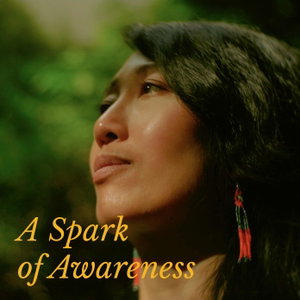
Dela
Over the past year, my work has been taking me deeper into a question that has been sitting underneath much of my coaching practice: what happens when we have already done a lot of the work in the mind, but something is still keeping us from living our full potential?
As a coach, I have spent years working with leaders on strategy, decision-making, self-awareness, leadership, relationships, purpose and business.
And yet, again and again, I have seen that knowing something intellectually does not necessarily mean that we can change it. We can understand why we behave the way we do. We can talk about our fears, our childhood patterns and our limiting beliefs. We can even have a very clear vision of the person we want to become.
And still, we repeat the same patterns.
This is what eventually led me to explore another dimension of the work: the wisdom of the body, the intelligence of the heart and, eventually, plant medicine.
For this episode of A Spark of Awareness, I invited Omar M’Rabet Gomez to have a conversation about his own journey with plant medicine, what he has learned through almost three decades of working with these traditions, and why so many leaders are increasingly curious about this work. This is not an invitation to see plant medicine as the answer to everything. There are many paths to transformation. But for some people, it can be a powerful catalyst for going beyond the patterns of the mind and accessing something that has been difficult to reach through conventional approaches alone.
From the corporate world to the jungle
Omar’s story is very different from mine, but there was something very familiar in it. Born in Mexico, he grew up with a strong connection to nature and spent much of his youth seeking out indigenous communities and learning from people who had maintained a relationship with nature that modern society has, in many ways, forgotten.
Long before plant medicine became a mainstream conversation, Omar was traveling, spending time with indigenous communities and learning from them. His first experience with peyote happened in Mexico, followed years later by his first experience with Ayahuasca in the Amazon in 2004. At the time, very little was known publicly about these traditions. There were no Instagram accounts explaining how to prepare for a ceremony, no mainstream podcasts and very little public conversation about psychedelics. He entered this world through direct experience.
What happened in those early ceremonies profoundly changed him. He describes experiences of forgiveness, self-love and a deep sense of connection. One of the most important realizations for him was what he calls radical unconditional self-love.
But what struck me most about Omar’s story is that he did not immediately leave the corporate world and become a facilitator. He went back. He worked in business. He managed a law firm. He lived a very material, successful life. And yet, something was missing.
Eventually, a series of profound life events brought him back to the path he had encountered in the jungle and ultimately led him to build a healing centre and dedicate his life to this work.
Looking back, he says something that stayed with me: he didn’t build the healing centre to heal other people. He built it to heal himself.
Helping others became a byproduct of his own healing journey. And perhaps this is an important distinction for anyone working in the space of transformation:
We cannot guide others where we have not been.
Why are leaders drawn to plant medicine?
One of the questions I wanted to explore with Omar was why so many high-performing leaders and entrepreneurs are increasingly curious about psychedelics and plant medicine.
Because this is not only happening in spiritual communities. Omar has worked with people from all walks of life: electricians, mechanics, mothers, entrepreneurs, executives and CEOs of some of the world’s largest companies.
And according to his experience, the most powerful leaders often encounter the same fundamental challenges as everyone else. They get in their own way.
Behind the performance, the success, the intelligence and the ability to make decisions, there can be self-doubt, imposter syndrome, fear, the need for recognition and a deep attachment to control. The more successful someone becomes, the more sophisticated the protection mechanisms can become.
You can build an incredible company while simultaneously building an identity around being the person who cannot fail. You can become a CEO while secretly wondering whether you are good enough. You can have millions in the bank and still be afraid that everything could disappear tomorrow. You can become very powerful externally while feeling insecure internally.
This is where Omar believes plant medicine can become a powerful catalyst. It can help people step outside the usual patterns through which they perceive themselves and their lives. Not because the medicine magically fixes anything, but because it can create an experience where you are able to see yourself, your story and your patterns from a different perspective.
The biggest barrier is ourselves
One of the themes that came up repeatedly in our conversation was control.
Leaders are often rewarded for being in control. Control the strategy. Control the numbers. Control the team. Control the outcome. Control the risk.
But what happens when control becomes the way we navigate our entire life?
Omar shared a simple metaphor that stayed with me. Imagine holding a handful of sand. If you squeeze it as hard as you can because you are trying to control it, the sand will escape through your fingers. But if you hold it gently, it can remain in your hand.
The same can happen with life. Sometimes, the harder we try to control an outcome, the more resistance we create around it.
And this is particularly interesting for high achievers because the very qualities that helped them succeed can eventually become the things that limit them. Discipline can become rigidity. Ambition can become exhaustion. Focus can become obsession. Self-reliance can become isolation. Confidence can become an inability to receive help. And control can become an inability to surrender.
But going beyond the mind does not mean becoming passive. This was an important point in our conversation.
Being in flow is not about doing nothing and waiting for the universe to solve your problems. It is not about abandoning ambition or responsibility. It is about removing some of the unnecessary weight that we carry while pursuing what matters to us.
The backpack we carry up the mountain
Omar gave another metaphor that I loved. Imagine that you are climbing a mountain. You are determined to reach the top, but you are carrying a huge backpack filled with everything you have accumulated throughout your life: past relationships, childhood wounds, fears, limiting beliefs, negative thought loops, expectations and identities.
You can still climb the mountain. But it is going to be much harder.
Plant medicine, in his experience, can sometimes help people look inside that backpack and ask: Do I still need to carry all of this?
Maybe the goal is not to stop climbing. Maybe the goal is to climb without carrying what no longer belongs to you.
This is where I see a very interesting connection with leadership. Many leaders are not lacking ambition. They are not lacking intelligence. They are not lacking discipline.
They are carrying too much.
And sometimes the next level of performance does not come from adding another strategy, another course, another productivity system or another goal. It comes from releasing what is consuming the energy that could otherwise be available for creation.
What are you afraid will happen if you change?
There is also a deeper fear that comes up when we talk about this work: who will I be if I change?
I have heard this question many times in my coaching practice. What if I don’t want to run my company anymore? What if I stop wanting the promotion? What if I don’t care about the money anymore? What if I want to build something completely different? What if I become a different person?
For many leaders, their ambition has become deeply connected to their identity.
The fear is not necessarily of failing. The fear is of discovering that the thing they have been chasing for the last 10, 15 or 20 years is no longer what they actually want.
And that can be terrifying.
Because if you have built your entire identity around being successful, what happens when your definition of success changes?
This is where I believe the work becomes much deeper than performance coaching. It becomes a question of identity.
Who are you underneath the achievement?
Who are you when nobody is watching? Who are you without the title? Who are you without the company? Who are you without the recognition? Who are you when you no longer need to prove anything?
Plant medicine can sometimes open the door to these questions very quickly. But the questions themselves are available to all of us, with or without medicine.
Why now?
Another question we explored was why this conversation is becoming so present now.
For me, there is something happening collectively. We have never been more connected digitally, and yet many people have never felt more disconnected from themselves, from nature and from each other.
We are constantly stimulated, consuming information, looking at screens. Receiving notifications, messages and opinions. And our ability to simply be present is becoming increasingly difficult.
For leaders, this is amplified. They are making decisions in an environment of constant uncertainty, rapid technological change, AI, economic pressure and competition. The old model was already intense. The speed of the new world is even faster.
And perhaps the answer is not to make humans operate even faster. Perhaps it is to develop another form of intelligence: one that is not only analytical, but that also includes the body, intuition, emotional intelligence, presence, discernment and connection.
This is where I see the bridge between conscious leadership and plant medicine becoming particularly interesting.
Beyond the mind does not mean against the mind
One thing I want to be very clear about is that I don’t see this work as mind versus body.
The mind is extraordinary. We need strategy. We need logic. We need analysis. We need science. We need critical thinking.
But we are not only our minds.
And when the mind has reached its limit, sometimes adding more information is not the answer. Sometimes the answer is to create enough space to access another form of knowing.
This is why I have become increasingly interested in what happens beyond the mind. Some of the deepest shifts in my own life did not happen because I finally understood something intellectually. They happened because I felt something.
I felt it in my body. I felt it in my heart. And once something is felt deeply enough, behaviour can begin to change in a way that intellectual understanding alone could not create.
Plant medicine is a catalyst, not the whole journey
One of the most important points I took from our conversation is that the ceremony itself is not the transformation.
It can be the catalyst. It can open a door. It can show you something. It can help you see a pattern from a completely different perspective.
But then comes the real work: integration.
What do you do with what you have seen? How do you change your relationships? How do you lead your company differently? How do you change your habits? How do you communicate differently with your team? How do you make decisions? How do you live?
This is where the work becomes practical.
And this is also why I believe that plant medicine should never be approached casually or as a shortcut. There are risks, there are contraindications, and the context matters enormously. The preparation, the facilitator, the setting, the lineage and the integration all matter.
There is a big difference between consuming a substance and entering into a properly held process of self-inquiry.
As Omar said during our conversation, we don’t “use” the medicine. We work with it.
That distinction matters to me.
A reflection for leaders
So if you are a leader listening to this and you are curious about plant medicine, I would start with a different question than “Should I do it?”
I would start with: What am I still carrying that is preventing me from becoming who I know I can be?
* Where am I operating from fear?
* Where am I trying to control something that cannot be controlled? Where am I performing? Where do I need external validation?
* What part of my identity am I afraid to lose?
* Who could I become if I no longer needed to prove that I am enough?
Plant medicine may be one path into those questions. It is not the only one. But for me, it has been a powerful doorway into a dimension of myself that I could not access through the mind alone.
And this is the work I am increasingly bringing into my leadership practice: helping leaders go beyond performance, beyond the identity they have built, and beyond the limitations of the mind, so they can reconnect with their own wisdom, purpose and aliveness.
Because the future of leadership may not need humans who can simply think faster. It may need humans who can feel deeper, see wider, and lead from a more conscious place.
I am dreaming to see a world where more leaders operate from that place.
Beyond The Mind: The Science of Plant Medicines
Watch The Masterclass Replay
Thanks for reading Rise and Play! Subscribe for free to receive new posts and support my work.
This is a public episode. If you would like to discuss this with other subscribers or get access to bonus episodes, visit riseandplay.substack.com
Avsnitt sparat!
Du hittar sparade avsnitt på Mina sidor.
Kunde inte spara avsnitt
Något gick fel. Försök igen.