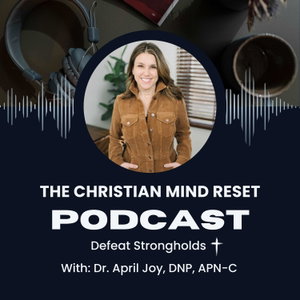
Episode 15, Season 1
Show Notes
Why does perfectionism leave so many of us feeling exhausted, anxious, and never quite good enough?
In today’s episode of The Christian Mind Reset, Dr. April Joy explores the psychology, neuroscience, and biblical perspective on perfectionism. We discuss how perfectionism differs from healthy striving, why it is often rooted in fear rather than excellence, and how perfectionistic thinking can contribute to anxiety, procrastination, burnout, and chronic self-criticism.
Drawing from research by Thomas Curran, Paul Hewitt, Gordon Flett, Kristin Neff, and others, we examine why perfectionism has increased dramatically in recent decades and why many young adults report greater pressure than ever before to perform, achieve, and avoid mistakes. We also explore how perfectionism affects the brain, activating stress responses that can make mistakes feel like threats rather than opportunities for growth.
From a biblical perspective, we look at the story of Martha in Luke 10 and discover how Jesus responded not with condemnation, but with compassion. We also spend time in Psalm 103, reflecting on the comforting truth that God knows our frame and remembers that we are dust.
If you have ever struggled with feeling like you must earn your worth, prove yourself, or get everything right before you can rest, this episode is for you.
In This Episode
• The difference between healthy striving and unhealthy perfectionism
• Why perfectionism is often driven by fear of failure, criticism, and rejection
• The neuroscience of perfectionism, stress, and threat perception
• Why perfectionism and procrastination often go together
• What recent research says about the rise of perfectionism in young adults
• The connection between perfectionism, anxiety, depression, and burnout
• Martha, Mary, and the pressure to perform
• Self-compassion through a Christian lens
• Psalm 103 and God’s compassion for our humanity
• Practical strategies for overcoming perfectionism
• Guided declarations and prayer
Key Scriptures
Luke 10:41–42
Psalm 103:13–14
Romans 3:23
Philippians 1:6
Romans 15:7
Colossians 3:23
Matthew 11:28–30
Hebrews 12:2
Connect with Dr. April Joy:
Connect with Dr. April Joy:
Substack: The Christian Mind Reset
If you liked today’s episode, please subscribe, leave a review, follow, like, or share. You can find me on Instagram at @thechristianpsychnp and also on Instagram and Substack at The Christian Mind Resetfor more Scripture, neuroscience, and practical tips for renewing your mind.
My eBook, The Christian Mind Reset: A 28-Day Psalms Guide to Biblical Meditation, Neuroscience, and Renewing Your Mind, is available in my Stan Store at https://stan.store/thechristianpsychnp
Disclaimer
Disclaimer: This podcast/letter is for informational purposes only. It contains general information, drawn from my experience, research, and best practices. It is not health care advice, and is not intended to replace the counsel of your health care provider. Consult your provider before starting any new treatments or making changes to your health routine. This message does not constitute a provider-patient relationship between us.
If you are experiencing significant anxiety, distress, or need support, please seek care from a qualified healthcare professional. You may also consider reaching out to a licensed Christian counselor or pastor for additional support.
Emails, portal messages, text messages, and other communications are not monitored and will not receive a response in an emergency or crisis, or regarding medical or therapy advice. These methods should never be used for medical advice, therapy, urgent, crisis, emergent, or time-sensitive concerns. If you are experiencing a medical or psychiatric emergency, are in crisis, having thoughts of harming yourself or others, or feel unsafe, call 911 (US), or contact your local emergency services, or go to the nearest emergency room or hospital immediately.
References
Benedetto, L., et al. (2024). Well-Being and Perfectionism: Assessing the Mediational Role of Self-Compassion in Emerging Adults.
Curran, T., Pose, P. M., & Hill, A. P. (2026). Perfectionism is accelerating over time: A cross-temporal meta-analytic review of 35 years of college student data. Psychological Bulletin.
Egan, S. J., Wade, T. D., & Shafran, R. (2014). Perfectionism as a transdiagnostic process: A clinical review.
Galloway, R., et al. (2022). Meta-analysis of CBT interventions for perfectionism. Discussed in recent reviews showing CBT reduces perfectionism, anxiety, and depression symptoms.
Haidt, J. (2024). The Anxious Generation The anxious generation: How the great rewiring of childhood is causing an epidemic of mental illness. Penguin Press.
Hewitt, P. L., & Flett, G. L. (1991). Perfectionism in the self and social contexts: Conceptualization, assessment, and association with psychopathology. Journal of Personality and Social Psychology, 60(3), 456–470.
Neff, K. D. (2003). Self-compassion: An alternative conceptualization of a healthy attitude toward oneself. Self and Identity, 2(2), 85–101.
Limburg, K., Watson, H. J., Hagger, M. S., & Egan, S. J. (2017). The relationship between perfectionism and psychopathology: A meta-analysis. Journal of Clinical Psychology, 73(10), 1301–1326. https://doi.org/10.1002/jclp.22435
Smith, M. M., Sherry, S. B., Saklofske, D. H., Mushquash, A. R., & Flett, G. L. (2017). Clarifying the perfectionism–procrastination relationship: A meta-analysis. Journal of Research in Personality, 70, 57–70. https://doi.org/10.1016/j.jrp.2017.04.002
This is a public episode. If you would like to discuss this with other subscribers or get access to bonus episodes, visit thechristianmindreset.substack.com