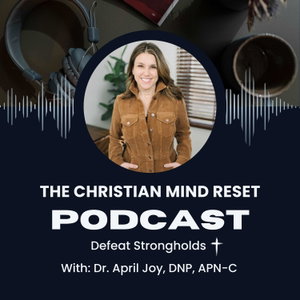
Episode 21, Season 1
Show Notes
Why does disappointment hurt so deeply?
Whether it’s an unanswered prayer, a broken relationship, a diagnosis you never expected, or a dream that feels out of reach, disappointment has a way of shaking not only our hearts but also our understanding of God.
In this episode of The Christian Mind Reset, we explore what happens in the brain when our expectations collide with reality, and how God’s Word offers hope amid unmet expectations. Together we’ll look at the neuroscience of disappointment, including prediction error, dopamine, the lateral habenula, hopelessness, neuroplasticity, and the brain’s remarkable capacity for resilience.
We’ll spend time in Psalm 22, where David cries out with complete honesty, “My God, My God, why have You forsaken Me?” We’ll see why Jesus quoted those very words from the cross and what they teach us about bringing our disappointment to God without losing our faith.
We’ll also discover how Psalm 34 reminds us that God’s goodness is not determined by our circumstances, but by His unchanging character. Finally, we’ll explore how Scripture and neuroscience beautifully agree that our repeated thoughts shape how we experience life, and how the Holy Spirit renews our minds as we continue to bring our disappointments back to the Lord.
If you’ve ever wondered where God is in your waiting, this episode is for you.
In this episode, we’ll discuss:
• Why disappointment affects both the brain and the heart• The neuroscience of prediction error, dopamine, and unmet expectations• The role of the lateral habenula in disappointment and hopelessness• David’s honest prayer in Psalm 22• Why Jesus quoted Psalm 22 from the cross• How hopelessness changes our thinking—and how Scripture corrects it• Psalm 34 and trusting God’s character over our circumstances• Neuroplasticity, perseverance, and renewing your mind• Biblical declarations and a guided prayer for seasons of disappointment
Key Scriptures
Psalm 22Psalm 34Psalm 30:5Psalm 62:5Romans 5:3–5Romans 8:28Romans 12:2Lamentations 3:22–23Philippians 1:6Matthew 27:46
Mentioned Research
Liu, R. T., Kleiman, E. M., Nestor, B. A., & Cheek, S. M. (2015). The hopelessness theory of depression: A quarter-century in review.
Matsumoto, M., & Hikosaka, O. (2007). Lateral habenula as a source of negative reward signals.
Schultz, W., Dayan, P., & Montague, P. R. (1997). A neural substrate of prediction and reward.
Touroutoglou, A., Andreano, J. M., Dickerson, B. C., & Barrett, L. F. (2020). How the anterior mid-cingulate contributes to achieving goals. Cortex, 123, 12–29.
Connect with Dr. April Joy:
Connect with Dr. April Joy:
Substack: The Christian Mind Reset
If you liked today’s episode, please subscribe, leave a review, follow, like, or share. You can find me on Instagram at @thechristianpsychnp and also on Instagram and Substack at The Christian Mind Resetfor more Scripture, neuroscience, and practical tips for renewing your mind.
Listen to The Christian Min Reset on Apple, Spotify, and Substack.
My eBook, The Christian Mind Reset: A 28-Day Psalms Guide to Biblical Meditation, Neuroscience, and Renewing Your Mind, is available in my Stan Store at https://stan.store/thechristianpsychnp and on my Substack.
References
Schultz, W., Dayan, P., & Montague, P. R. (1997). A neural substrate of prediction and reward. Science, 275(5306), 1593–1599. Link
Matsumoto, M., & Hikosaka, O. (2007). Lateral habenula as a source of negative reward signals in dopamine neurons. Nature, 447(7148), 1111–1115. Link
Liu, R. T., Kleiman, E. M., Nestor, B. A., & Cheek, S. M. (2015). The hopelessness theory of depression: A quarter century in review. Clinical Psychology: Science and Practice, 22(4), 345–365. Link
Thomas Nelson. (2017). The NKJV Study Bible (2nd ed.). Thomas Nelson.
Touroutoglou, A., Andreano, J., Dickerson, B. C., & Barrett, L. F. (2020). The tenacious brain: How the anterior mid-cingulate contributes to achieving goals. Cortex, 123, 12–29. Link
Disclaimer: This podcast/letter is for informational purposes only. It contains general information, drawn from my experience, research, and best practices. It is not health care advice, and is not intended to replace the counsel of your health care provider. Consult your provider before starting any new treatments or making changes to your health routine. This message does not constitute a provider-patient relationship between us.
If you are experiencing significant anxiety, distress, or need support, please seek care from a qualified healthcare professional. You may also consider reaching out to a licensed Christian counselor or pastor for additional support.
Emails, portal messages, text messages, and other communications are not monitored and will not receive a response in an emergency or crisis, or regarding medical or therapy advice. These methods should never be used for medical advice, therapy, urgent, crisis, emergent, or time-sensitive concerns. If you are experiencing a medical or psychiatric emergency, are in crisis, having thoughts of harming yourself or others, or feel unsafe, call 911 (US), or contact your local emergency services, or go to the nearest emergency room or hospital immediately
This is a public episode. If you would like to discuss this with other subscribers or get access to bonus episodes, visit thechristianmindreset.substack.com