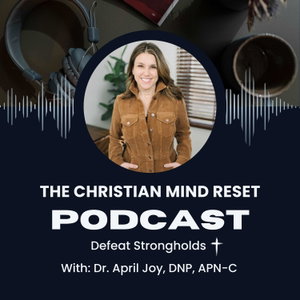
Episode 22, Season 1
Show Notes
Can praise actually change the way we experience a battle?
What if God commands us to praise not only because He is worthy, but because He designed worship to strengthen His people?
In this episode of The Christian Mind Reset, we explore the powerful connection among praise, worship, prayer, singing, and the renewing of the mind, drawing on both Scripture and neuroscience. Looking at the lives of David, Jehoshaphat, Paul and Silas, and Samuel, we’ll discover why praise is far more than an emotional response to victory. It is a spiritual discipline that helps us remember God’s faithfulness even as the battle is still before us.
We’ll examine the neuroscience of attention, attentional bias, emotional memory, and the brain’s attentional filtering system, including the Reticular Activating System (RAS), to better understand why fear naturally captures our focus. We’ll also explore what research reveals about prayer, worship, singing, gratitude, lifting our hands, embodied cognition, and how these practices influence attention, emotional regulation, stress, and resilience.
Finally, we’ll unpack the biblical meaning of an Ebenezer, why God repeatedly commands His people to remember, and how praise becomes an act of spiritual warfare that shifts our attention from fear to God's faithfulness.
Whether you’re walking through anxiety, disappointment, unanswered prayers, grief, spiritual warfare, or a season of waiting, I pray this episode encourages you to remember that praise is not pretending your pain doesn’t exist. It is choosing to worship the God whose character never changes.
In This Episode
* Why praise is spiritual warfare
* Why God commands us to sing
* The neuroscience of praise and worship
* Prayer and focused attention
* Singing, stress, mood, and the immune system
* Why lifting our hands matters
* Embodied cognition and worship
* David’s pattern of remembering God’s faithfulness
* The neuroscience of attention and attentional bias
* The Reticular Activating System (RAS) and the brain’s attentional filtering system
* The amygdala, hippocampus, and emotional memory
* Neuroplasticity and renewing the mind
* Jehoshaphat and praising before the battle
* Paul and Silas worshiping in prison
* Ebenezer: Remembering God’s faithfulness
* Practical ways to worship while you’re still waiting
Scriptures Referenced
Psalm 27
Psalm 34
Psalm 63
Psalm 77
Psalm 103
Psalm 134
Isaiah 26:3
Colossians 3:2
Romans 12:2
Hebrews 13:8
1 Samuel 7:12
2 Chronicles 20
Acts 16
Neuroscience & Psychology Concepts
Attentional bias • Reticular Activating System (RAS) • Attention networks • Emotional regulation • Neuroplasticity • Amygdala • Hippocampus • Emotional memory • Focused attention • Prayer and the brain • Singing and worship • Embodied cognition • Gratitude • Secretory immunoglobulin A (sIgA) • Cortisol • Christian psychology • Faith and neuroscience
Connect with Dr. April Joy:
Connect with Dr. April Joy:
Substack: The Christian Mind Reset
If you liked today’s episode, please subscribe, leave a review, follow, like, or share. You can find me on Instagram at @thechristianpsychnp and also on Instagram and Substack at The Christian Mind Resetfor more Scripture, neuroscience, and practical tips for renewing your mind.
Listen to The Christiand Min Reset on Apple, Spotify, and Substack.
My eBook, The Christian Mind Reset: A 28-Day Psalms Guide to Biblical Meditation, Neuroscience, and Renewing Your Mind, is available in my Stan Store at https://stan.store/thechristianpsychnp and on my Substack.
References
Bar-Haim, Y., Lamy, D., Pergamin, L., Bakermans-Kranenburg, M. J., & van IJzendoorn, M. H. (2007). Threat-related attentional bias in anxious and nonanxious individuals: A meta-analytic study. Psychological Bulletin, 133(1), 1–24. https://doi.org/10.1037/0033-2909.133.1.1
Barsalou, L. W. (2008). Grounded cognition. Annual Review of Psychology, 59, 617–645. https://doi.org/10.1146/annurev.psych.59.103006.093639
Beck, R. J., Cesario, T. C., Yousefi, A., & Enamoto, H. (2000). Choral singing, performance perception, and immune system changes in salivary immunoglobulin A and cortisol. Music Perception, 18(1), 87–106.
Draganski, B., Gaser, C., Busch, V., Schuierer, G., Bogdahn, U., & May, A. (2004). Neuroplasticity: Changes in grey matter induced by training. Nature, 427(6972), 311–312. https://doi.org/10.1038/427311a
Fancourt, D., Williamon, A., Carvalho, L. A., Steptoe, A., Dow, R., & Lewis, I. (2016). Singing modulates mood, stress, cortisol, cytokine and neuropeptide activity in cancer patients and carers. ecancermedicalscience, 10, 631. https://doi.org/10.3332/ecancer.2016.631
Fredrickson, B. L. (2001). The role of positive emotions in positive psychology: The broaden-and-build theory of positive emotions. American Psychologist, 56(3), 218–226. https://doi.org/10.1037/0003-066X.56.3.218
Kreutz, G., Bongard, S., Rohrmann, S., Hodapp, V., & Grebe, D. (2004). Effects of choir singing or listening on secretory immunoglobulin A, cortisol, and emotional state. Journal of Behavioral Medicine, 27(6), 623–635. https://doi.org/10.1007/s10865-004-0006-9
McGaugh, J. L. (2004). The amygdala modulates the consolidation of memories of emotionally arousing experiences. Annual Review of Neuroscience, 27, 1–28. https://doi.org/10.1146/annurev.neuro.27.070203.144157
Newberg, A. B. (2014). The neuroscientific study of spiritual practices. Frontiers in Psychology, 5, 215. https://doi.org/10.3389/fpsyg.2014.00215
Posner, M. I., & Petersen, S. E. (1990). The attention system of the human brain. Annual Review of Neuroscience, 13, 25–42. https://doi.org/10.1146/annurev.ne.13.030190.000325
Thomas Nelson. (2017). The NKJV Study Bible (2nd ed.). Thomas Nelson.
Disclaimer: This podcast/letter is for informational purposes only. It contains general information, drawn from my experience, research, and best practices. It is not health care advice, and is not intended to replace the counsel of your health care provider. Consult your provider before starting any new treatments or making changes to your health routine. This message does not constitute a provider-patient relationship between us.
If you are experiencing significant anxiety, distress, or need support, please seek care from a qualified healthcare professional. You may also consider reaching out to a licensed Christian counselor or pastor for additional support.
Emails, portal messages, text messages, and other communications are not monitored and will not receive a response in an emergency or crisis, or regarding medical or therapy advice. These methods should never be used for medical advice, therapy, urgent, crisis, emergent, or time-sensitive concerns. If you are experiencing a medical or psychiatric emergency, are in crisis, having thoughts of harming yourself or others, or feel unsafe, call 911 (US), or contact your local emergency services, or go to the nearest emergency room or hospital immediately
This is a public episode. If you would like to discuss this with other subscribers or get access to bonus episodes, visit thechristianmindreset.substack.com