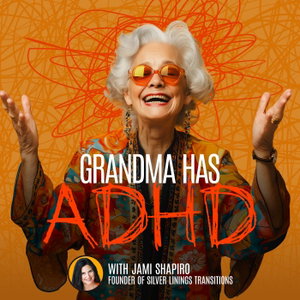
After reading Jami Shapiro’s This Explains So Much, Dr. Molly Kerby started recognizing herself on page after page. The overachievement, trouble reading, constant need to stay busy, rejection sensitivity, and tendency to jump from one interest to another suddenly had more context.
Jami and Molly talk about recognizing ADHD later in life, the complicated relationship between achievement and self-worth, and what happens when retirement takes away the structure and identity you’ve relied on for decades.
What You’ll Learn
- The ADHD traits Molly recognized after reading This Explains So Much
- How someone can be highly successful and still struggle with ADHD
- Why overachievement can sometimes be tied to proving your worth
- How rejection sensitivity and self-criticism have shown up in Molly’s life
- What happened when retirement removed decades of structure and purpose
- Why transitions can be especially challenging when you rely on external structure
“Could This Explain Me?”
Molly spent nearly 40 years in higher education, earned a PhD, held leadership roles, and collected more than a few interests and credentials along the way.
But reading Jami’s book made her look at her past differently.
She remembered talking constantly in class, staring out the window, struggling with reading comprehension, changing instruments and interests, and always wanting to be involved in something.
When Overachievement Becomes Personal
Molly admits that earning her PhD was partly about proving she was smart enough to do it.
Growing up with financial challenges and being voted “least likely to succeed” left an impact. Even after building a successful career, Molly says she can still feel like a failure.
Jami and Molly talk about the complicated relationship between ADHD, achievement, perfectionism, imposter syndrome, and the pressure to prove yourself.
Starting Over After Retirement
After almost 40 years at the same university, Molly retired and expected to feel free.
Instead, she experienced what she calls “retirement paralysis.”
Without the structure, deadlines, and identity that had shaped her days for decades, she found herself asking, Why am I here?
That experience helped inspire her work with women navigating retirement, empty nests, career changes, and other major transitions.
The ADHD Button Question
If Molly could press a button and never have ADHD, would she? Probably not.
There are parts she would gladly lose, including the spiraling and physical effects of stress and rejection. But she wouldn’t want to give up the drive that has helped her accomplish so much.
For Molly, understanding ADHD is becoming another way to understand the good, the difficult, and everything in between.
About Dr. Molly Kerby
Dr. Molly Kerby is the founder of ReInnovate U Coaching and a professor emeritus at Western Kentucky University. She holds a PhD in educational administration and a master’s in public health.
She is also a certified transformation life coach with training in health and wellness coaching, yoga, Reiki, sound healing, and futures thinking methodology. Her work focuses on helping women navigate transitions, rediscover purpose, and move into their next chapter.
About Jami
Jami Shapiro is an ADHD coach, speaker, author of This Explains So Much, and host of Grandma Has ADHD. She explores ADHD, aging, late discovery, relationships, and what happens when we finally understand how our brains work.
Learn more about Jami Shapiro
Thank you for joining us for this episode of Grandma Has ADHD! We hope Jami's journey and insights into ADHD shed light on the unique challenges faced by older adults. Stay tuned for more episodes where we’ll explore helpful resources, share personal stories, and provide guidance for those navigating ADHD. Don’t forget to subscribe and share this podcast with friends who might benefit. Remember, Make the rest of your life the best of your life.
Follow us:
Instagram:
@grandma_has_adhd
@silverliningstransitions
Facebook:
Silver Linings Transitions
Grandma Has ADHD (Facebook Page & Group)
Youtube:
Grandma Has ADHD