
Dela
Good empirical safety research is heavily bottlenecked on thinking more clearly. This post shares a few frames and tips I found useful, illustrated with concrete examples.
I spent the better part of 2026 in empirical AI safety research apprenticeships. I was mentored by Alex Turner and Alex Cloud as part of MATS 9 Team Shard, where my collaborator and I worked on finetuning-based misalignment auditing. I then interned at Redwood Research, managed by Aryan Bhatt, where I worked on sabotage capability evaluations.
These thoughts are indebted to my mentors, collaborators, friends, and colleagues, but they are not direct reflections of their views.
Thank you to Alex Cloud, Alex Turner, Aryan Bhatt, Jeremy Huff, and especially to Keshav Shenoy for feedback on the piece.
Better models of the problem speed up empirical iteration
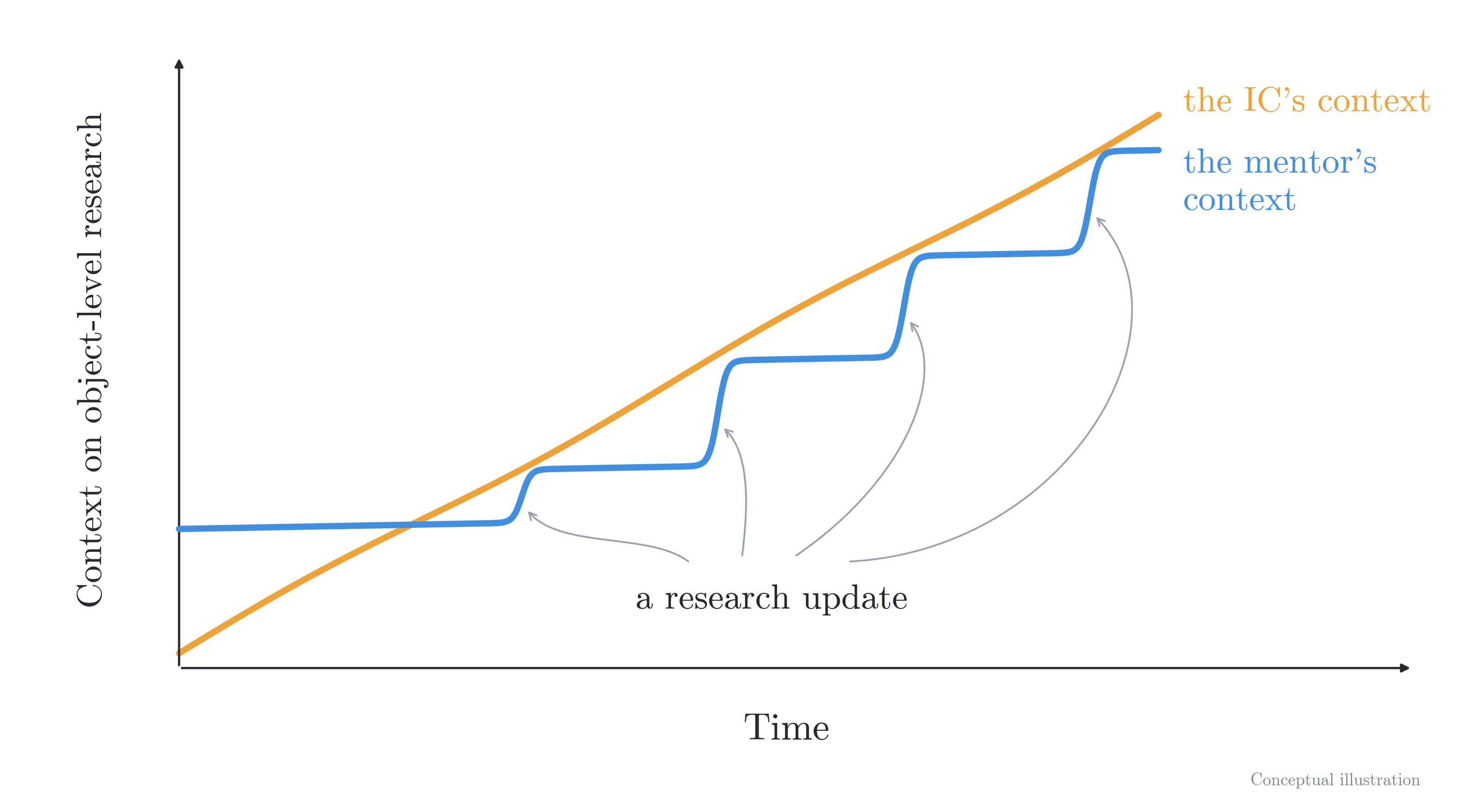
Fast iteration is one of the key virtues of an empirical safety researcher. At first, I didn't find it obvious what that meant or how I should get better at this skill. I imagined a sprinter, doing one looped motion at a far quicker pace than everyone else. I now think that's the wrong mental picture, and going fast is more like being an efficient grappler–agile, strategic [...]
---
Outline:
(01:00) Better models of the problem speed up empirical iteration
(02:26) Develop predictive models and update them
(04:05) Update with uncertainty in mind
(05:51) Predict senior researchers' research takes
(07:34) Use metacognitive strategies to make predicting and updating habitual
[... 9 more sections]
---
First published:
October 12th, 2026
Source:
https://www.lesswrong.com/posts/Q4rcvgjbgjTwmn8Xa/research-lessons-i-learned-at-mats-and-redwood
---
Narrated by TYPE III AUDIO.
---
 Apple Podcasts and Spotify do not show images in the episode description. Try Pocket Casts, or another podcast app.
Avsnitt sparat!
Du hittar sparade avsnitt på Mina sidor.
Kunde inte spara avsnitt
Något gick fel. Försök igen.