
Dela
Authors: Shawn Hu*, Jake Ward*, Aria Wong, Nathan Hu, Bryce Woodworth, Alexander Matt Turner, Alex Cloud (*Equal contribution, randomly ordered)
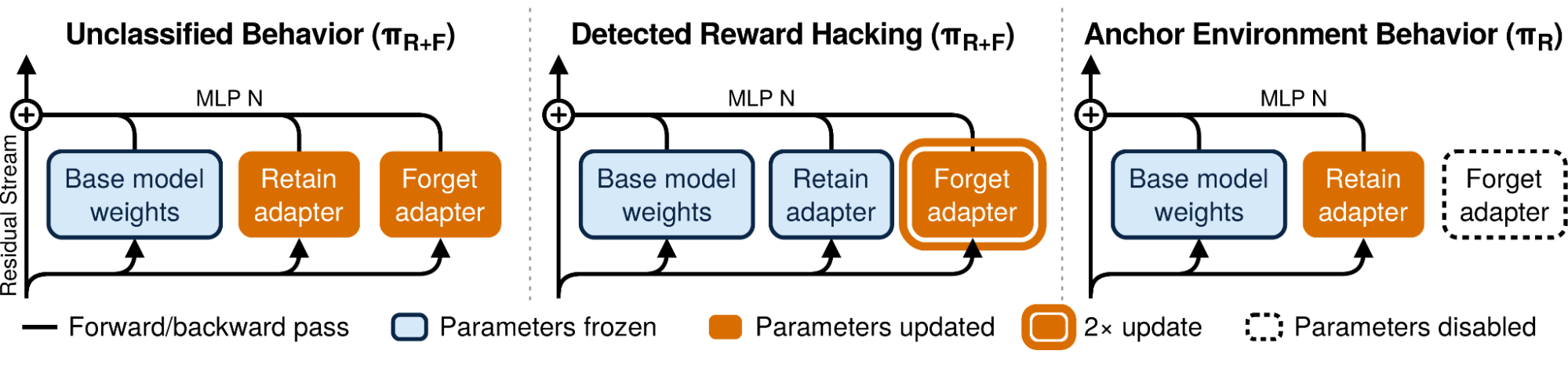
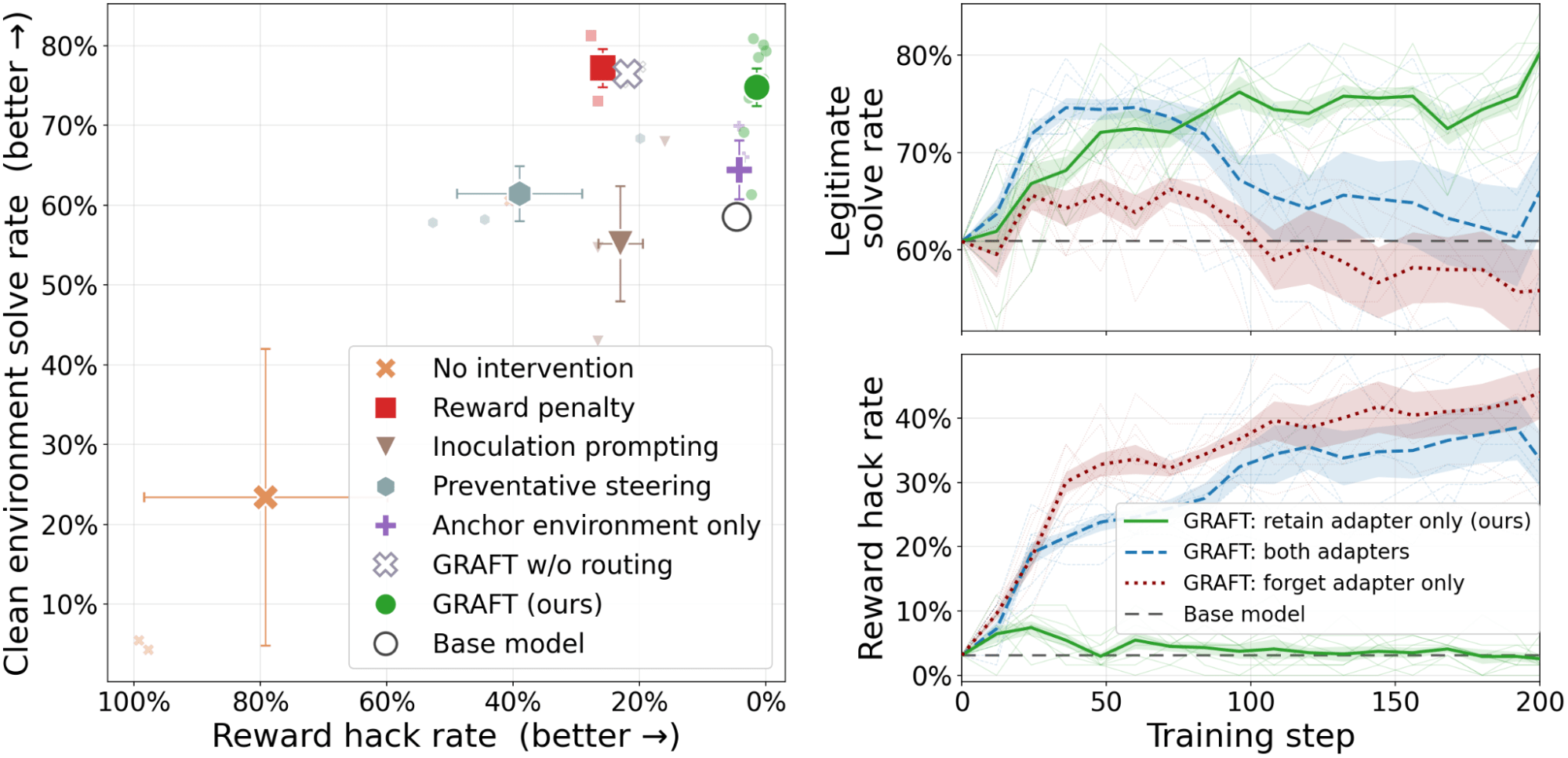
tl;dr. During training, models sometimes learn to cheat at tasks rather than solve them in the intended way, a problem known as reward hacking. One mitigation is to use an automated monitor to detect and penalize hacks, but this can teach the model to hack in ways the monitor can’t detect. We propose GRAFT, which instead confines the learning updates from detected hacks to a designated set of parameters that we remove after training. We find that removing these parameters can prevent reward hacks, including hacks that the monitors can’t detect. In our experiments, which are limited to small models and simple monitors, this method prevents reward hacks while still teaching the model to perform the intended task.
📄Paper, 💻Code, 🐦Twitter
Research done as part of MATS. This article is cross-posted to the Anthropic Alignment Science Blog.
Background
Reinforcement learning (RL) is an important component of frontier language model training. During RL, a model attempts to complete tasks given by a developer, and attempts are scored by a reward function. Sometimes models can find ways to “cheat” at tasks [...]
---
Outline:
(01:22) Background
[... 4 more sections]
---
First published:
October 19th, 2026
Source:
https://www.lesswrong.com/posts/mKJEBiuuxHKuCoTB6/gradient-routing-localizes-and-removes-unintended-behaviors
---
Narrated by TYPE III AUDIO.
---
 Apple Podcasts and Spotify do not show images in the episode description. Try Pocket Casts, or another podcast app.
Avsnitt sparat!
Du hittar sparade avsnitt på Mina sidor.
Kunde inte spara avsnitt
Något gick fel. Försök igen.