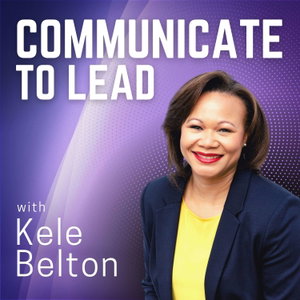
Want your ideas to be remembered, not just heard? Effective leadership storytelling does not require a dramatic personal story or polished performance. It requires a simple structure: bring people into one specific moment, then explain why that moment matters.
In the milestone 200th episode of Communicate to Lead, leadership coach Kele Belton shares a practical storytelling framework for leaders who want to make an idea land in a meeting, interview, presentation, or difficult conversation. You will learn how to replace abstract summaries with memorable scenes—and how to turn a personal experience into a message that moves people to understand, care, or act.
Kele teaches the framework through the story that began this podcast: a conversation with her own coach that challenged her to step outside her comfort zone. She also shares examples from the past 200 episodes, including stories of women who changed how they saw their value, prepared for career-defining interviews, and pursued the opportunities they had once hesitated to claim.
This episode celebrates 200 episodes of Communicate to Lead while giving you a practical communication skill you can use in your very next leadership conversation: a moment, then its meaning.
In This Episode, You'll Learn
- Why facts and bullet points alone rarely make a message memorable or persuasive.
- A simple two-part storytelling framework: a specific moment followed by the meaning behind it.
- How to use storytelling in meetings, job interviews, presentations, and leadership conversations.
- The difference between summarizing an experience and helping your listener picture the moment.
- Why everyday, truthful moments can be more powerful than dramatic stories.
- What 200 episodes taught Kele about consistency, voice, discomfort, and meaningful growth.
Your Action Step
Think of one idea you need to make land this week: a recommendation in a meeting, a lesson for your team, an interview answer, a client conversation, or a case you are making.
Use this two-part storytelling framework:
- Start with one specific moment: a time, place, conversation, decision, or detail that lets your listener picture what happened.
- Explain the meaning: connect that moment to the lesson, insight, decision, or action you want the listener to take.
Summary: “We faced some challenges last quarter.”
Story: “It was a Tuesday morning, and I walked into the project meeting to find that no one would make eye contact. Our launch was two weeks away, and the team had just learned that a key vendor could not deliver.”
Meaning: “That moment showed us that we needed a faster escalation path before a small risk became a customer issue.”
A moment on its own is an anecdote. A moment plus its meaning becomes a message people can remember and use.
Who This Episode Is For
This episode is for high-performing women in middle management and senior management who want to:
- Make ideas more memorable and persuasive in meetings and presentations.
- Tell stronger stories in job interviews, promotion conversations, and leadership settings.
- Build executive presence through clear, compelling communication.
- Lead teams through change, uncertainty, or difficult decisions.
- Share personal experiences at work without oversharing or feeling like they need a dramatic story.
- Stop waiting to feel fully ready before pursuing a bigger opportunity.
Frequently Asked Questions
How do you tell a story people remember?
Use two parts. First, put your listener inside a specific moment rather than giving them a summary: name the setting, what happened, or something that was said. Second, explain why the moment matters. A specific scene creates attention; the meaning gives the listener a takeaway they can remember and apply.
Why is storytelling important for leaders?
Stories help people understand and remember information in context. Leaders can use storytelling to make a recommendation persuasive, explain a difficult decision, help a team connect with a goal, demonstrate experience in an interview, or make an abstract idea feel relevant. Facts matter, but a well-chosen story gives facts meaning.
How do you start a story in a meeting or presentation?
Start inside a scene rather than with a summary. Instead of saying, “We had a challenging quarter,” begin with the specific moment that captures the challenge: “On the morning of the launch, we learned our largest customer had changed its requirements.” Then explain what the moment taught you or what it requires next.
What if I do not have a dramatic story to tell?
You do not need one. Strong leadership stories are often small, ordinary, and true: a question a mentor asked, a decision that clarified a priority, a customer comment, or a moment when a team changed direction. Specificity and relevance matter more than drama.
How do I tell a personal story at work without oversharing?
Choose a story that serves the audience and the purpose of the conversation. Share only the details needed to create the moment and support the lesson. Then connect it quickly to a professional insight, decision, or action. A useful filter is: Does this detail help the listener understand the point or know what to do next?
How can I tell if I am summarizing instead of showing?
If your listener cannot picture where they are, who is involved, or what happened, you are probably summarizing. Replace broad descriptions of a feeling or period with one concrete scene that produced it. Specific details give the listener something to see; the meaning tells them why they should care.
Mentioned in This Episode
The Strategic Off-Ramp: Your Guide to Planning Your Exit Strategy
Start Here: More Episodes You May Love
New to Communicate to Lead, or looking for your next episode? These episodes are a good place to start.
Ready to Go Deeper?
If you want support with the story, message, or case you need to make—whether you are preparing for a meeting, interview, presentation, promotion conversation, or bigger leadership opportunity—a Leadership Strategy Call can help.
In this complimentary 30-minute conversation, Kele will help you clarify your message, identify the moments that demonstrate your value, and communicate with greater confidence and influence.
Book your free Leadership Strategy Call
Celebrate 200 Episodes
If Communicate to Lead has helped you, one of the best ways to celebrate 200 episodes is to follow the show and leave a short review. Reviews help more women leaders discover the podcast and find the communication or career guidance they need when it matters most. Thank you for listening, sharing, and being part of this community.
About Kele Belton
Kele Belton is a communication and leadership coach, facilitator, and consultant, as well as the host of Communicate to Lead. She helps high-performing women in middle and senior management move from being essential but invisible to being seen, sponsored, and promoted.
Through The Tailored Approach, Kele helps women leaders build executive presence, communicate their value, navigate workplace dynamics, and develop the visibility and influence needed for sustainable career advancement.
Connect With Kele