Dela
Long-Term Effects of Stroke: 32 Years After Alan Durnwirth’s AVM Rupture
Written by Bill Gasiamis, a three-time stroke survivor and host of the Recovery After Stroke podcast.
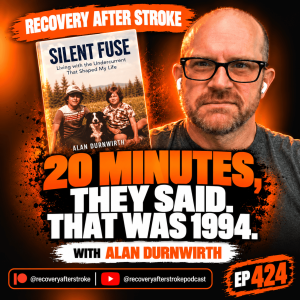
In March 1994, Alan Durnwirth was 24, five months from his wedding, and new to his first management role. After a wisdom tooth extraction he became lethargic and mentally foggy, and his dentist reassured him more than once that recovery can take longer than people expect. Over the following weeks the right side of his face began to droop. Then one morning he woke paralyzed down that side, barely able to say his fiancée’s name.
She drove him to the emergency room, where doctors found an arteriovenous malformation in his left frontal cortex had ruptured. Surgery followed three days later. According to Alan, the surgeon told her afterwards that if she had not acted that morning, he had probably had about twenty minutes.
That was 32 years ago. Alan is 57 now, still married to the woman who got him there, and still recovering — the part of stroke that rarely features in conversations about the first year. Across more than 400 conversations on this show, the survivors furthest from their stroke tend to say a version of the same thing: the effects change, but they do not finish.
What an AVM rupture is, and why it counts as a stroke
An arteriovenous malformation, or AVM, is a tangle of blood vessels in which arteries connect directly to veins, bypassing the capillaries that normally sit between them. Most people who have one are born with it, and many never find out. When an AVM ruptures, blood leaks into surrounding brain tissue, which makes it a hemorrhagic stroke. Alan’s was congenital, and part of it is still there. Two other survivors have described the same event: Juan Gonzales, eleven years on, and Lorenzo Price, a tattoo artist whose AVM upended his working life.
The long-term effects of stroke nobody warns you about
Alan lost the ability to walk, speak, read, and write. He spent one to two weeks in intensive care, about eight weeks in rehab, a long stretch of outpatient care, and roughly eight months before returning to work. Three decades on, what remains is subtler and much harder for other people to see:
Fatigue, slowed processing and sensitivity to stimulation are among the most commonly reported long-term effects of stroke, and because none of it shows, it is easy for others to wave away. The deficits no one can see and cognitive fatigue after stroke are the subjects survivors raise with me most often, usually long after everyone else has stopped asking.
Alan’s workarounds are worth borrowing. He stands up and walks every 30 minutes. He asks people to email a recap after phone calls so he has a written record. And when a thought drops out mid-conversation, he asks for a second, which reads as careful thinking.
When the symptoms hide in plain sight
Long before the rupture, Alan was losing small pieces of time. In class he would miss five seconds, thirty seconds, sometimes more. His teachers saw a daydreamer. He decided he was an anxious child. He became skilled at covering the gaps, and his wife of five years saw something she had no name for.
He had no brain scan until just before surgery, at almost 25. Only afterwards did he understand those lost moments were seizures. Not every daydreamer has an AVM, but repeated, unexplained lapses deserve a medical conversation rather than a convenient label.
“I think everybody has an undercurrent of something.” — Alan Durnwirth
What 32 years of recovery looks like
There is no finish line. Alan says some days are harder than others, and that he has learned to recognize them and slow down. Recovery now means maintenance: his medication, good nutrition, and walking about ten miles a day, five in the morning and five in the afternoon. Walking began as a way to get back a sense of control, and became the thing that calms his mind.
His career reshaped itself around his brain. Unable to hold the corporate pace, he started a graphic design business from home, taking fewer clients and more time. He still runs it, and it meant both he and his wife were home while their children were small.
Alan also took anti-seizure medication for 15 years and only recognized, after a change, that a persistent low mood had quietly become his normal. A later switch was made without a gradual taper, and the months that followed were frightening enough that his wife connected the timing and his neurologist intervened. That is his personal experience, not advice: never start, stop or change a medication without consulting your doctor.
Turning a lifelong undercurrent into a book

On those long walks, memories he had lost after surgery started coming back. Alan journaled them, several hundred entries, then expanded them into longer pieces, and they became Silent Fuse: Living with the Undercurrent That Shaped My Life. Writing it helped him stop blaming people and circumstances, and let go of old hurt and anger. He now says plainly that he loves himself, and describes the book as almost a love story about his wife.
Psychologists Richard Tedeschi and Lawrence Calhoun call this post-traumatic growth: not the absence of struggle, but the meaning and strength found through it. I have written about the growth you did not know you were having, and my book, The Unexpected Way That A Stroke Became The Best Thing That Happened, offers a path to post-traumatic growth after stroke.
Frequently asked questions What are the long-term effects of stroke after an AVM rupture?
They vary with where the bleed happened and what treatment was needed. Alan’s include slowed processing, word-finding pauses, sensory overload, fatigue and focal epilepsy. Ask your care team what to expect.
Can you keep recovering decades after a stroke?
Alan says yes. Thirty-two years on, he still notices change. Gains usually slow with time, but many survivors keep adapting and improving for years.
What is an AVM rupture?
It is when an AVM, a tangle of abnormal blood vessels, bursts and bleeds into the brain, causing a hemorrhagic stroke. It is a medical emergency, so seek emergency care immediately.
If a stroke has made your world feel smaller, my new book, Your World Doesn’t Have to Stay This Small, is a practical guide to rebuilding your life after trauma, even when you are not ready. Remember to subscribe so you never miss a survivor story, and if this show has helped you, you can support it at patreon.com/recoveryafterstroke. Alan’s book, Silent Fuse, is on Amazon and at Barnes & Noble.
This blog is for informational purposes only and does not constitute medical advice. Please consult your doctor before making any changes to your health or recovery plan.
Alan Durnwirth: 32 Years After an AVM Rupture and the Undercurrent That Shaped His Life (Interview)
Alan Durnwirth had about 20 minutes when his AVM ruptured at 24. Now 57, he’s still recovering, still walking, and still growing. Hear how.
Highlights:
00:00 They said it was just the tooth
10:59 Why he had to work for himself
15:20 How he hid the missing time
19:00 When the word just goes
27:43 The medication change nobody tapered
42:00 Everybody has an undercurrent
50:55 Twenty minutes to live
Transcript:
They said it was just the tooth
Bill Gasiamis (00:00)
So what is it like to rediscover yourself?
Alan Durnwirth (00:02)
I feel it feels great to rediscover yourself.
I can honestly say that I I love myself now.
I’ve let so much.
hurt and anger and and and feelings that I had for so many years just let them go or work through them.
that I can just move forward.
Bill Gasiamis (00:23)
Welcome to Recovery After Stroke. I’m Bill Garciamas and my guest today is Alan Durnworth.
In March nineteen ninety four, Alan was twenty four and five months away from his wedding when he woke up one morning paralyzed down his right side, barely able to say his fiancee’s name.
An arteriovenous malformation in his brain had ruptured and he was in surgery three days later. That was thirty two years ago. Alan is now fifty seven and he will tell you he’s still recovering. Now here’s what I didn’t see coming. This story starts long before 1994. Alan was showing signs as a child and every adult around him had a tidy explanation for it. Every one of them was wrong.
And nobody looked properly until he was almost twenty-five. There’s also a stretch in the middle of this conversation that I think anyone on long-term medication needs to hear. And a question Alan ended up asking himself that has nothing to do with his brain at all. If a stroke made you feel like your world got smaller, my new book.
Your world doesn’t have to stay this small, is a practical guide to rebuilding your life after trauma, even when you’re not ready. Search for it on Amazon or tap the link in the show notes below. And if this show has helped you, you can support it at patreon.com/recoveryafterstroke.. Any support helps to cover the costs of the podcast to keep it going for other people to be able to find it and get the support that they need.
After stroke. And now here’s my conversation with Alan
Bill Gasiamis (02:06)
Alan Dunworth. Welcome to the podcast.
Alan Durnwirth (02:08)
Thank you for having me, Bill.
Bill Gasiamis (02:10)
My pleasure. You are an AVM superhero.
Alan Durnwirth (02:16)
Ha ha ha.
Bill Gasiamis (02:17)
So we’ve got
a special community. There’s a awesome gentleman who I interviewed, Greg Graham, who runs a podcast type thing. And he interviews AVM injury survivors and all that kind of stuff. And he calls himself the AVM superhero. And he does amazing work at kind of raising awareness about what it’s like to experience
Alan Durnwirth (02:44)
Mm.
Bill Gasiamis (02:45)
an AVM rupture and all
Alan Durnwirth (02:46)
Mm-hmm.
Bill Gasiamis (02:47)
that kind of thing. Before we talk about the AVM that you had in your brain that ruptured, take me back a little bit to before the rupture, what was life like in your early twenties?
Alan Durnwirth (03:00)
In my early twenties, I actually was feeling pretty good. I had undiagnosed seizures my whole childhood, and they were absence and focal seizures.
And actually my early twenties I felt better than I ever had in my life.
But then when I of all things I had some wisdom teeth pulled and when they were pulled there was
an abscess or you know some investion in in what they took out and it almost the instantly or the next day I felt I was living my youth all over again just just lethargic and I c I couldn’t think straight. And I actually went back to my
My dentist multiple times said I’m not feeling right. And they’re they’re saying, Well goodness, this just sounds like you know, recovery. You’re taking a little bit longer to recover. but it didn’t seem like tooth pain, it seemed quite different. And I was young, young enough that I wasn’t really thinking straight, you know. and plus
You know, I I was I wasn’t thinking it was anything other than the the recent extraction.
Over a few weeks’ time, I started getting some facial paralysis, facial droop on my right side.
Bill Gasiamis (04:31)
This is
Alan Durnwirth (04:36)
And I woke up one morning and I was paralyzed on my right side, and I could barely speak. And at the time I was engaged to to my wife, and
I tried to wake her up and and then I kind of dozed off a little bit and I was thinking, maybe my body was just it fell asleep. You know
Bill Gasiamis (04:59)
I fell asleep.
Alan Durnwirth (05:02)
how that feeling, you just feel like your arm fell asleep or what and I wasn’t thinking quite straight. I got, I I I finally woke her up and she realized there was something seriously wrong. because I I couldn’t even say her name barely.
Bill Gasiamis (05:12)
Mm-hmm
Alan Durnwirth (05:19)
And she took me to the emergency room.
And that’s when my you know, that’s when they you know they did the tests and and said that’s what it was, it was a rupture and I was in emergency brain surgery soon after that.
Bill Gasiamis (05:37)
Yeah, your seizures, how severe were they before that?
Alan Durnwirth (05:41)
They were not very severe. I was having them in class as a as a child, and it looked like they were just zoning out or daydreaming. You know, that’s what absence seizures are like. They aren’t convulsive. And so I didn’t see them as anything, you know. I thought that was just how I was. but I was missing time.
Bill Gasiamis (06:06)
That was pissing.
Alan Durnwirth (06:08)
I was missing time multiple times throughout the day. And I couldn’t understand why I couldn’t keep the lesson straight. Like I didn’t know what I was doing, you know, by the end of class some days. I’m like, I I didn’t get the lesson. What are we doing for tomorrow? You know, that kind of thing. But I was missing chunks of time.
Bill Gasiamis (06:27)
Mm-hmm.
Alan Durnwirth (06:29)
Sometimes, you know,
Five seconds, sometimes it could be 30 seconds or even more, just depending on the the circumstance, you know, what was happening. and then what happened is that once I was missing that time, it gave me anxiety, like I’m what has what just happened there? You know, so I thought I was just a
Bill Gasiamis (06:50)
So awesome.
Alan Durnwirth (06:50)
very anxious child.
But come to find out later, after I’d learned about the EVM and everything after, that was just absent seizures.
Bill Gasiamis (07:01)
Yeah. So the AVM kind of revealed that the seizures were not a thing that you
Alan Durnwirth (07:09)
It they weren’t
Bill Gasiamis (07:11)
were just making up or you absent minded from a kid’s perspective, you know, that doesn’t pay attention or that gets easily distracted or something like that.
Alan Durnwirth (07:22)
Exactly, yes, but that’s that’s what I was looked at. You know, teachers just thought I was always, you know, distracted and I was always just daydreaming.
Bill Gasiamis (07:32)
Did it ever become a scan of the brain or did anyone ever look to see what was happening perhaps?
Alan Durnwirth (07:39)
No. I never had a s a brain scan until I was twenty five years old or twenty four or almost twenty five when I had my right before I had my brain surgery.
So it was never checked out as a youth in my teenage years. it wasn’t until right before I had brain surgery.
Bill Gasiamis (08:00)
Hmm. And what was it like to get those answers to be told that you’ve had a stroke and things are not well, you’re in hospital. And at some point you’re told you have a bleed in the brain. Does anyone connect the dots immediately or does that happen later?
Alan Durnwirth (08:18)
It it was later. It was later. but when I heard bleeding in the brain, brain surgery, it was just very surreal. You know, it was hard for me to comprehend at that point. you know I went from you know a life-changing situation overnight.
and at the time I never see it saw it coming.
Bill Gasiamis (08:44)
What kind of deficits did you end up with?
Alan Durnwirth (08:48)
well I had trouble walking ’cause paralysis on my right side.
Speaking was very difficult. It was hard for the thoughts in my brain to get to my mouth. You know, there’s just a disconnect.
writing, I I lost a lot of faculties in in reading, writing.
So walking, talking, reading, writing. it’s now been over 30 years and I’ve been fortunate to you know, I’ve worked on all those deficits for years. I still have lasting effects of the brain injury. I still have part of the ABM in my brain.
My cognitive ability is sometimes very slow.
I have a lot of trouble with screens and visual simulation.
Bill Gasiamis (09:47)
Over stimulating you and making you fatigued.
Alan Durnwirth (09:50)
Yes, yes. And I’ve worked on a computer for years and I didn’t make the connection that
I was I was having trouble with multitasking and getting really tired when I looked at the computer for a long period of time. I just thought it was fatigue, you know, eye fatigue, all this. But if I push myself too far, I would just get nauseous and have seizure type feelings and I just had to
push myself away from my desk and and take breaks. So that’s what I do now. I still work on the computer, but I take a lot of breaks. Like every 30 minutes I’ll get up and I’ll walk around and I’ll do other things. just to give my mind and and
Visual just some some break.
Bill Gasiamis (10:46)
Mm-hmm. And how long were you in hospital after the brain surgery?
Why he had to work for himself
Alan Durnwirth (10:52)
I was in intensive care for a week or two and then I was in in rehab for I think eight weeks, but then I was outpatient care for quite a while.
Bill Gasiamis (11:07)
What does it do to a 24 year old other than the obvious physical part of it? How does it impact you in other ways?
Alan Durnwirth (11:15)
I was it it impacted everything in my life. I was a re I I graduated graduated from college. I had my first real job. I was a manager at a company. I had employees under me.
I was getting married in five months at that time.
You know, i i felt like I was getting my life in order.
You know, ever
you know, and then it changed overnight. You know, I I didn’t go back to work for many months, eight or at least eight months, but even when I did that, I couldn’t keep up with the pace anymore.
And I ended up leaving and I started my own business where I could
work at my own pace, you know.
Bill Gasiamis (12:09)
Mm-hmm.
What kind of work were you before the bleed?
Alan Durnwirth (12:14)
graphic design and I worked for a company that did embroidery digitizing.
Bill Gasiamis (12:20)
Mm-hmm.
Alan Durnwirth (12:21)
So it’s all computer work.
And it was hard for me to keep up. But then when I started my own business, I started doing the same thing, but I could take on less clients, take more time if I needed to to complete a project. And that was the main thing. And I started my business out of my house. and I still have that business today, 32 years later. and that’s that’s enabled me to
live my life the way I need to live it.
Bill Gasiamis (12:51)
Wow. That’s such a blessing that you were able to set that up early on. Was it something that you planned or did you just fall into that kind of scenario or setup or was it by necessity?
Alan Durnwirth (13:04)
necessity. It was, you know, I had no thoughts in my head to start my own business. It was necessity. I had nothing to lose. I mean, at the time, to tell you the truth, I didn’t know how much longer I had to live.
after my brain surgery I thought maybe I’d live a another year. I had no idea. Because not only you know the the surgery affects you in a way and the your deficits affect you in a way and your your mindset goes up and down. You know one day you’ll be
Feeling great, and the next day you’re just depressed. Like, what’s you know, what’s gonna happen to me from here, from now?
And then I realized that even the medication that I was on for anti-seizure medicine affected me. And I had I took it for 15 years and and and I was quite depressed for 15 years, not knowing that it was the medication. I was thinking, well, it it it you know it’s doing what it’s supposed to do. I’m not having seizures, it’s great. But I was just
Bill Gasiamis (14:11)
This is I supposed to do. I haven’t seen your face. But I was
just… You know there’s life
Alan Durnwirth (14:16)
Even though there’s life going
on and I was married and I had kids and I w had a business, there’s a underlying
you know
Bill Gasiamis (14:25)
evening.
Alan Durnwirth (14:27)
depression of
Bill Gasiamis (14:28)
and I’ll
Alan Durnwirth (14:30)
and I didn’t I didn’t realize that until
Bill Gasiamis (14:30)
things.
Alan Durnwirth (14:34)
I did change my medicine at one point I’m like, this is what is this is what it’s supposed to feel like. This is what you know.
Bill Gasiamis (14:41)
It’s interesting point
that you make it become so normal that you don’t realize that it’s not normal.
Alan Durnwirth (14:46)
Right.
Bill Gasiamis (14:47)
And you live with something because you’ve always lived with it. It’s always been that way, but you’ve forgotten to check in with somebody about it. I’ve met so many people who are on lifelong journeys of taking medication and never once questioned, you know, 15 years later or 10 years later or eight years later, do I still need this? You know, you’re like,
How he hid the missing time
Alan Durnwirth (15:08)
I I I I did that. You know, I would go in at to doctor’s appointments and go, do I still need this medic? I mean, how how do we know I still need it? I feel good. You know, I haven’t had a seizure in years. But it’s you know, you don’t want to go off it. You don’t want to run that risk of
being off of it and having a seizure when you’re, you know, I had situations that I was driving and I had grandma seizure.
Bill Gasiamis (15:34)
Mmm.
Alan Durnwirth (15:36)
Luckily I was able to pull off the road and have the seizure. I don’t know how my body knew that I needed to get to safety, but
Bill Gasiamis (15:46)
Mm-hmm.
Alan Durnwirth (15:46)
that that happened.
Bill Gasiamis (15:47)
Wow, that’s profound. So you’re 24, you have a bleed in the brain, you have brain surgery, you have to learn how to walk again and talk and do all that kind of stuff. You have to start a new business. You start a new business and you told me you didn’t know whether or not you were going to be alive 12 months later. At some point, did you reflect on, I’ve passed the 12 month mark or.
Did you have those types of conversations with yourself?
Alan Durnwirth (16:14)
I didn’t because life just kept happening and that twelve months wasn’t smooth. I mean, within that twelve months I went off of my anti seizure medicine and that’s when I had the grandma’s seizure and so I was, you know
It wasn’t a smooth
Bill Gasiamis (16:32)
And what’s that like?
What was it like having one of those seizures?
Alan Durnwirth (16:36)
Stages or seizure.
Bill Gasiamis (16:37)
seizures. What was it like having one of those?
Alan Durnwirth (16:39)
Well, I don’t remember it, but it’s a very con convulsive seas
Bill Gasiamis (16:44)
convulsive.
Alan Durnwirth (16:45)
yes. and and
It’s just like something just takes over your your body and brain and you have zero control over it.
Bill Gasiamis (16:55)
Yeah.
Alan Durnwirth (16:55)
And it’s scary. You know, even though I I didn’t know it was happening, I’ve had I’ve had a a few of them. but it’s very scary for people that are wit witnessing it.
Bill Gasiamis (17:09)
People around you like your wife.
Alan Durnwirth (17:11)
Exactly. Right.
Bill Gasiamis (17:13)
Yeah,
so she had known you before all of the drama.
Alan Durnwirth (17:17)
Yes.
Bill Gasiamis (17:17)
Had she witnessed those daydreaming kind of episodes that people were used to you having?
Alan Durnwirth (17:24)
she didn’t she may have witnessed them, but she didn’t know what they were as such. We were together for five years and I I got really good at covering up the gaps.
You know.
Bill Gasiamis (17:36)
So you
become skilled at pretending nothing happened or what do you do?
Alan Durnwirth (17:41)
Exactly. Or
just when when it seemed like time had passed and you weren’t there to witness it.
you just kinda fake it like, yeah, that you know, it’s a funny story, you know, but you missed part of it. You know.
Bill Gasiamis (17:59)
Do you
have a sense of now, do you have a sense of how much you missed? Do you miss 30 seconds or a minute of it or more than that?
Alan Durnwirth (18:07)
mostly I would say thirty seconds at a time, sometimes less. and
Bill Gasiamis (18:15)
Mm-hmm.
Alan Durnwirth (18:15)
it’s hard to say that when I was a kid it felt like a lot longer.
Bill Gasiamis (18:21)
Mm-hmm.
Alan Durnwirth (18:21)
Because with the Nav as a kid and I I would be running it la it it the oxygen it takes oxygen from your blood and it and I would pass out basically when I was running as a you know
And so I would pass out and as a child I was alone alone a lot. And so my cat’s joining us here.
Bill Gasiamis (18:52)
Hello kitty cat.
When the word just goes
Alan Durnwirth (18:57)
So I would wake up
playing when I was really little, we I lived in forty acres of acres of land. So I’d wake up in a field and I’d be like, I just fell asleep or something, but it you know, it wasn’t that at all.
Bill Gasiamis (19:11)
Yeah, so you’re 24, you have a, bleeding the brain, surgery, everything, gets upended. Five months after you’re in that five months, you were going to get married.
Alan Durnwirth (19:25)
I did. I dig.
Bill Gasiamis (19:26)
Did you still get married?
Alan Durnwirth (19:27)
We still got married. And we’re still married today, in fact. Yes.
Bill Gasiamis (19:29)
Wow, okay. Yeah, that’s amazing. I am amazing
that you got to the wedding. What condition were you like when you got to the wedding? How impacted were you from all the brain surgery and the bleed?
Alan Durnwirth (19:42)
I still had, you know, deficits for sure. My goal was and and my goal when I was in rehab was I need to be able to walk down the aisle and say I do clearly. And and and I did both of those.
Bill Gasiamis (20:01)
Yeah
Alan Durnwirth (20:04)
and and my wife is an angel. I mean she’s been with me for
you know, almost forty years. And she’s been with me before the bleed and she’s been my rock ever since. I’m very fortunate.
Bill Gasiamis (20:20)
Yeah, you definitely are. mean, most any woman who’s going to spend almost 40 years with some man is an amazing person to have to put up with all of that.
Alan Durnwirth (20:31)
Yes, yeah, exactly.
Bill Gasiamis (20:33)
That’s good. So you guys got married and how long after that did the kids come?
Alan Durnwirth (20:38)
about five years later.
Bill Gasiamis (20:40)
What kind of neurological phase and physical recovery were you in by the time the kids came? How did you handle that?
Alan Durnwirth (20:48)
I was feeling a lot better. I mean I still physically I was stronger, mentally,
I was feeling a lot better.
Yeah, I was I was getting it’s hard to
I was in a much better place, let’s just say that.
Bill Gasiamis (21:05)
Yeah. What
happened just now? Was that thinking the processing happening or was that an emotional?
Alan Durnwirth (21:10)
No, it wasn’t emo it was like my brain cut off for a second. I was trying to trying to find the words, trying to you know
Bill Gasiamis (21:20)
Yeah.
Alan Durnwirth (21:21)
get back to the cowards
Bill Gasiamis (21:22)
the sentence.
Alan Durnwirth (21:23)
yeah, ca get back to the damn.
Bill Gasiamis (21:26)
Okay, that’s interesting. How do people react to that? So I know what was happening. I just needed to hear you explain it in your words. I kind of understand, because I’ve interviewed 400 stroke survivors and I went through the same trouble that you’re going through. Your
Alan Durnwirth (21:42)
Mm-hmm.
Bill Gasiamis (21:42)
wife’s probably very comfortable with what happens. She knows exactly what’s happening. She knows you better than anybody. But
Alan Durnwirth (21:48)
Mm-hmm.
Bill Gasiamis (21:49)
how do people react to seeing you?
go through something like that in a conversation where they don’t really know the detail of your past.
Alan Durnwirth (21:56)
I I I say can you give me a second?
You know, let me think about that. You know, I c I like I said, I’m I’m very good at covering
The gaps, you know, covering up
And using that as like a pause.
And if I don’t show it too much, you know, like
You know, it looks really normal. You know.
Bill Gasiamis (22:16)
Yeah, I love it.
Alan Durnwirth (22:19)
At least to me it feels, you know, like it’s intentional. You know, d just
Bill Gasiamis (22:23)
Yeah.
Alan Durnwirth (22:24)
give me a just give me a second. And
Bill Gasiamis (22:26)
They think you’re more intelligent and deeper thinking.
I love it. I love all those little things that people do to to work their neurology into, you know, a normal part of life, like to make it seem normal to everybody else, but it’s a strategy to get people over the line. That’s a classic example of adaption, you know, how people go through difficult things and then they adapt and they find a way to.
Alan Durnwirth (22:52)
Mm-hmm.
Bill Gasiamis (22:54)
you know, it co-exists in a world which is perhaps much more faster paced, especially in conversations or meetings or,
Alan Durnwirth (23:02)
Mm-hmm.
Bill Gasiamis (23:03)
negotiations or things about work or all that type of
Alan Durnwirth (23:07)
Right.
Bill Gasiamis (23:08)
stuff, you know, and always meeting new people. You don’t have the ability to educate them on your past and how your brain works. And I imagine that would be
exhausting if you had to do that every single time you met somebody new and you wanted to
Alan Durnwirth (23:22)
Mm-hmm.
Bill Gasiamis (23:23)
preempt your pause in your thinking or in your conversation.
It seems like quite an amazing thing that stroke survivors often find themselves doing.
Alan Durnwirth (23:36)
Mm-hmm. With my work, I I don’t talk on the phone much anymore. I don’t think anybody does really. It’s mostly email. And even if I do have a conversation on the phone, I ask them to recap and send me the email or something like that. Because then I have it in writing, I can go back to it. or if it have an email exchange is always in writing, I can go back and I don’t, you know.
It’s nice to have a paper trail.
Bill Gasiamis (24:06)
physical database of the conversation so that you can just refer back to it anytime you want.
Alan Durnwirth (24:14)
Right, exactly.
Bill Gasiamis (24:16)
I love it. So technology has been good to you. Imagine, has AI helped in that space as well, or is that?
Alan Durnwirth (24:22)
I haven’t used
AI much, no. Mm mm. No, I really haven’t.
Bill Gasiamis (24:27)
Yeah, that’s okay.
Alan Durnwirth (24:28)
I would say the the the biggest thing is yeah, no, I don’t use AI. It it hasn’t
Yeah.
Bill Gasiamis (24:35)
It hasn’t come up as a thing that you need to use. That’s perfectly fine. So what was it like being a dad with all of the challenges that stroke causes? For me, my children were teenagers and it was really difficult when I was going through all the acute phase of my bleed and recovery. It was challenging
Alan Durnwirth (24:55)
Mm.
Bill Gasiamis (24:56)
because teenagers are really annoying human beings and
It’s all about them and it’s very difficult to manage them when you’re feeling well, let alone when you’re
Alan Durnwirth (25:04)
Mm-hmm.
Bill Gasiamis (25:05)
dealing with a, know, brain bleed and brain surgery and all that kind of stuff. But little babies, they’re little babies too, you know? And if you’re
Alan Durnwirth (25:13)
Sure.
Bill Gasiamis (25:13)
getting overwhelmed by your computer monitor, I imagine that all of the hustle and bustle around children will be a challenge as well. How did you manage that?
Alan Durnwirth (25:25)
Well, when I started my own business and then when it started going fairly well and we had our first child, my wife left her job, so she was home and I was home as well. And so I didn’t have the hands on as much during the day. My wife took care of, you know, our first and our second being at home.
But I was able to
yeah, pass off when I need was overwhelmed, you know, that kind of thing. or it taught me how to just slow down. You know, just
sometimes when you’re overwhelmed you just need to calm find that calm place. and that’s kind of going internal a little bit.
Bill Gasiamis (26:13)
Hmm.
Alan Durnwirth (26:13)
I was very fortunate to be able to be home with my kids.
And since you had teenagers, it was a little more difficult when my kids were, you know, young and I was able to adapt with them as they got older and
I was able to give them the attention that I wish I had when I was a k child.
Bill Gasiamis (26:36)
Mm-hmm. You guys had that unique gift that occurred because of the necessity to work from home, start your own business, work at your own pace. That just
Alan Durnwirth (26:48)
Mm-hmm.
Bill Gasiamis (26:49)
also then became, well, now I’m at home working at my own pace and around the children. Your wife’s able to be at home. So it was a very unique opportunity to go into parenthood and to manage.
the very early years of raising the children. Such
Alan Durnwirth (27:08)
Mm-hmm.
Bill Gasiamis (27:09)
an unbelievable outcome. All things considered from where you guys started off five months before you were married.
Alan Durnwirth (27:16)
sure. Exactly. Yeah. Well, at the time I had my brain surgery, you know, my wife could have still left. She had we didn’t have kids. We weren’t married yet. You know, she had every opportunity to to to run the opposite direction, but she really became closer when I couldn’t find my words. She was there to to help me out.
Bill Gasiamis (27:42)
She may have had the opportunity, it doesn’t sound like she even contemplated it.
The medication change nobody tapered
Alan Durnwirth (27:46)
I don’t believe she did, no. And that that’s just you know, the kind of person she is and and and I knew that
You know, sh she’s always been the one for me. And I think you have those people in your life that
That are your support when you need it and I would do the same for her.
Bill Gasiamis (28:06)
Yeah, it’s a great outcome. How old are the kids now?
Alan Durnwirth (28:08)
twenty two and twenty six. Twenty three and twenty
Bill Gasiamis (28:10)
What’s it like
Alan Durnwirth (28:11)
six.
Bill Gasiamis (28:11)
and what’s it like for them to experience your version of processing and thinking compared to their mum?
Alan Durnwirth (28:17)
I don’t know if they notice it.
or they’re used to it.
Bill Gasiamis (28:21)
Well, that’s just dad has always been that way.
Alan Durnwirth (28:23)
Dad’s always been that way. Yeah.
Bill Gasiamis (28:25)
Yeah,
standard, normal, whatever.
Alan Durnwirth (28:28)
Yeah.
Bill Gasiamis (28:28)
Yeah. And how old are you now?
Alan Durnwirth (28:31)
fifty seven.
Bill Gasiamis (28:32)
So you’ve been on a really long journey. I don’t think I’ve interviewed anyone who’s been that many years out from stroke. So 24 when it happened, 57 now, so 33 years.
Are you still finding things changing, improving, getting better? How do you experience the recovery part? Because I imagine, well, I’m 14 years out and I feel like I’m still recovering. Do you still feel that?
Alan Durnwirth (28:59)
yes. And some days are more than others. And I’ve learned to slow down and rec I recognize it.
And one thing that I’ve always well I’ve done for the last several years is that I walk a lot. I walk ten miles a day.
Bill Gasiamis (29:16)
Mm-hmm.
Alan Durnwirth (29:17)
And that really calms my mind.
I walk five in the morning and five in the afternoon most days. So and and it wa it at in the beginning it wasn’t just for exercise. It was because I was trying to
you know, calm, you know, get to a a a calm place.
Because actually several years ago I had a a mishap with
I changed anti seizure medicine, but it affected me very adversely.
Bill Gasiamis (29:44)
in a bad way.
Alan Durnwirth (29:45)
in a bad way.
Bill Gasiamis (29:46)
Mm-hmm.
Alan Durnwirth (29:48)
And I was taking both medicines at the same time. They didn’t say the taper. And it basically had a a psychotic disorder.
Bill Gasiamis (30:00)
breakdown.
Alan Durnwirth (30:01)
Yeah. I mean nothing I didn’t know I I didn’t know how to tr I didn’t trust my mind anymore.
Bill Gasiamis (30:07)
Hmm.
Alan Durnwirth (30:08)
and then when I went off of it, they didn’t say to taper, he just said reverse course, go back to your old regiment. And so going off
cold turkey. It just affected me so awful. I had so much anxiety in my body.
And that’s when I started walking, basically. Because that’s the only thing that kept me movement kept me feeling like I had control over what was happening.
Bill Gasiamis (30:42)
So the interesting scenario, so you’re on a certain medication for a period of time and then they switch it. Why did they switch it?
Alan Durnwirth (30:49)
Well, was on the one medicine for so many years and after fifteen years they said there’s better medicines now, you know.
You know, we’ve like you we here here are the different medicines that we think you should try. And for years and years I was always, you know, it works. Don’t mess with it. You know.
Like said, I thought I felt I felt good. It didn’t it I didn’t have any seizures, right? So
Because I was thinking when I went off of it at one point, that’s when I was driving. My wife was next to me and I had a grandma seizure and you know, that was something I didn’t want to ever happen again.
Bill Gasiamis (31:31)
And then you’ve changed your medication. You’re taking a new one in conjunction with the old one now. So they added one.
Alan Durnwirth (31:37)
Exactly. They didn’t say it.
Bill Gasiamis (31:39)
They added one. Did you guys miss the instructions or something? Or is that how you instructed to add this one rather than take that one out?
Alan Durnwirth (31:50)
As far as I remember and documentation, it was just the for the first week take this an additional additional medication, the next week you double it, then then triple and then so by the f you know, a month out I was taking double what I was taking, what my body was used to. And
And my my my mind was just
I I couldn’t trust what was happening in my mind.
Bill Gasiamis (32:21)
Did anyone link it to the new medication? If everything was stable before that for a certain amount of time.
Alan Durnwirth (32:27)
Of course, my wife was around me the most, you know, and she she made the connection. and it wasn’t until I went back to my neurologist that it got sorted out. But
Bill Gasiamis (32:39)
how long
Alan Durnwirth (32:39)
There is quite
Bill Gasiamis (32:40)
had lapsed between when you started taking it and when it was sorted out.
Alan Durnwirth (32:44)
Couple months.
Bill Gasiamis (32:45)
Wow.
So in this psychosis scenario, did you need medical treatment?
Alan Durnwirth (32:50)
I did not. No. I was I was spending my days alone
Bill Gasiamis (32:56)
Mmm.
Alan Durnwirth (32:57)
and you know my wife was at work, the kids were at school and
My days were just very, you know, at one point I thought we were having a gas stake in our house and I’d called it gas company, they’d come out and they’d check, nope, everything looks fine. Next day I’d call them again. I smell gas, you know.
And then once that kind of tapered off, I was we’ve got mold in our walls. The mold in our house. It’s gonna kill us. It’s killing me. It’s killing our family.
I’d go to the store and and and I’d think that the police officer was there t and and he was there for me.
You know, this is all s made up in my head, of course.
Bill Gasiamis (33:44)
Mm-hmm.
Alan Durnwirth (33:46)
and where when it was probably the worst is when I got thoughts of burning my house down to save my family. Because
Bill Gasiamis (33:57)
from
Alan Durnwirth (33:58)
I because I thought my house was gonna kill us from the mold spores or the gas leak or whatever.
Whatever there was yeah.
And that was the low that was the lowest
Bill Gasiamis (34:08)
That sounds intense,
Alan Durnwirth (34:10)
point. Of course that didn’t happen.
Bill Gasiamis (34:14)
Because you’re in the house
right now, thank God.
Alan Durnwirth (34:16)
I’m in the house right now. Yep.
Bill Gasiamis (34:20)
my gosh, that’s just crazy
to think that medication could do that to somebody that instead of making them better, it’s doing that.
Alan Durnwirth (34:27)
yes.
Yes.
But it was my wife again saving me connecting the dots of, you know, when did this start? Or you know, we sat down and she’s like, when did you start feeling
Bill Gasiamis (34:38)
It’s
Alan Durnwirth (34:39)
like this? And when has it been when have you, you know, when did you start getting worse and I see what’s happening now? Let’s let’s go talk to your doctor again and and see what what we can do.
Bill Gasiamis (34:54)
So then after that was sorted with the doctor, the walking became an embedded thing that you had to do or that you choose to do. How does it play a role in your life now? Other than being exercise and good for you, how else does it play a role?
Alan Durnwirth (35:11)
Essentially it’s kind of maintenance for me. You know, I take my medication, I I walk and I eat well, and it’s all maintenance.
and when I don’t walk in the morning, my wife’s like, go for your walk because I’ll pace around the house. I just have, I just need to do it. You know.
Bill Gasiamis (35:31)
And it’s somehow
direct that energy so that it’s not around her.
Alan Durnwirth (35:36)
Yeah. Sh she she she recognizes it and she’s very very good about saying, do what you need to do. Yeah.
Bill Gasiamis (35:50)
My wife
had a little episode about a month ago. And when I say episode, it was, I think it was about 10.30 PM. And we were getting ready to go to bed, at least I thought I was. And my wife was got up and started doing chores. She’s never done chores at 10.30 PM. None of us have, but it was like, excuse me, what are you doing? And she said, I don’t know, I just feel like I need to.
do something. What do you need to do?
Alan Durnwirth (36:17)
Sure.
Bill Gasiamis (36:17)
I don’t know. Well, don’t do chores now. I want to go to bed. I don’t need you running around like a crazy woman doing
Alan Durnwirth (36:22)
Ha ha ha.
Bill Gasiamis (36:24)
chores and fixing things and tidying things up and all that kind of stuff. I was just trying to work out like what’s behind that. What happens? Cause I don’t know. I just have some energy. I need to burn. said, well, go for a run or something. You know, just, just go outside.
Alan Durnwirth (36:36)
Sure.
Bill Gasiamis (36:37)
Just leave me alone. Stop fussing around the house.
Alan Durnwirth (36:39)
Well that’s probably what she feels like. my
Bill Gasiamis (36:42)
Yeah.
Alan Durnwirth (36:42)
wife feels like, like, okay, your energy is too much for me right now.
Bill Gasiamis (36:48)
Yeah,
I like it. It’s just interesting. You triggered that memory. We had a bit of a laugh afterwards with my wife. She doesn’t do that ever, but it was just a strange thing. And a little while later, she went to bed a little while after me and I was in bed and she was trying to contain herself, you know, in the other room, just not be so noisy and so active
Alan Durnwirth (37:10)
Mm.
Bill Gasiamis (37:11)
at 10 30 PM. Tell me about
what happened with the journey to the book. So you’ve written a book. I do believe you have a copy in front of you there. Can you hold it up and show
Alan Durnwirth (37:23)
Okay.
Bill Gasiamis (37:23)
us the book is silent fuse living with the undercurrent that shaped my life. So I imagine, you know, that means living with the condition or the brain injury or the AVM
Alan Durnwirth (37:35)
Exactly, yes.
Bill Gasiamis (37:37)
that kind of shaped your life after the age of 24. There’s a cool photo on the front. Who’s on the front of the book? You and.
Alan Durnwirth (37:43)
This is my my brother Brian, my dog Pepper, and myself back in the 70s on the the 40 acres of land that we grew up on. And the book starts back when I started having seizures and then and didn’t know about it and how it
Bill Gasiamis (38:01)
how old?
Alan Durnwirth (38:02)
shaped. My first seizure I remember is six years old.
Bill Gasiamis (38:08)
Okay.
Alan Durnwirth (38:08)
Yeah. and then it goes through you know, some school my school years and how it affected me up until I had my my bleed and then after. But what happened is that
When I was walking, my mind would get calmed down. I started remembering things, things that came back that I forgot after my surgery. So I started keeping a journal. And after several hundred journal entries, I started making some of those longer stories as I remembered the details.
And I wasn’t writing a book at the time. I was just collecting memories and sharing stories with you know my my brother that’s on the cover and and it brought us back to our youth and this kind of thing. But after so much, you know, you know, so many decades of
living with the same same thing. I just I had to write it down. I had to put it all down. And it’s been a great healing process for me to put it all down. It was been a healing process, you know, my my kids have been able to read about my youth and what happened and how, you know, they see how I’ve persevered.
Bill Gasiamis (39:40)
you
Alan Durnwirth (39:40)
through my life and they’ve seen it but they didn’t realize it. They didn’t realize what was happening before and the reason why I’ve done things now when they were kids and I was home and and and doing things with them that I felt I missed. I got to live my childhood over, basically, you know.
Bill Gasiamis (40:03)
Yeah.
Alan Durnwirth (40:04)
Because in some ways when I was, you know, after I had my brain bleed, I felt like I had a new lease on life. Like, okay, I’m gonna I have another chance. I need to do this. I need to get through this as as well as I can. And
had a great attitude about it. For the most part. doctors always said that, you know, your healing is is is going well because of your attitude.
Bill Gasiamis (40:34)
Yeah, mindset and attitude play a massive role in recovery because it helps to create a foundation for a good recovery. If
Alan Durnwirth (40:43)
Mm-hmm.
Bill Gasiamis (40:44)
you’ve got a bad attitude, well, it’s not gonna be a good foundation and if it’s gonna be shaky, so it’s gonna be hard.
Alan Durnwirth (40:49)
Right.
Bill Gasiamis (40:49)
If you can manage your attitude and your mindset, by manage it, mean, keep it.
more than 50 % in the positive rather than the negative,
Alan Durnwirth (41:02)
Mm-hmm.
Bill Gasiamis (41:03)
then that’s a good way to go. The book becomes a thing that occurs just because it was the next step, because everything else that came before it was a short memory, then an elaboration on that memory, and then somehow a structured story that went into the next one that kind of just…
seems to tell your story, is it about telling your story?
Alan Durnwirth (41:28)
It’s about my story, yes. and it’s it it initially it was just putting perspective to my life and understanding that
what I have, what I suffer from currently has always been there. I’ve I’ve had a health I was born with a arterial venous mal malformation, which has been present since birth and it’s affected me for 57 years. But I didn’t realize it.
Bill Gasiamis (41:58)
So it’s helped you come
Alan Durnwirth (41:58)
Until
Everybody has an undercurrent
Bill Gasiamis (42:00)
to terms with every single thing that you’ve been through up until you had the bleed and then after the bleed.
Alan Durnwirth (42:06)
How did I come to terms? Well, I had to
Bill Gasiamis (42:09)
Did it help you come to terms with it or?
Alan Durnwirth (42:12)
It did. It did. I I learned not to blame people and situations on my outcome or what happened. Because when I was younger I could have been on on
Medicine for my teachers when I was very young. And it’s like, why didn’t anybody ever see that this is what’s happening?
you know, I could have, you know, I chose not to do the blame game. I I kind of went up and down, but in the book that it’s just very this is just these are the facts and this is what happened. This is where I am now. And I’m finally I’m at peace with it now.
Bill Gasiamis (42:51)
Hmm. And when did you start writing the book?
Or actually, when did you start jotting
Alan Durnwirth (42:53)
Well, I
Bill Gasiamis (42:55)
down the notes for? Okay. So it’s
Alan Durnwirth (42:58)
Several years ago. Yeah.
Bill Gasiamis (43:02)
been like a really long therapy session.
Alan Durnwirth (43:04)
It has, and I d it’s only been a few years that I
started compiling it. it was very difficult to
pick out certain stories that really moved the needle through the the journey of the book. My youth is very quick, but it sets up kind of the the base of the story. And then it goes into, you know, the brain bleed and then the recovery and then after. Because there was a large gap that I was
kind of coasting through life, you know, I guess. And yeah, I wasn’t having any any major health scares, you know, it was just
You know, I wasn’t having any any seizures or any any major events.
But I didn’t realize that that’s kind of the undercurrent of it. It’s all there, but you don’t realize it. And I think everybody has an undercurrent of of of something.
Bill Gasiamis (44:07)
Yeah. Nobody gets away with going through life scot-free. Everyone has something going on.
Alan Durnwirth (44:13)
No, no.
No, I mean, you could be the way you are now could be because how you were raised by your parents, and you don’t think about why you do something. It just has always been. And and what I did is at one point I was like, why am I still doing it this way? Is this right for my is this right for me? Where did I get that mindset? Where did I
Get that in the first place. so you have to really think about
you know, almost dissect your life and something if you don’t like something, how can I change it? And where did that come from in the beginning?
Bill Gasiamis (44:50)
Is the jotting down of those stories the first time that you started to contemplate you and yourself and why you are you and who, are you really you or are you parts of your parents and parts of the other people that you were living with? Was it the first time that you started contemplating that or had you been on that self-reflection and introspection journey years earlier?
Alan Durnwirth (45:17)
No, it wasn’t until I had the the went off the drug mishap that I really started the and it and it was because of the walks. I was more of like a meditative meditative situation in a walk that your
mind gets quiet and then memories would come up. And it wasn’t something like I was
making them happen, they just came and like, my gosh, I remember that. I remember this. And so I dot jot it down. And then not even thinking about it in in another day, another, you know, how many days later, something else would trigger which correlated with that initial memory.
Bill Gasiamis (46:02)
Mmm.
Alan Durnwirth (46:02)
So
that’s when things started getting having some momentum of of of a story and a memory.
Bill Gasiamis (46:11)
Hmm. So what is it like to rediscover yourself?
Alan Durnwirth (46:16)
I feel it feels great to rediscover yourself.
I can honestly say that I I love myself now.
I’ve let so much.
hurt and anger and and and feelings that I had for so many years just let them go or work through them.
that I can just move forward.
You know.
Bill Gasiamis (46:38)
Are we getting
in the way of your life?
Alan Durnwirth (46:41)
Yeah, yeah.
Bill Gasiamis (46:42)
In what way? What were they stopping you from doing? Do you have a sense of that?
Alan Durnwirth (46:45)
Not necessarily
stopping, but there’s kind of
I don’t know, maybe sometime stopping that you have this I can’t do that or
I I I never thought I’d read a book about it, you know. But it it it became like anything if you do a little bit at a time, that’s when things
to fruition. I don’t know. I
Bill Gasiamis (47:08)
Has it just made it possible for you to contemplate things that perhaps before you would have just brushed off as that’s not possible or not doable or I can’t do that? Has it just opened yourself to more possibilities?
Alan Durnwirth (47:19)
It has. It has opened myself to more polic possibilities. And I have more time now. My kids are, you know, my wife and I are empty nesters and so but you have more time to think and and you don’t have, you know, kids at home that are demanding your attention at times of the day.
Bill Gasiamis (47:40)
find that a huge benefit like being an empty nest, so to speak, just the amount of extra time that’s allocated to an idea. For example, if I have an idea, you know, that
Alan Durnwirth (47:52)
Mm-hmm.
Bill Gasiamis (47:53)
I want to work through or develop, or I can do that in a shorter amount of time. Previously, you know, it would be interrupted by sports or pickups or drop offs or have you done your homework or
the usual stuff, you know? And now
Alan Durnwirth (48:10)
Exactly.
Bill Gasiamis (48:11)
it’s like, if I’m not working, if I’m at home and my wife’s at work, I have got nine hours that are all mine that I can just throw myself into whatever it is that I’m working on. And it’s so, it’s such an amazing thing to have time to do, to do a deep dive into a topic, you know?
My second book came from that. came from realizing that I could squeeze this book out in a quarter of the time it took me to squeeze out to develop the other book, which was four years.
Alan Durnwirth (48:47)
Right.
Bill Gasiamis (48:48)
But also my brain has healed much more in that time compared to where I was when I was writing the first book.
Alan Durnwirth (48:56)
Sure, yeah. I understand.
Bill Gasiamis (48:57)
And then, you
know, so then you start seeing pieces of the puzzle and for the first time you can go, wow, I know where that fits, that fits right there and that fits right there. And then before you know
Alan Durnwirth (49:09)
Yeah. Yeah.
Bill Gasiamis (49:11)
it, you’ve got something because you just had the opportunity to go back again and again and again and just keep chipping away, keep chipping away. And it’s that long game, you you’re playing the long game. It’s like, if I
Alan Durnwirth (49:22)
Mm-hmm.
Bill Gasiamis (49:23)
go to do this every single day,
For some people it might be walking, for others it might be the gym, for others it might be writing a book or whatever. If I just do a small amount of it within 12 months, that’s a huge amount of things that we’ve
Alan Durnwirth (49:38)
Exactly.
Bill Gasiamis (49:39)
done and accomplished and habits that we’ve formed and challenges
Alan Durnwirth (49:43)
Mm-hmm.
Bill Gasiamis (49:43)
we’ve overcome. So I know what you mean. I can really relate to that empty nesters.
situation of being a positive bittersweet, know, like I miss my kids not being around, but also it’s cool to not have them around.
Alan Durnwirth (49:58)
One thing without the kids at home, of course, like you said, you miss but I feel like I’ve gotten to know my wife again.
Bill Gasiamis (50:07)
Yeah.
Alan Durnwirth (50:07)
And that’s you know, I’ve seen I’ve seen couples that when the kids leave then they split, like we don’t have anything at left. You know, but we have such a rich history that we just you know, you find a way and you you know
Bill Gasiamis (50:24)
If you’re curious about each other rather than sort of judgmental, you will find a way. I believe you’ll find a way. And it’s for us, we went through something similar. Okay, so the fussing over the kids and all that stuff has ended. We’ve been doing that for 20 odd years.
Alan Durnwirth (50:42)
No.
Bill Gasiamis (50:42)
What do we do now?
Alan Durnwirth (50:43)
Exactly, exactly.
Twenty minutes to live
Bill Gasiamis (50:46)
And what was really
good about that is my wife was finishing her master’s in psychology. So she, she put that time to good use as well. She was going to make it about her and learn and
Alan Durnwirth (51:00)
yeah.
Bill Gasiamis (51:00)
do, you know, finish her studies from when she was in her twenties, which she intended in her twenties, but we became young parents. So parenthood and all that stuff was what,
took precedence and she put all that stuff on hold and then picked it up 20 years later. And she’s gonna be
Alan Durnwirth (51:20)
Right. Yeah. Yeah.
Bill Gasiamis (51:25)
finishing her studies and fully qualified at 57. And then she’s gonna set up her own practice. And
Alan Durnwirth (51:32)
Great. Yeah.
Bill Gasiamis (51:33)
it is possible to rediscover and continue on with something that you’ve put on hold and…
Alan Durnwirth (51:41)
Mm-hmm.
Bill Gasiamis (51:41)
and start living the other part of your dreams, that part that you had to pause for a little while. It’s
Alan Durnwirth (51:50)
Right.
Bill Gasiamis (51:51)
a long game and stroke recovery is often that, it’s often a long game. And while the acute phase can be hard, you can get some kind of consistent movement forward if you practice little things that make your life better.
whatever they are for you. And
Alan Durnwirth (52:09)
Exactly. Yes.
Bill Gasiamis (52:10)
I love that you’ve sort of healed from the past by going on this journey, the book, what isn’t just a story about somebody who lived through all this difficult time, but it’s also become a tool. like the thing that healed you almost.
Alan Durnwirth (52:27)
Exactly. Exactly. It’s it’s essentially
It’s a life story, but it’s not only about health struggles. It’s about who helps you through these struggles, the the love of others and and how we can persevere
It it’s it’s it’s almost a love story of my wife for me.
Because without her I don’t know if I’d be here.
You know, the morning that I went into the ER, I basically had twenty minutes to live. That’s what the surgeon told my wife after my surgery. He said, If you hadn’t brought him in and acted quickly, he probably had twenty minutes.
And for a long time I was like people would say, Why didn’t you call an ambulance? I probably would have made it if the ambulance came. I probably would have
You know, I probably wouldn’t have made it to the hospital.
Bill Gasiamis (53:26)
Yeah, would have taken a bit too long.
Alan Durnwirth (53:29)
Yeah.
Bill Gasiamis (53:29)
Sometimes I remember many, many years ago, the first person I ever met who had a brain hemorrhage due to an aneurysm was the friend of my wife. She was 21 years old at the time. So I’ve been with my wife for 30 or more years as well, 32 years or something like that. Before we were married, we would hang out and a mutual friend of ours was 21 and had a brain hemorrhage. And her brother,
threw her in the back of the car and drove her to hospital
Alan Durnwirth (53:59)
Mm-hmm.
Bill Gasiamis (53:59)
because the alternative of waiting with her for an ambulance to be dispatched, even though the hospital was nearby, that ambulance may have been anywhere. And
Alan Durnwirth (54:09)
Exactly.
Bill Gasiamis (54:10)
he realized the quickest path to the hospital, which was maybe five or maybe two or three kilometers away, was from his house.
to the hospital, not from a phone call to dispatch, to get an ambulance from another location to turn up. And she credits her brother as well for saving her life because if it wasn’t for that,
Alan Durnwirth (54:33)
Right.
Bill Gasiamis (54:33)
it wouldn’t have happened. So I know what you mean when you say that, I can relate to that. What an amazing decision under duress for somebody to make.
you know, in a difficult time.
Alan Durnwirth (54:48)
Mm-hmm.
Bill Gasiamis (54:48)
Alan, it’s been amazing chatting to you, getting to know you and learning a little bit about your story. Where can people get in touch with you if they wanted to reach out and where can I get the book?
Alan Durnwirth (55:01)
Well they can buy the book on Amazon or Barnes and Noboro and hopefully soon at your local bookstore. But Amazon is the the easiest at this point. and they can get a contact me at silent hyphenviews dot com or
Hello@silenthyphenfused.com for an email.
Bill Gasiamis (55:27)
All right, I really appreciate your time. Thank you so much for reaching out.
Alan Durnwirth (55:30)
Well thank you, Bill. Thank you for the time. I
Bill Gasiamis (55:33)
Well, that’s it for another episode of the Recovery After Stroke podcast. A massive thank you to Alan for being so open about a story he spent most of his life covering up. Now, what stays with me is that thirty-two years after stroke, it’s definitely not the finish line for Alan. It is a maintenance program that he’s got in place now to continue being fit, well and healthy.
10 miles a day, attention to the things that set him off, and a decision to stop blaming people and circumstances. And then the line I did not expect from a man describing a brain hemorrhage that he loves himself now. Alan’s book, Silent Fuse, is on Amazon and at Barnes Noble, and you can find him at silentfuse.com or on Instagram at SilentFuse Official.
If this episode landed for you, go back and listen to Juan Gonzalez, who talked about his AVM rupture eleven years on. Remember to share this episode with someone who needs to hear it. My book, The Unexpected Way That a Stroke Became the Best Thing That Happened, is also available at recoveryafterstroke.com/book. And if this show has helped you, you can support it at Patreon.com/recoveryafterstroke..
All the proceeds go into keeping the podcast going, paying for the hosting and the person who helps me behind the scenes to put all the episodes up every week and make it free for people who need this type of information after they’ve had their stroke. I’m Bill Gasiamis and I’ll see you in the next episode.
The post Alan Durnwirth: 32 Years After an AVM Rupture and the Undercurrent That Shaped His Life appeared first on Recovery After Stroke.
Avsnitt sparat!
Du hittar sparade avsnitt på Mina sidor.
Kunde inte spara avsnitt
Något gick fel. Försök igen.