Dela
Video podcast production at Gotham Production Studios
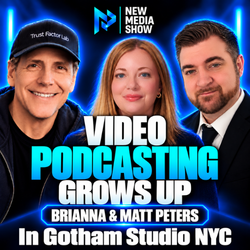 In New Media Show #692, Rob Greenlee takes the conversation into Gotham Production Studios in New York City for an in-person discussion with co-founders Brianna Peters and Matt Peters about the changing business of video podcast production.
From a quick studio tour to a conversation about cameras, content strategy, AI, and audience relationships, this episode explores what it takes to create a show people keep coming back to.
The key question: how can creators improve video production quality, build a sustainable business, and preserve the human connection that makes podcasting valuable?
Three practical takeaways
Identify the biggest constraint on your next episode: the content, sound, lighting, editing time, or discovery. Choose one improvement you can sustain, define the result you want, and review what changes over your next four episodes. This editorial exercise draws on the discussion.
From an audio hobby to a video production business
Gotham began in 2017 with a practical problem: Matt needed a better place to record his own podcast. What started as an audio recording space grew into a service business as clients asked for help producing their shows. Brianna and Matt explain how an early webcam setup evolved into multicamera studios, with a more substantial video investment in 2019 and a shift toward brands and professional creators after the pandemic.
That change reached beyond cameras. Lighting, furniture, set design, and the in-room experience became part of the production offering. Matt explains why Gotham increasingly refers to its clients’ productions as shows and encourages businesses to consider them as part of a broader marketing strategy.
Better production, realistic budgets, and room for independent creators
Matt describes Gotham’s usual three-camera approach and why some visual effects are more practical to create in post-production than with additional camera operators. The discussion also examines the pressure created by celebrity shows and television-scale expectations. Matt worries that expensive productions can discourage people from starting; Brianna emphasizes that a strong concept and audience connection can still stand out on a smaller budget.
For creators, the question becomes how much production serves the show. Rob and his guests explore the balance between polish, accessibility, and the natural conversation that audiences associate with podcasting.
Custom sets and the next studio experience
Brianna and Matt explain the challenge of giving each show a distinctive look inside a shared studio. Small branding elements can work within existing rooms, while dedicated sets require more space and planning. They describe past custom productions and their plans for a future location with more flexible sets and space for live recordings, ticketed events, and brand activations. These are plans for Gotham’s next phase.
Strategy that fits the creator
Brianna shares her coaching approach: cut the noise from generic advice, clarify why someone is creating a show, and build actionable steps around that person’s goals. The conversation challenges the idea that one workbook, formula, or celebrity example can provide the right plan for every creator.
Matt explains Gotham’s internal approach to assessing a show and finding manageable improvements. Thumbnails, clips, websites, guest selection, and appearances on other podcasts can all play a role. Drawing on his work with Greg Fitzsimmons’ Fitzdog Radio and Sunday Papers, he describes refreshing the packaging and discovery strategy while keeping the host’s established voice.
AI and the value of being in the room
Brianna describes using AI to support operations, marketing, discoverability, and editing. She also predicts that uncertainty about synthetic and staged media could increase demand for tangible, in-person experiences. Rob connects that possibility to audience trust and the value of direct human interaction.
The discussion considers how creators can use new tools while maintaining their judgment and identity. For Gotham, that includes exploring a studio environment where recording, community, and live experiences can happen in the same place.
Solo creators, direct relationships, and sustainable support
Can one person still do it all? Matt believes there is still room for creators working with a microphone and webcam, while suggesting that outside help can relieve production bottlenecks when resources allow. Rob reflects on running New Media Show himself to understand the tools and workflows shaping the industry.
The conversation closes with the value of smaller, engaged audiences, newsletters, memberships, merchandise, and direct support. Rob and Matt also discuss their concerns about ad skipping and how AI might affect advertising models. Their broader point is to consider the relationship a show creates, alongside its reach and production quality.
Video chapters
Approximate chapter times follow the supplied video transcript’s minute markers. The separate audio edition may differ.
Guest resources
Brianna Peters and Matt Peters are the co-founders of Gotham Production Studios in New York City. Brianna discusses strategy, coaching, client relationships, and business development; Matt shares his perspective on production, storytelling, editing, and show growth.
Related New Media Show conversations
About the host and the show
Rob Greenlee hosts New Media Show and founded Trust Factor Lab. He is a 2017 Podcast Hall of Fame inductee. New Media Show explores podcasting, video, AI, audience trust, and the business of creator media.
Build an audience. Earn trust. Grow a media business.
AI disclosure
AI tools helped organize and draft these show notes from the supplied episode transcript. The summary paraphrases the recorded conversation. The conversation features human host Rob Greenlee and human guests Brianna Peters and Matt Peters. The transcript also identifies an AI-generated voice introduction.
The post What Does a Video Podcast Need to Compete? At Gotham Production Studios in NYC | #692 first appeared on New Media Show.
Avsnitt sparat!
Du hittar sparade avsnitt på Mina sidor.
Kunde inte spara avsnitt
Något gick fel. Försök igen.