
Dela
WATCH OR LISTEN · EPISODE 690
Watch video | Listen to audio | Read show notes
Watch video
Prefer audio? Listen here.
Open audio in a new window | Download audio
Follow the audio podcast: Apple Podcasts | Spotify | RSS
Show notes
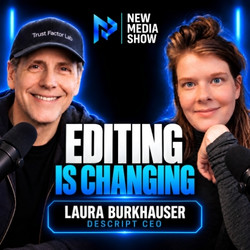
In New Media Show #690, Rob Greenlee talks with Laura Burkhauser, CEO of Descript, about AI editing, creative direction and the decisions that make a creator’s work distinctive. The conversation asks what becomes more valuable about human judgment as production tools become more capable.
Three practical takeaways
Try this: Choose one repetitive editing task for AI assistance. Write down the intended story, compare the automated result with the original, and record the time saved and corrections needed before publishing. This is an editorial exercise informed by the conversation, not a promise of a particular result.
Editing as craft, and editing as a production task
Laura distinguishes between creators whose art is editing and creators whose primary art is storytelling. An experienced editor may want precise control over individual choices. A storyteller may want help removing the technical obstacles between an idea and an audience. Those needs call for different workflows.
Rob and Laura explore the shift toward directing AI tools. A useful prompt depends on knowing the intended result, communicating it clearly and judging what the tool produces. Laura’s point is that a creator’s perspective remains important even when the technical work becomes easier.
Reduce tool friction while keeping human judgment
Laura describes an approach that reduces repetitive production work while leaving the creator responsible for the vision and story. Rob connects that to his experience assembling radio programs manually and using newer editing tools.
The discussion also considers the expectations AI companies create. Claims about effortless production can overlook the creative decisions that still need attention. The practical question is which work should be automated and which choices deserve deliberate human review.
Authenticity depends on the choices behind the edit
Rob asks whether an unedited recording is necessarily more authentic than an edited conversation. Laura argues that editing can make meaning easier to understand. A close-up or reaction shot can clarify an emotional moment, provided it serves the conversation rather than changing its meaning.
They also discuss the tension between being authentic and performing authenticity online. Laura emphasizes a recognizable human presence and engagement with a community. Rob relates this to his work with Trust Factor Lab and the importance of human connection as synthetic media becomes more common.
Start creating, then learn what the business needs
Laura was a Descript customer before joining the company. Producing a podcast with a friend helped her discover that she could create and share work without first mastering a complicated production process. Her advice in the conversation is to start recording, editing and learning.
Rob and Laura question whether pressure to monetize immediately can discourage experimentation. They distinguish media sold as a product from media that supports another business, such as consulting, coaching or a founder-led company. They also consider community support and sponsorships relevant to a specific audience. These are possible models, not guaranteed outcomes.
Algorithms, attention and the next creator workflow
Laura explains her preference for intentional viewing, including turning off YouTube recommendations. Rob describes using both subscriptions and discovery. Their discussion asks what personalization systems optimize for and whether engagement alone captures a useful human outcome.
In the closing discussion, Laura outlines a direction for Descript beyond individual editing tasks: helping creators develop subject areas, build a useful content library, distribute work and learn from it. These comments describe her perspective on future development at the time of the recording, not a list of features independently verified as available today.
Video chapters
Choose a chapter to jump within the video player. These timings follow the edited video; the separate audio edition may differ.
Guest resources
Laura Burkhauser is the guest and Descript CEO in this episode.
About the host and the show
Rob Greenlee hosts New Media Show and founded Trust Factor Lab. He is a 2017 Podcast Hall of Fame inductee. Find more conversations in the episode library or receive the episode newsletter.
AI disclosure
AI tools assisted with transcription, organization and editing of these show notes. The summary paraphrases the recorded conversation; the “Try this” exercise is an editorial suggestion. The episode features human host Rob Greenlee and human guest Laura Burkhauser.
The post How AI Is Changing the Creator Workflow | Descript CEO Laura Burkhauser #690 first appeared on New Media Show.
Avsnitt sparat!
Du hittar sparade avsnitt på Mina sidor.
Kunde inte spara avsnitt
Något gick fel. Försök igen.