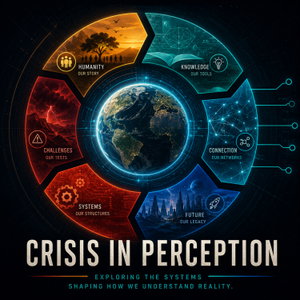
How well can we know another person when much of what we see is a story constructed from memory, reputation, and expectation?
Welcome to Crisis in Perception, where we examine the systems shaping our world.
Using Paper Towns by John Green as its lens, this investigation explores how interpersonal projection can transform a complicated human being into a simplified character. Quentin’s search for Margo Roth Spiegelman gradually reveals that the adventurous, mysterious person he imagines is partly a product of school legends, childhood memories, selective evidence, and his own desires.
The deeper system involves a reinforcing relationship between performance, reputation, and expectation. Margo’s public identity encourages people to interpret her actions through the legend surrounding her, while Quentin’s idealization causes him to treat clues as confirmation of the future he hopes to find.
Through the novel’s imagery of paper towns, strings, grass, maps, and cracked vessels, the episode examines projection, reputational lock-in, information asymmetry, autonomy, adolescent identity, and the difference between imagining another person and allowing that person to remain unknown.
📺 Watch on YouTube:
https://youtu.be/KuIFMN0vxcA
❤️ Support / Episode Post on Patreon:
https://www.patreon.com/CrisisinPerception/posts/paper-towns-when-164477511?utm_medium=clipboard_copy&utm_source=copyLink&utm_campaign=postshare_creator&utm_content=join_link
This episode discusses key plot outcomes from the referenced fictional work in order to analyze its underlying social, economic, and systemic themes.
If these ideas resonate, consider reading the work yourself or borrowing it from your local library. Supporting authors and libraries helps keep critical inquiry accessible.
If you value systems-level analysis like this, please follow, rate, and share the project.
This content was created using AI-assisted tools for research synthesis, structuring, and narration support. All analysis, framing, and editorial decisions are guided by human judgment as part of the Crisis in Perception project.