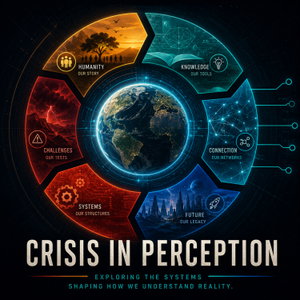
What happens when the models used to understand an economy exclude the forces capable of destabilizing it?
Welcome to Crisis in Perception, where we examine the systems shaping our world.
Using Debunking Economics – Revised, Expanded and Integrated Edition: The Naked Emperor Dethroned? by Steve Keen as our lens, this investigation examines why neoclassical economics failed to anticipate the 2007–08 financial crisis—and why the dominant framework remained institutionally powerful afterward.
Keen argues that equilibrium-centered economics minimized the importance of private debt, bank-created money, disequilibrium, and financial feedback loops. The result was not merely an inaccurate forecast, but a restricted model of economic reality that shaped what students, researchers, and policymakers were trained to observe.
The episode traces the interaction between intellectual assumptions and institutional persistence: textbook standardization, professional incentives, journal authority, policy access, apparent stability, expanding debt, and the tendency to interpret failure as an external shock rather than evidence against the framework itself.
Central systems and tensions include paradigm lock-in, private-credit creation, debt-financed demand, financial-instability feedback loops, mathematical elegance versus empirical realism, and equilibrium versus dynamic economic change.
📺 Watch on YouTube:
https://youtu.be/B7CPl2Oi2wY
❤️ Support / Episode Post on Patreon:
https://www.patreon.com/CrisisinPerception/posts/debunking-when-164470487?utm_medium=clipboard_copy&utm_source=copyLink&utm_campaign=postshare_creator&utm_content=join_link
If these ideas resonate, consider reading the work yourself or borrowing it from your local library. Supporting authors and libraries helps keep critical inquiry accessible.
If you value systems-level analysis like this, please follow, rate, and share the project.
This content was created using AI-assisted tools for research synthesis, structuring, and narration support. All analysis, framing, and editorial decisions are guided by human judgment as part of the Crisis in Perception project.