During a crisis, information must move quickly. But the systems that make rapid communication possible can also allow emotionally compelling falsehoods to outrun verification.
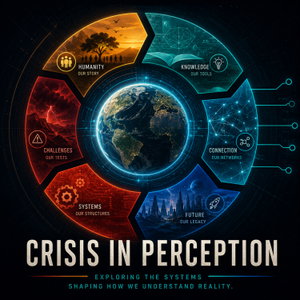
Welcome to Crisis in Perception, where we examine the systems shaping our world.
Using Communication and Misinformation: Crisis Events in the Age of Social Media, edited by Kevin B. Wright, this Deep Dive investigates the social, psychological, technological, and institutional systems that shape misinformation during periods of uncertainty.
The collection presents social media as a dual-purpose infrastructure. Digital networks can distribute emergency guidance, connect affected communities, support first responders, and provide emotional or material assistance. The same networks can also spread conspiracy theories, health misinformation, political manipulation, and misleading climate claims across large audiences without traditional gatekeepers.
At a systems level, the investigation traces how confirmation bias, motivated reasoning, negativity bias, source credibility, repetition, homophily, engagement metrics, echo chambers, and recommendation algorithms interact. Together, these mechanisms create a feedback loop in which uncertainty increases sharing, emotional content attracts engagement, algorithms increase visibility, and repeated exposure makes unsupported claims feel familiar and credible.
The central tension is speed versus verification: how can an information network remain open, responsive, and useful without allowing urgency and popularity to replace evidence?
📺 Watch on YouTube:
https://youtu.be/NJYJ5xzmvq8
❤️ Support / Episode Post on Patreon:
https://www.patreon.com/CrisisinPerception/posts/communication-in-164409984?utm_medium=clipboard_copy&utm_source=copyLink&utm_campaign=postshare_creator&utm_content=join_link
If these ideas resonate, consider reading the work yourself or borrowing it from your local library. Supporting authors and libraries helps keep critical inquiry accessible.
If you value systems-level analysis like this, please follow, rate, and share the project.
This content was created using AI-assisted tools for research synthesis, structuring, and narration support. All analysis, framing, and editorial decisions are guided by human judgment as part of the Crisis in Perception project.