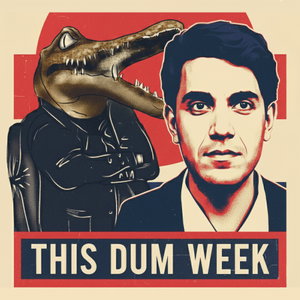
The episode opens with a tribute cold open: a news obituary for Peter Cullen, the voice of Optimus Prime, who died at 85, followed by an extended clip of Cullen recounting how his Marine veteran brother Larry's advice ("if you're gonna be a hero, be a real hero... be strong enough to be gentle") echoed in his head during his original audition. From there RollerGator and Alex burn through a dense scattershot of news: a phantom lion sighting in Indiana that segues into Milo Yiannopoulos's deportation to the UK after an ICE airport arrest (with DHS publicizing his mugshot to promote its $3,000 self-deportation program, and Laura Loomer taking public credit for turning him in); a former Hamilton County judge's prostitution and jail-contraband charges; the launch of a rival "Twitter.Now" site by a Virginia startup claiming Elon Musk's X abandoned the Twitter trademark; and, while waiting for a caller with the handle "Howling Bunghole" to join, a read of Trump's 50% tariffs on Canada and his executive order renaming Lake Ontario to "Lake America." Howling Bunghole eventually gets on and, after a Doug Ford/Rob Ford mix-up, unloads some raunchy backstory on the long-running Milo Yiannopoulos–Laura Loomer feud. A Better/Coinbase crypto-backed mortgage announcement spins into a long risk-and-volatility debate, a New York "manhole mystery" gets blamed on poor nomenclature, and a KRQE investigation revives the Albuquerque DWI corruption scheme with newly unsealed FBI wiretap transcripts of officers casually joking about their decades-long extortion racket. A tangent on Grokopedia's quiet abandonment leads into an extended, enthusiastic detour where Alex describes his own side project: an LLM that acts as a web server, "hallucinating" a website for any URL typed into a browser.
The back half of the first two hours belongs to a two-part "Meet the Flockers" segment. Part one covers a Brevard County "Deputy of the Year" who resigned after a Nazi-salute photo, a gun-during-sex photo with his ex-girlfriend, and Flock database misuse to track her surfaced, paired with a surprisingly skeptical Ron DeSantis press clip calling for legislative "overhaul" of license-plate readers. Part two is a long, granular dissection of a Signal Akron investigation into Flock CEO Garrett Langley's PR campaign — a conference call in which he coaches Ohio police officials to leave national media to him ("let me handle the New York Times... they'll pick up a sob story") while sidestepping a council member's questions about Flock's built-in abortion- and immigration-enforcement search filters. The hosts use it to riff at length on bad database UX (comparing Flock's search-justification dropdown to medical billing codes), Fourth Amendment doctrine around license-plate readers, and a hypothetical "Flockacop" app that crowdsources surveillance of police to test whether officials' privacy objections are principled or self-interested.
The final ninety minutes pivot to data centers and AI infrastructure: a DC Blox lawsuit over a proposed data center next to the Nashville Zoo, a long argument between the hosts over whether data centers' noise and water complaints are substantive or symbolic ("the arguments are not the arguments... the concerns are not the concerns"), a Climate Power memo coaching 2028 Democratic hopefuls to capitalize on cratering public support for data centers, and an Axios report blaming a Chinese bot farm for stoking anti-data-center sentiment that the hosts mock as wildly disproportionate (200 accounts blamed out of 200,000 flagged). Meta's $18 billion child-safety settlement, Nvidia's reported $13 billion bid for Hugging Face, and OpenAI's surprisingly capable new "Jalapeño" chip each get dissected through Alex's recurring "commoditize your complement" and money-to-compute "AI game" frameworks. The show closes with a two-part "Traces of AI Dystopia": a murky class-action lawsuit accusing xAI of training Grok on CSAM, ICE's new $2 million fleet of robot dogs, Beijing's World Humanoid Robot Games (where sprinting robots broke Usain Bolt's 100-meter record while others caught fire or snapped in half), and a closing teardown of Texas Senate candidate Ken Paxton's data-center platform, which would make data centers criminally liable for any downstream chatbot harm to children — a proposal the hosts dismantle as incoherent, unenforceable campaign "signaling" before signing off with a final, heartfelt farewell to Optimus Prime.
Detailed Outline
Cold Open: Peter Cullen's Death and an Iran Bombing Joke (00:00:00 - 00:04:38)
Main Topic: An Optimus Prime Tribute and the Show's Traditional Opening Banter
- The show opens with a news obituary clip: Peter Cullen, the voice of Optimus Prime since the 1980s and reprised in Michael Bay's 2007 Transformers film after 20 years away from the role, died at his Los Angeles home on August 26th at age 85
- An extended clip follows of Cullen recounting a personal story: his brother Larry, a decorated Marine captain back from Vietnam, asked what he was auditioning for; when Cullen said "a hero," Larry told him not to be a "Hollywood hero" but to "be strong enough to be gentle" — advice Cullen says was ringing in his ears as he read the Optimus Prime audition copy
- The show formally opens with its standard introduction, after which Alex jokes that the US "has just bombed Iran again," calling it "Groundhog Day"; RollerGator jokingly asks if this was in retaliation for Optimus Prime's death, and Alex says if Iran was involved he wants "revenge," prompting a joke about going "on a jihad"
Key Quote: "Peter, if you're gonna be a hero, be a real hero. Don't be a Hollywood hero type with all the BS and all the yelling and screaming and the trying to be tough. Be strong enough to be gentle." — Peter Cullen, recounting his brother Larry's advice, in the tribute clip played on air
Key Quote: "Yeah, given that the US has just bombed Iran again, I think we're getting there... it is Groundhog Day. Doesn't matter." — Alex, on whether he's had a sufficiently dumb week
Notable Detail: RollerGator explicitly frames the episode as a tribute to Cullen throughout the show, later admitting he "did do a fair amount of sulking" over Cullen's passing and closing the episode by dedicating it to his memory.
A Lion on the Loose in Indiana and Milo Yiannopoulos's Deportation (00:04:38 - 00:12:55)
Main Topic: A Phantom Big Cat Gives Way to a Real ICE Arrest
- Police in Madison and Hancock Counties, Indiana spend hours searching for a reported lioness and cub near Pendleton using thermal-imaging drones after a tip went viral on the sheriff's Facebook page; the drones eventually spot only a pig, and the search is called off with the sighting unconfirmed
- RollerGator jokes that the "illegal immigration situation" has produced "illegal immigrant lions," pivoting into: Milo Yiannopoulos, a former Breitbart tech editor and early Trump backer, is deported to the UK one day after being arrested by ICE at the Louis Armstrong New Orleans airport for missing a July immigration hearing
- DHS publicizes Yiannopoulos's mugshot on X to promote its $3,000-and-a-flight-home voluntary self-deportation program ("being in detention is a choice"); conspiracy figure Laura Loomer, who is close to Trump, publicly takes credit for reporting Yiannopoulos to ICE
- The read-aloud article recaps Yiannopoulos's 2017 Breitbart resignation over past remarks appearing to defend "cross-generational relationships" and downplaying sexual abuse; he has said he was himself abused as a teen by two older men
- Alex had already guessed the Yiannopoulos story was coming before RollerGator read it, prompting a running joke about an "arms race" between the two of them; RollerGator jokingly floats starting a GoFundMe for Yiannopoulos's "re-immigration," which Alex declines
Key Quote: "So it seems that the illegal immigration situation in this country is so out of control that we have illegal immigrant lions running through the cities." — RollerGator
Key Quote: "Is this a long con to entrap Milo Yiannopoulos?" — Alex, correctly predicting the next story before it was read
Key Quote: "Being in detention is a choice... We encourage all illegal aliens to take control of their departure with the Customs and Border Patrol Home app." — DHS statement on X, quoted in the article read on air
Notable Detail: Yiannopoulos himself once said publicly that "sexual abuse is not the worst thing that's ever going to happen to you. Going bankrupt is worse" — a line RollerGator and Alex later cite jokingly as the reason Alex won't contribute to a hypothetical GoFundMe for him.
A Judge's Prostitution Charges and the Birth of "Twitter.Now" (00:12:55 - 00:20:37)
Main Topic: A Corrupt Ex-Judge, and a Legal Fight Over Who Owns "Twitter"
- Former Hamilton County, Ohio Judge James Kenny, 75, pleads not guilty to prostitution, solicitation, and obstruction charges after allegedly using his attorney credentials to smuggle vape pens and tobacco into the Clermont County Jail and trading contraband for sex acts with an inmate; he has a prior 2004 conviction for sexual imposition and is held on a $150,000 cash surety bond
- RollerGator recalls a previous judge scandal involving a female judge caught having sex with a police chief in her chambers, then jokingly attributes the male-judge pattern to "the patriarchy" giving men "a smaller pool" of judgeships to misbehave in
- RollerGator explains he still calls the platform "Twitter," never "X," which leads into: a Virginia startup called Operation Bluebird launches "Twitter.Now," arguing Musk's X Corp abandoned the Twitter and tweet trademarks after a tentative April 2026 ruling from US District Judge Colm Connolly; X Corp is suing to block it
- The new site features "Vera," a Gemini-based automated fact-checker that its founders test by posting deliberately false claims like "George Washington was our second president"; trademark attorney Josh Gerben calls the gambit "chutzpah" but says it's not necessarily an "open and shut case" for X
- RollerGator and Alex admit that during past Twitter-competitor waves (Parler, Truth Social) they each only ever made token posts about food, never real content
Key Quote: "This was a quick hearing today, so Kenny entered the courtroom in a wheelchair... investigators say James Kenny had sex with an inmate and brought banned items into the jail." — from the WLWT News 5 report read on air
Key Quote: "It's our opinion that X has abandoned the rights on the Twitter and tweet trademarks." — Steven Coates, Operation Bluebird co-founder and Twitter.Now general counsel, quoted in the article
Expert Analysis: Josh Gerben, Washington D.C. trademark attorney — "There's an element of chutzpah to do this, and they're going to get the best fight that X has... it's a really interesting escalation of the case."
Notable Detail: RollerGator's only contribution to his old Parler account was reportedly the word "spaghetti," which he offers as evidence that "it's important to bring something" when joining a new social platform, "even spaghetti."
Howling Bunghole, the US-Canada Trade War, and Lake America (00:20:37 - 00:28:17)
Main Topic: A Renamed Great Lake and a Caller's Gossip About Milo and Loomer
- While waiting for a listener with the handle "Howling Bunghole" to join the space, the hosts read a story on the escalating US-Canada trade war: Trump imposes 50% tariffs on Canadian goods, prompting Canada to retaliate dollar-for-dollar on roughly 700 American products
- Trump, after Ontario Premier Doug Ford said Trump "can kiss my ass" following the trade talks' collapse, signs an executive order renaming Lake Ontario "Lake America"; Canadian PM Mark Carney and New York Governor Kathy Hochul both flatly reject the new name
- Howling Bunghole finally joins and proposes settling the US-Canada feud with a fight between Doug Ford and former DC Mayor Marion Barry, mistakenly conflating Doug Ford with his brother Rob Ford (whom RollerGator fondly recalls as "a partier" in the Andrew W.K. tradition)
- The caller then reveals gossip about a feud between Milo Yiannopoulos and Laura Loomer: Yiannopoulos previously claimed on X that Loomer isn't "really" Jewish and that she would get drunk and sexually harass interns, one of whom allegedly made a crude remark about her anatomy that Howling Bunghole repeats on air
- RollerGator and Alex decline to take sides in the feud, telling the caller he can "have" Loomer with their blessing
Key Quote: "The president fuming since Ontario Premier Doug Ford unloaded on him when the trade deal fell apart. Well, he can kiss my ass as far as I'm concerned." — from the ABC News segment read on air
Key Quote: "This lake is called Lake Ontario today and forever." — Canadian PM Mark Carney, quoted in the segment
Key Quote: "If Laura Loomer is listening to this, I just want to let you know I really don't mind the taste of wet bread." — Howling Bunghole, the caller
Key Quote: "You will not get a fight from either of us. You can have her. She's all yours, sir. You will not receive any competition or backstabbing from us up here." — RollerGator, responding to the caller
Notable Detail: RollerGator jokes that "at least America can rest assured it is fighting this battle of maturity" by renaming a 400-year-old lake in the middle of a live tariff dispute.
Crypto-Backed Mortgages and the Quiet Death of Grok's Companions (00:28:17 - 00:40:50)
Main Topic: Bitcoin Collateral for Home Loans, and an Emotional-Attachment Tangent
- Better Mortgage and Coinbase announce general availability of a token-backed conforming mortgage product, built to Fannie Mae guidelines, letting Coinbase One members pledge crypto as collateral without selling it; approved borrowers get a 1% rebate up to $10,000, and an earlier waitlist showed $260 million in projected loan volume with 76% of respondents already Coinbase One users
- RollerGator repeatedly presses Alex on what happens in a cascading-collapse scenario — home values fall, the borrower loses their job, and their crypto collateral craters simultaneously — while Alex clarifies the loans themselves are dollar-denominated and crypto is likely only a fractional part of underwriting, calling it "a niche product" unlikely to cause the next financial crisis
- The two riff on Coinbase increasingly resembling "an all-in-one" gambling-and-banking app with sports betting and prediction markets, joking that "maybe Elon bought the wrong everything app after all," since X lacks Coinbase's breadth of products (if also its Grok-powered "anime porn bots")
- Alex reveals that xAI's "Companions" product (AI chat personas) is reportedly being quietly phased out due to low popularity, which RollerGator uses to note that he has never formed an emotional attachment to any LLM product — only to Peter Cullen's voice as Optimus Prime — leading into a short riff on the word "authenticity" having become a meaningless buzzword
Key Quote: "The only problem comes if these kinds of mortgages are a large proportion of the overall pool, which seems... still in the future, let's just say." — Alex
Key Quote: "Maybe Elon bought the wrong everything app after all." — RollerGator
Key Quote: "I did develop an emotional attachment to the voice of Peter Cullen as Optimus Prime... but I have not gotten any emotional connection to any LLM or talking LLM or anything similar." — RollerGator
Key Quote: "Nothing is authentic and everything is authentic. Is that where we are now, Alex?" / "Yes, that's where we are." — RollerGator and Alex
New York's Manhole Mystery and the Albuquerque DWI Wiretaps (00:40:50 - 00:55:20)
Main Topic: An Unsolved Urban Puzzle, and a Decades-Long Police Extortion Scheme Finally Gets Its Wiretaps Made Public
- For months, groups of five or six people have been filmed opening manhole covers in New York City, Brooklyn, and now Wantagh on Long Island, disappearing underground for unclear reasons before resealing the covers; police searching below have found nothing disturbed, and the NYPD suspects urban scavenging for valuables
- RollerGator blames the phenomenon on poor branding, joking that calling them "manholes" naturally invites men to "go down the hole"; Alex suggests the news coverage itself may be inspiring copycats by publicizing the mystery; both rule out a Teenage Mutant Ninja Turtles connection for lack of any reported toxic-ooze spill
- KRQE's investigation into the long-running Albuquerque DWI corruption scheme returns with newly unsealed federal wiretap transcripts: officers Honorio Alba and Joshua Montaño are heard casually discussing lying about court appearances, taking bribes, and funneling DWI arrests to defense attorney Thomas Clear III's office as part of a scheme running since at least 1995
- The scheme worked by having a "patsy" get a target drunk and driving them home, having a police officer pull the target over for DWI, then referring them to Clear's office, which would (for a fee) get the case dropped by simply not showing up to the first hearing
- Wiretapped officers are heard joking about faking a doctor's-appointment excuse for missing court ("TMI, but I just threw up... we're going to blame McDonald's") and discussing how much money paralegal-turned-fixer Ricardo "Rick" Mendez was charging per case ($1,300 to as much as $8,500); 10 former officers, two defense attorneys, and Mendez have now pleaded guilty
- RollerGator notes that judges occasionally did push back by demanding proof of the excuses officers gave for missing hearings, though it evidently wasn't enough to stop the scheme for decades; Alex asks, in a Breaking Bad reference, whether any of the defense attorneys involved were named Saul (they were not)
Key Quote: "You can do almost whatever you want in this unit, bro, but don't broadcast it. Don't tell the whole world." — Former APD officer Honorio Alba, quoted from a wiretapped December 2023 call
Key Quote: "When I went to him, guess how much he was charging for a DWI?... $1,300." — Ricardo "Rick" Mendez, quoted from the wiretaps, referring to attorney Thomas Clear III
Key Quote: "Biggest takeaway is I wish we would have started sooner." — Raul Bujanda, former FBI special agent in charge of the Albuquerque field office, now the city's executive director of public safety
Notable Detail: RollerGator observes that in the wiretapped calls, the officers' tone is strikingly nonchalant — discussing extortion and perjury "like this was their job" — which he says is even more unsettling than the underlying facts of the scheme itself.
Grokopedia's Vaporware Ending and Alex's Hallucinated Web (00:55:20 - 01:09:00)
Main Topic: An Abandoned AI Encyclopedia Leads Into Alex's Own Experimental Side Project
- A YouTube chat comment notes that Grokopedia, Elon Musk's AI-generated encyclopedia project, appears to have been completely abandoned; Alex agrees, calling it "vaporware" in retrospect, and speculates it faced the same catch-22 as the Companions product: without visible consumer demand there was no incentive to keep spending tokens maintaining it, making it look more like a "stunt" than a sustained product
- Alex describes his own long-running side project: a system that makes an LLM behave like an HTTP server, hijacking his home network's mDNS so that typing any made-up ".local" address in a browser causes the model to "hallucinate" a full website on the spot, with results cached for faster reloads
- He demonstrates the concept with an anecdote about typing "monoblockchair.local" after watching a video about the ubiquitous white molded garden chair (a mass-produced "design object" with no known designer) and getting a generated page about it instantly, rather than a wall of chatbot text
- Alex describes an embedded chat widget on each generated page that lets a user iteratively reshape it ("put more images") and floats a broader vision of an AI-generated "overlay" atop the ordinary web that filters out unwanted elements like ads, plus a "web of LLM" or "discovery" paradigm to eventually replace chat interfaces
- RollerGator connects the idea to augmented reality, proposing a hypothetical pipeline combining a Whisper-style voice interface, an LLM, and an Apple Vision Pro to generate real-time AR overlays (like an "escape room" experience mapped onto a real room); Alex jokes progress on this kind of thing is bottlenecked partly because "too many people are trapped on the porn bots"
Key Quote: "I was building out something... a thing that basically gets an LLM to act like an HTTP server... whatever you put on your browser's URL bar, it will hallucinate a website." — Alex
Key Quote: "You don't want to just like vomit text in your face. It gives you a different way of... experiencing it." — Alex, on why a generated webpage is a better interface than a chatbot answer
Key Quote: "I think a lot of this stuff is gonna happen, because the reason it's not happening right now is ultimately compute speed... and too many people are trapped on the porn bots." — Alex
Notable Detail: Alex says he's been able to make the hallucinated pages generate in a few seconds rather than "half a minute," which he calls "surprisingly complicated" — the main engineering challenge of the whole project.
Meet the Flockers, Part 1: The Deputy of the Year's Nazi Salute and DeSantis's Doubts (01:09:00 - 01:17:00)
Main Topic: A Disgraced "Deputy of the Year" and an Unexpectedly Skeptical Governor
- Michael Fultz, named Brevard County, Florida's "Deputy of the Year" hours earlier, resigns after the sheriff's office receives a photo appearing to show him giving a Nazi salute with a Hitler-style mustache (taken before he became a deputy, which he calls "a joke"), a second photo showing him holding a firearm to his ex-girlfriend's head and mouth during sex (which she says was consensual, though he admitted violating firearm safety and training rules), and an accusation that he logged into the Flock license-plate database to look up his ex-girlfriend's tag, which he denies was to spy on her
- RollerGator and Alex track their reactions escalating story by story, from assuming it might be a costume, to shrugging off a "private affair," to concluding "it just cannot be saved"
- In an unrelated press clip, Florida Governor Ron DeSantis voices real skepticism about Flock cameras, calling for the state legislature to "overhaul" their use, noting New Hampshire has restricted license-plate readers to state right-of-ways, and pointing out Florida's Senate passed an "AI Bill of Rights" that the House refused to act on
- DeSantis recalls that license-plate readers were originally sold to Floridians purely as a toll-collection tool, and worries aloud about "a handful of tech companies" knowing where everyone goes, directly citing officers using the system to track ex-girlfriends as the kind of abuse that concerns him
Key Quote: "Just hours after this awards ceremony where Michael Fultz was honored as Deputy of the Year, the sheriff's office says it received this photo of Fultz, who appears to be performing a Nazi salute." — from the ClickOrlando/WKMG report read on air
Key Quote: "When I see like a police officer using this to track like an ex-girlfriend, I'm like, you know, what the hell's going on with this? So I think this has happened very quickly. I think people are right to be concerned." — Florida Governor Ron DeSantis, quoted from a press clip
Key Quote: "This raises the question of who got passed up for the Deputy of the Year award, and what are they up to?" — RollerGator
Notable Detail: DeSantis notes he is "in the process of reviewing" New Hampshire's restrictions on license-plate reader use as a possible model for Florida legislation.
Meet the Flockers, Part 2: Flock CEO Garrett Langley's Akron PR Campaign (01:17:00 - 01:44:00)
Main Topic: A Leaked Strategy Call Reveals the Gap Between Flock's Public and Private Messaging
- A Signal Akron investigation finds the city's roughly 146-150 Flock cameras log every passing license plate into a database searchable for 30 days by any of the more than 6,000 agencies nationwide running Flock's roughly 120,000 cameras; the system explicitly includes built-in filters that, if not activated by an agency, allow searches tied to enforcing anti-abortion or immigration laws (Akron says both filters are switched on/blocked locally)
- Records from a 5-month stretch of 2025 show more than 37,000 Flock searches by Akron officers, many logged with no discernible reason, vague abbreviations, or blank fields despite department policy requiring justification; among them, officers tracked the car of Autumn Riddle, a prominent police critic, logging the search only as "activist recording" or "law enforcement"
- Flock CEO Garrett Langley convenes an August 6th conference call with Ohio police and government officials, described internally as a strategy session to counter growing criticism; he says 80% of his time is now spent on national media (3-4 interviews per day), tells local officials to leave outlets like the New York Times to him ("they'll pick up a sob story" from local media instead), and promotes a "success stories" portal used by roughly 2,000 customer agencies to counter local criticism, alongside a new $500-per-camera annual vandalism insurance plan
- When Akron council member Fran Wilson presses Langley about the abortion-related search filter, he pivots to attacking a 404 Media story about a Texas officer's search rather than answering directly, leaving Wilson feeling that Flock has "collected an absolute treasure trove of data" while being evasive about how it's used
- RollerGator and Alex compare Flock's search-justification dropdown to bad medical billing codes, arguing that mandatory data-entry fields which return no value to the person filling them out will always be filled in badly or dishonestly; they criticize Akron's fix (tightening the dropdown only after a citizen complaint) as reactive rather than proactive
- The two debate Fourth Amendment doctrine at length — the legal theory that a license-plate camera is equivalent to a cop's own eyes in public, and therefore not subject to the same warrant requirements as a private search — with RollerGator predicting an eventual Supreme Court test case, and Alex proposing a hypothetical "Flockacop" app that crowdsources facial-recognition surveillance of police to test whether officials' objections to being surveilled are principled or purely self-interested
Key Quote: "Don't trust what you read on Facebook about flock cameras... these are the facts for our town." — Flock Safety CEO Garrett Langley, quoted from the internal conference call
Key Quote: "Let me handle the New York Times. You handle your local media... they'll pick up a sob story." — Garrett Langley, quoted from the call
Key Quote: "I was really shocked that we have an immigration and abortion-related offense filtering for a public safety technology. That fact, the fact that it even exists, tells us a lot about where we are in the country... We are in a dark time." — Akron City Council Member Fran Wilson
Key Quote: "Anytime you have to gather data from an end user, you need to make gathering that data return something of value to that user, or else you will get garbage." — Alex, on Flock's search-justification dropdown
Key Quote: "It is incumbent upon those who are the least capable of raising an issue to find and conclusively demonstrate that a problem exists, prove that problem exists to those who are least likely to want to accept that the problem exists, then get them to fix that problem." — RollerGator
Key Quote: "If doing this places an officer's life at risk, presumably doing the opposite is placing people's lives at risk. Ergo, get fucked." — Alex, on his hypothetical "Flockacop" app for surveilling police
Hosts' Analysis: Both hosts say they don't necessarily think Langley is personally malicious, but conclude his instinct is to reframe every privacy complaint as a matter of adjustable "efficacy" rather than to acknowledge any legitimate downside to the product — and that recruiting local police departments as an unpaid PR army, while understandable from a CEO's perspective, is a tell that the company is playing defense rather than engaging honestly.
The Data Center Backlash: Nashville's Zoo Lawsuit and the Noise-and-Water Fight (01:44:00 - 01:59:00)
Main Topic: A Legal Fight Over a Data Center Next to the Nashville Zoo Opens a Broader Debate
- DC Blox, the company behind a proposed two-building data center complex next to the Nashville Zoo, sues Metro Nashville, arguing the city's data-center zoning ordinance and Mayor Freddie O'Connell's executive order banning large-scale data center development violate its due process and equal protection rights, since the property previously housed an office and data center for Asurion without incident; Metro has separately passed a bill authorizing eminent domain against the site
- Alex argues that widely repeated complaints about data centers causing "extreme noise pollution" and wasting drinking water are largely overstated, citing a debunked figure with what he calls a "1,000x" error behind one popular water-usage claim, and argues companies like Google respond to the noise complaint simply by promising quieter next-generation designs rather than contesting the substance of the claim
- RollerGator counters that genuine noise from a data center could plausibly stress the zoo's animals, joking that it might explain why the earlier-reported Indiana lions "went rogue" and fled
- Alex's broader argument: data centers function as a cultural "totem" for anxieties about surveillance and loss of control (a stand-in for "the NSA" or the security state), meaning that even if every specific technical objection were resolved, opponents would simply shift to a new one, such as data centers "taking up too much space" or "stealing jobs"
- The segment closes with a brief Terminator riff — Alex is a longtime fan of the franchise and Terminator: The Sarah Connor Chronicles — joking that anti-data-center activists see themselves as modern-day justified "Sarah Connors," except that many are also self-described antinatalists, which disqualifies them from the role, followed by a news brief: a 63-year-old man set himself on fire in the lobby of Google's Lower Manhattan office building; police report no clear motive, and Google says he may have been trying to reach a different tenant's space in the building
Key Quote: "It fucking annoys me that everybody has to fucking be talking about the fucking water all the time." — Alex
Key Quote: "The arguments are not the arguments. The concerns are not the concerns, and therefore the solutions are not the solutions." — Alex
Key Quote: "You know, like I said, that might be why the lions left. They just went rogue." — RollerGator
Notable Detail: Alex notes that data centers, as an icon, "represent the security state... they are all the NSA" to critics — meaning the actual complaint is about surveillance anxiety rather than literal decibels or gallons of water, which he says makes engaging the stated arguments on their own terms mostly beside the point.
Climate Power's Memo, Grid Economics, and China's Bot Farm (01:59:00 - 02:20:00)
Main Topic: Democrats Angle for Advantage as the Hosts Debate Who Actually Pays for the Extra Power
- An Axios report details a memo from Climate Power, a pro-Democrat climate group, coaching the party's 2028 hopefuls to capitalize on cratering public support for data centers; it cites a University of Pennsylvania survey showing 61% of Americans now oppose new local data centers (up 12 points since February/March) and a YouGov poll showing only 24% think new data centers are good for the country, while accusing Trump and the GOP of giving the industry "a blank check to raise our utility bills, poison our air, and drain our water"
- RollerGator raises a specific economic concern: adding a data center's load to a local grid doesn't necessarily raise costs linearly, and the marginal cost of the "last watt" needed to meet a new peak or higher baseload could be disproportionately high, with that added cost often getting passed on to existing (and often poorer) ratepayers rather than the data center itself
- Alex counters that data centers are typically steady, high-utilization "baseload" consumers rather than sharp demand spikes, and that many either build their own on-site power generation (citing SpaceX's recent turbine-company acquisition) or secure advance grid-capacity approval, sometimes even selling surplus power back to the grid and lowering prices for everyone; he illustrates the difference with an anecdote about the UK's historic "national kettle" phenomenon, in which a huge, synchronized spike in electricity demand occurred nationwide whenever a popular BBC program ended and viewers all went to make tea
- An Axios follow-up, "China Is Secretly Fueling America's Data Center Rage," reports that X's safety team identified roughly 200,000 suspected Chinese bot-farm accounts, only about 200 of which were found posting content critical of data centers and AI energy use; the House Energy and Commerce Committee has separately asked the FBI and White House to brief lawmakers on foreign influence campaigns allegedly delaying $45.8 billion in Virginia data-center projects
- RollerGator and Alex mock the "200 out of 200,000" framing as absurdly thin evidence, comparing it to the widely mocked 2016 narrative blaming a small Russian Facebook ad buy for the election outcome; Alex separately laments that neither side of the real debate is actually engaging with "the conversation we're trying to have... as a country," calling both sides' arguments "absolutely retarded"
Key Quote: "Trump and Republicans have given AI data centers a blank check to raise our utility bills, poison our air, and drain our water." — Climate Power memo, quoted in the Axios report
Expert Analysis: Jim Prosser, Silicon Valley communications consultant and former Twitter head of corporate communications — "If you get both Greg Abbott and Kathy Hochul agreeing on something, it's probably not a Chinese psyop... it's about touching grass and actually being somewhere. If you're a venture capitalist in Atherton or Menlo Park opining about how somebody in Ohio should feel and you've never been to Ohio, that's a problem."
Key Quote: "Pray tell, what were the other 199,800 accounts doing?... If you had 200,000 fake accounts posting about all sorts of things, you could literally find 200 talking about any particular thing and therefore make a post like that. It would mean nothing." — Alex
Key Quote: "The issue is not the issue. China's disinformation campaigns are not the issue. The water and the energy and the whatevers are probably not the issue. There's another conversation we're trying to have, perhaps, as a country... and we seem to be dead set on figuring out how not to have it." — Alex
Notable Detail: Alex's UK "national kettle" anecdote — a real, well-documented phenomenon in which British grid operators had to build extra standby capacity purely to handle the demand spike from millions of people boiling water for tea right after popular TV broadcasts ended — is used to illustrate a genuinely hard grid-engineering problem, in contrast to what he considers the more manufactured data-center controversy.
Meta's $18 Billion Settlement and Nvidia's Bid for Hugging Face (02:20:00 - 02:43:00)
Main Topic: A Landmark Child-Safety Settlement, and a Strategic Acquisition in the AI Model Ecosystem
- Meta agrees to pay up to $18 billion in a settlement with 48 states, resolving claims it engineered Instagram and Facebook to "entice, engage, and ultimately ensnare" children and teens; new rules include 2-hour daily time limits for under-18 users, blocking the apps from midnight to 6am, hiding like counts, and banning some beauty filters; Meta denies wrongdoing and calls on TikTok and YouTube to adopt similar changes
- Victoria Hinks, whose 16-year-old daughter Alexandra died by suicide after what Hinks describes as social-media addiction, tells reporters outside the courthouse that "no amount of money is ever going to bring my beautiful daughter back"
- RollerGator and Alex riff darkly that banning official beauty filters will simply spawn an "illicit," gray-market filter economy (since phone manufacturers already build their own filters and third-party apps can post directly via API), while the platforms' separate proliferation of AI "companion" and sex-bot advertising remains untouched by the settlement
- Separately, Nvidia is reportedly close to acquiring Hugging Face, the leading open-source AI model repository, for roughly $12.9-13 billion, after Google, Microsoft, and Salesforce had also reportedly shown interest
- Alex explains the acquisition through the lens of "commoditize your complement" — the same logic by which Google subsidizes free browsers to protect its search business — arguing Nvidia wants AI models to remain a cheap, ubiquitous commodity so that all the real money keeps flowing toward GPU purchases, and that owning Hugging Face lets Nvidia defensively prevent any rival lab from ever gatekeeping the open-model ecosystem the way Microsoft has never closed off open-source hosting on GitHub after acquiring it
Key Quote: "No amount of money is ever going to bring my beautiful daughter back." — Victoria Hinks, mother of Alexandra, quoted outside the courthouse
Key Quote: "Some criminal gang somewhere is gonna make a lot of money doing [illicit beauty filters]. Why not us?" — Alex
Key Quote: "NVIDIA's product is GPUs. GPUs run models. So the models are a complement of the GPU... NVIDIA wants people to be putting all their money in buying GPUs, and therefore it wants the models to be free." — Alex, explaining "commoditize your complement"
Key Quote: "If you follow the GitHub acquisition by Microsoft, Microsoft is not going to stop you from putting Linux software on GitHub... to do that would be to destroy their GitHub acquisition." — Alex
Notable Detail: RollerGator presses Alex on why Nvidia specifically benefits from owning Hugging Face rather than just letting the market sort itself out; Alex frames it as pre-empting a scenario where a rival like Anthropic or Microsoft (both financially capable of a $13 billion purchase) could instead acquire it and start gatekeeping access to open models.
OpenAI's Jalapeño Chip and the Strategic Game of AI (02:43:00 - 02:55:00)
Main Topic: A Surprisingly Fast, Cheap New Chip Gives Nvidia a Real Scare
- OpenAI unveils an in-house AI chip, nicknamed "Jalapeño" (prompting RollerGator to note that "a jalapeño is not a chip"), reportedly built in just nine months and unusually strong on tokens-per-second throughput relative to its energy use, according to figures OpenAI itself released
- Alex lays out his long-standing mental model of "the AI game" as a self-reinforcing loop — money buys energy, energy powers data centers, data centers train models, models power applications, and applications make money that feeds back into the loop — with Nvidia, the major labs, and cloud/neocloud providers all fighting for leverage at different points in that cycle
- He notes OpenAI reportedly used its own unreleased "Astra" coding model to help port existing AI models onto the new chip's architecture, sidestepping the "CUDA moat" that has historically locked developers into Nvidia hardware; he places this alongside Google's TPUs, Amazon's Trainium, and Tesla's abandoned Dojo project as precedent for labs building in-house chips as leverage against Nvidia, even if the chip never fully replaces Nvidia hardware
- RollerGator counters that Nvidia's enduring strength comes from its GPUs being genuinely general-purpose (useful for gaming, crypto, and more, not just LLMs), whereas a chip custom-built to run today's specific AI architecture risks rapid obsolescence if there's a fundamental breakthrough (like cracking continuous learning) that changes what future models need
- Both agree that, of the major players building "castles" across all four layers of the stack (energy, data centers, models, and applications), Elon Musk currently has the broadest simultaneous footprint, despite Grok lagging behind labs like Fable and Anthropic on raw model quality
Key Quote: "You have money, and money buys energy. Energy goes into data centers, data centers train models, and models underpin applications which make money, which feeds back into the loop." — Alex, describing his model of "the AI game"
Key Quote: "Designing something that is exceptionally good at running your current specific architecture is a potential limitation on the versatility of your product... what happens if there is a breakthrough in the LLM technology that makes that current set of chips not particularly useful?" — RollerGator
Key Quote: "This is the Super Bowl, right? Like you have incredibly competent operators. Say what you want about Altman, it doesn't matter, he is very, very good at what he does." — Alex
Notable Detail: Alex notes that Elon Musk, though technically behind on raw model quality, is "probably the only one that has credible entries in all four" layers of the AI stack (energy, data centers, chips/models, and applications) once his broader consortium is considered as a whole.
Traces of AI Dystopia, Part 1: Grok's CSAM Lawsuit and ICE's Robot Dogs (02:55:00 - 03:11:00)
Main Topic: A Murky Legal Complaint Against xAI, and a New Robotic Tool for ICE
- A proposed class-action complaint against xAI alleges Grok was trained on child sexual abuse material tied to a "Jane Doe" plaintiff who was raped as a preschooler in the early 2000s to produce CSAM later added to hash lists maintained by the National Center for Missing and Exploited Children and the Canadian Centre for Child Protection; the suit claims Grok's default policy of treating public X posts and its own image outputs as training data means newly generated, AI-made images resembling her keep re-entering its training pipeline
- RollerGator and Alex spend an extended stretch trying to parse the actual technical claim, noting that a "hash list" identifying known abuse images is conceptually different from an AI-generated image merely judged "similar enough" to resemble the plaintiff, and expressing skepticism about how the connection to xAI's training data was specifically established; they nonetheless agree that if any part of the underlying claim is true, "they should pay something and scrub their training set"
- Alex offers a technical explanation of why content like this can't be filtered out at the image-generation level: diffusion models work by iteratively denoising an image toward whatever concept vectors match a text prompt, meaning any two concepts the model has ever learned (RollerGator's example: "panda bears wearing suits playing tennis") can in principle be combined — so the only reliable defense is a pre-filter that blocks disallowed requests before generation even starts, not a filter on the generation process itself
- ICE places a $2 million order for a fleet of robot dogs with 360-degree cameras and door-opening ability, to be used in operations considered unsafe for human agents, alongside newly approved "shock gloves" capable of delivering up to 380 volts; ICE made nearly 47,000 arrests in July 2026, the most since October 2022, with the majority of those arrested having no criminal record — and Milo Yiannopoulos, from earlier in the show, is confirmed to now be in ICE detention awaiting deportation
- RollerGator says he's long been uncomfortable with Boston Dynamics-style robot dogs specifically because early demo videos of engineers kicking them to show off their balance made him feel sympathy for the machines — a reaction he considers dangerous given that he may someday need to "kill these things without remorse"
Key Quote: "I can have panda bears wearing suits playing tennis, right? Those are just concepts... the degree to which these image generators are trained on concepts, the concepts can be combined." — Alex, explaining why CSAM-adjacent content can't be filtered out purely at the generation level
Key Quote: "It seems to follow then that... any CSAM ingested in the training before takedown likely continued to shape the model's outputs even after the original images were removed from public view." — from the Ars Technica report read on air
Key Quote: "I felt bad for the robot dog, and that's not good. I need to be able to kill these things without remorse if necessary, and I can't have that visceral reaction." — RollerGator, on ICE's new robot dogs
Notable Detail: RollerGator jokes that Milo Yiannopoulos, discussed earlier as being deported, "is not part of the AI dystopia... he was just part of the normal dystopia," to which Alex quips that Yiannopoulos "is in the training data" now — specifically Grok's.
Traces of AI Dystopia, Part 2: Beijing's Robot Games and Ken Paxton's Data Center Crackdown (03:11:00 - 03:33:58)
Main Topic: Sprinting Robots That Catch Fire, and a Texas Senate Candidate's Incoherent Liability Proposal
- Beijing's second annual World Humanoid Robot Games (August 22-26) produces viral footage of robots sprinting faster than Usain Bolt's 100-meter world record and clearing higher standing jumps than the prior year's event, alongside robots crashing into barriers, snapping at the waist in a shower of sparks, or catching fire outright; the same robots struggled badly at mundane tasks like folding and hanging laundry
- Purdue PhD researcher Deepam Patel tells Ars Technica the sprinting and jumping feats show genuine "whole-body control" progress, but that these remain narrow, single-task machines rather than general-purpose robots — proven by the fact that the sprinting robots could not even slow down after crossing the finish line — and suggests testing robots on the same task 10 times in a row would be a more meaningful benchmark than one-off viral stunts
- Alex explains that the underlying reinforcement-learning algorithms for training these robots aren't especially new; the real bottleneck is building physics simulators accurate enough to generate the huge number of training repetitions needed, since real-world trial-and-error is far too slow, and any given trained model tends to be tightly coupled to the specific robot chassis it was trained for
- Alex briefly shares a $399 duck-shaped home robot/camera product; RollerGator, "a huge fan of ducks," says he's uneasy about a device designed to be adorable that also doubles as a surveillance camera in his house, though he's reassured slightly that it's open source
- Texas Attorney General and US Senate candidate Ken Paxton releases a data-center regulatory platform pledging to ban Chinese technology from US data centers and hold companies criminally liable if their data centers power AI chatbots that "endanger children"; the plan closely echoes Democratic opponent James Talarico's earlier "Hold Data Centers Accountable" proposal, even though Paxton voted for the 2013 sales-tax exemption that fueled Texas's data-center boom (now projected to cost $3.2 billion in lost revenue) and has taken roughly $450,000 from data-center-affiliated donors, while Talarico has received $10 million in super-PAC support from LinkedIn co-founder Reid Hoffman
- Adam Thierer of FIRE, quoted in a post Alex shares, calls Paxton's criminal-liability theory "the most open-ended and destructive theory of vicarious liability in history," comparing it to holding an electric utility criminally liable for any appliance plugged into its grid, or a gun and ammunition maker liable for any crime committed with its products
- RollerGator and Alex spend the closing stretch dismantling the proposal: modern cloud infrastructure is redundant and geographically diffuse enough that no single data center can reliably be tied to a specific harmful output, a company like Microsoft may subcontract to entirely different data centers than the one nominally hosting an app, and the standard as written would functionally criminalize hosting anything from Roblox to Google Calendar if bad actors misused them; both conclude no data center operator would actually risk operating under such an open-ended threat and would simply relocate rather than face it, meaning the proposal is pure Senate-campaign "signaling" with no real chance of surviving legal challenge
Key Quote: "If you cross the finish line, that's the goal. It doesn't matter if you stop, and it doesn't matter if you fall into different pieces." — Deepam Patel, Purdue PhD candidate and US Army DEVCOM Army Research Lab researcher, quoted in the Ars Technica report
Expert Analysis: Adam Thierer, FIRE — Paxton's plan "would enshrine into law just about the most open-ended and destructive theory of vicarious liability in history... this is like saying an electricity company will be held criminally liable for problems that develop with any appliance plugged into the grid."
Key Quote: "The desire to keep pushing things down the chain of causality... [the situation] makes a lot more sense if you just think about data centers as a bad thing that does bad things, and the laws as, we're tough on bad things. It used to be tough on crime. Now it's tough on data centers, apparently." — RollerGator and Alex
Key Quote: "Were anything remotely like this to pass in Texas... the data centers would simply get up and leave Texas. You don't put a gun to your head and sit there happily hoping [it doesn't go off]." — Alex
Key Quote: "We lost Optimus Prime and we're not going to get him back. So the world is a little bit weaker out there than it was before, but we will try to carry on in his legacy." — RollerGator, closing the show
Notable Detail: RollerGator and Alex close by wondering aloud why these facilities are even called "data centers" given they're mostly compute-and-throughput infrastructure rather than storage, joking that "the next generation should be called something else to throw people off" — a rare moment of the show ending on a genuinely open question rather than a punchline.
Overall Structure and Flow
This episode runs noticeably longer than a typical outing (roughly three and a half hours) and is bookended by an unusually sincere framing device: the death of Optimus Prime voice actor Peter Cullen opens the show with an extended, emotional tribute clip and closes it with RollerGator's on-air eulogy, giving even the raunchiest tangents (the Howling Bunghole caller's Milo-and-Loomer gossip, the crypto-mortgage doom-loop questioning) a throughline of genuine affection underneath the usual irreverence. The front two hours are unusually scattershot even by this show's standards — a lion sighting, a deportation, a corrupt judge, a trademark fight over "Twitter," a listener call, a crypto product launch, a manhole mystery, and a decades-old police corruption scheme all get covered before "Meet the Flockers" formally begins around the one-hour mark, though the segment itself, once it starts, becomes the episode's first real anchor point, expanding from a single disgraced deputy into a sustained, quote-by-quote dissection of Flock's internal PR strategy that echoes the format the show used for the Flock CEO's All-In Podcast interview in prior weeks.
The back third is where the episode's real argument crystallizes: a sustained, multi-segment examination of the data-center backlash (the Nashville zoo lawsuit, the noise-and-water debate, the Climate Power memo, the China bot-farm story, and the Ken Paxton platform) that RollerGator and Alex use to make a consistent meta-point — that stated objections to unpopular technologies (Flock cameras, data centers, AI chatbots) are rarely the real objections, and that policy responses built on the stated objections therefore tend to be either reactive theater or, in Paxton's case, borderline incoherent as written. The two "Traces of AI Dystopia" segments that close the show, unusually split into two parts rather than the show's more typical single survey, bring that same lens to bear on Grok's CSAM lawsuit and Beijing's viral robot games before landing back on the Paxton story as the culminating example — suggesting an episode that, despite its sprawling and disconnected first half, was quietly building toward one sustained argument about the gap between how institutions and campaigns talk about new technology and how it actually works.