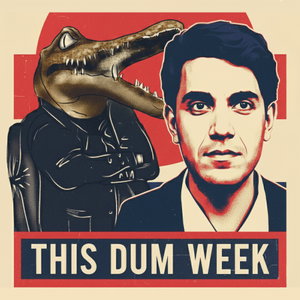
The June 28, 2026 episode of This Dum Week opens on an experiment: RollerGator announces the show is now streaming simultaneously to YouTube and Substack for the first time, adding both platforms to the usual Twitter Space. Alex is late, as expected. The opening speedrun covers seven compressed items across roughly twenty minutes: Gracie the giraffe has been missing from a Texas game reserve for two weeks and a $5,000 reward has been posted (a story RollerGator explicitly designates as a Chekhov's gun he intends to fire before the episode closes); an Oklahoma woman is suing Arby's after allegedly contracting oral herpes from a sandwich whose manager — who had a visible active outbreak — was subsequently charged with felony poisoning; John Bolton pleaded guilty to one of eighteen mishandled-classified-information counts and will serve probation; Vanilla Ice was the sole remaining performer when Trump's Great American State Fair concert on the National Mall was cancelled two hours before showtime; Detroit Lions cornerback Terrion Arnold faces life in prison for allegedly orchestrating a kidnapping over a disputed $200,000; and Georgia teacher Maris Nichols, previously arrested for sex with six students, violated her house arrest conditions 85 times in 27 days, tracked by ankle monitor to retail stores and fast food restaurants. Two swatting stories follow: an anonymous caller filed a CPS report claiming Pete Buttigieg had confessed to "unspeakable violent crimes" against his children, separating his four-year-old twins from their parents for 24 hours, before RollerGator pivots to revisit an Amy Coney Barrett swatting clip — and the recollection that the person convicted of plotting to kill Kavanaugh was reported throughout as female. The sentencing of Sophie Rosk (born Nicholas Rosk) — eight years from Judge Deborah Boardman against the DOJ's requested thirty-plus — opens a genuine philosophical exchange: Alex finds it uncomfortable to convict someone for an act they abandoned, questions whether a terrorism enhancement for the "political importance of a target" coheres as a principle, and observes that the sentencing signal to the next person who approaches a line and then stops may be badly calibrated.
The episode's intellectual center is a pair of connected segments. The first is explicitly framed by RollerGator as "good AI news, not in Traces of AI Dystopia": the Vesuvius Challenge has produced a virtual unwrapping of an entire Herculaneum scroll, recovering over 70 columns of text and two previously unknown ancient books from 1,800 carbonized papyrus scrolls that have been sitting in Naples libraries since their 18th-century excavation — scrolls that workers initially burned as coal, that were previously described as "saggy brown burritos," and whose ink was invisible to X-rays because it has the same density as the papyrus beneath it. The breakthrough required University of Kentucky computer scientist Brent Seales's virtual unwrapping software, a crowdsourced prize competition, and ex-physicist Casey Handmer's recognition that the ink, though invisible in density, left a distinctive crackle texture in CT scan data. The $700,000 grand prize went to a team that included 21-year-old University of Nebraska student Luke Ferritor — whose subsequent career as a Thiel Fellow, SpaceX intern, and DOGE participant generated a Bulwark article titled "The Boy Genius Who Killed 14 Million Poor People" — which RollerGator uses as the hinge into a long, methodical fact-check of Representative Ro Khanna's claims about Elon Musk on a podcast appearance. Khanna argues Obama "made" Musk through what Khanna implies was a gift (Tesla's loan was repaid nine years early with interest), that Musk's trillion-dollar net worth represents genuine extraction from working people (Alex's Mona Lisa analogy: only one share trades at any given margin price — the headline figure is accounting notation, not a vault), and that a one-time 5% wealth tax can permanently fund universal childcare (one-time revenue cannot fund a recurring program). Neither host defends Musk's politics; both treat the factual record as non-negotiable regardless of who benefits from its correction.
The final hour spans Traces of AI Dystopia and a closing sub-segment RollerGator calls "Will the Real Dario Amadei Please Shut Up?" A 404 Media report establishes the absurdist frame: Accenture required senior staff to demonstrate AI tool usage or forfeit promotions, and the result is non-technical workers burning token budgets converting PDFs to Markdown — while Uber blew through its entire AI allocation in four months after telling employees to use the tools "as much as possible." The regulatory picture that follows is denser: OpenAI's GPT-5.6 is being released in a government-directed staggered rollout approved customer-by-customer; Anthropic was excluded from a June 9 White House meeting attended by OpenAI and Meta; Andy Jassy reportedly disclosed Fable vulnerabilities to White House officials, after which export controls arrived and Anthropic took both Fable and Mythos offline. Alex builds from his prior week's Mythos/Fable timeline thread to identify Anthropic's two-track regulatory strategy: first push for closed-source model regulation (now partially achieved as OpenAI also does staggered releases), then push for open-source model regulation to raise compliance costs prohibitively for new entrants, locking up the US market without winning the global competition. RollerGator closes with a Gizmodo report — Anthropic's White House negotiations have improved since Amodei personally stepped back from them — and a Bloomberg clip in which Amodei identifies with Leo Szilard, puts civilizational collapse risk at 10 to 25%, argues for checks and balances over dominant actors, and within the same interview argues that the problem is too many unregulated AI companies. Alex's verdict: Amodei is a world-class model trainer "distilling the news" rather than analyzing it, whose fundamental error is inviting the only government that has ever used nuclear weapons offensively to serve as the regulatory check on what he believes may be comparably dangerous technology. The episode closes as promised: a news clip reports Gracie the giraffe found safe near Lakey, Texas. Real County Sheriff Nathan Johnson: "She's fat and happy and safe. She just decided to go on a little fling and had a bit of a catch-me-if-you-can attitude there for a minute."
Detailed Outline
Opening Speedrun (00:00:00 - 00:22:00)
Main Topic: Seven Items From the Week, Plus a Promised Chekhov's Gun
New Simulcast Announcement
- First episode to stream simultaneously on Twitter Space, YouTube, and Substack
- RollerGator announces the multi-platform experiment; YouTube comments visible on screen but too small to read; stats are harder to track when split across platforms
- Alex arrives late, as is customary
Gracie the Giraffe Goes Missing
- Gracie, a three-year-old giraffe, vanished from Cedar Hollow Ranch near San Antonio, Texas two weeks prior
- Ranch offering $5,000 reward; ground and helicopter searches underway
- RollerGator explicitly designates this a Chekhov's gun to be fired before the episode ends
- Alex: "Did the giraffe get access to Mythos or what?" and declines to "stick my neck out too far" on the disappearance
Arby's Herpes Lawsuit
- Oklahoma woman suing Arby's after allegedly contracting oral herpes from a sandwich
- Surveillance footage allegedly shows the manager — who had a visible, active oral herpes outbreak — spitting in the customer's food
- Manager charged with felony poisoning with intent to injure; plaintiff suing Arby's corporately as well
- RollerGator has a longstanding anti-Arby's vendetta; McDonald's hot coffee lawsuit invoked for precedent comparison
- Alex has never eaten at Arby's and sees no reason to change that
John Bolton Plea Deal
- Former Trump National Security Advisor pleaded guilty to 1 of 18 counts of mishandling classified information — sharing materials with relatives for use in his memoir
- Facing 60 months probation; the investigation had been ramping under the Biden administration
- CBS legal analyst Jessica Levinson explains the "career prosecutors" framing used to insulate the prosecution from comparison to Trump-era cases
- RollerGator notes the identical framing has been applied to claim independence in both Trump and Biden-era prosecutions
Key Quote: "All that's left is to find out how many years the judge is gonna bolt on." — Alex
Vanilla Ice Concert Cancellation
- Part of Trump's "Great American State Fair" for America's 250th birthday on the National Mall
- Cancelled two hours before showtime due to weather
- Rob Van Winkle (Vanilla Ice) was the only remaining performer after Martina McBride, the Commodores, Bret Michaels, and Young MC all withdrew citing undisclosed political ties
- RollerGator was upset on behalf of "his boy" Vanilla Ice
- Alex: "there was ice buildup"
Terrion Arnold (Detroit Lions) Arrested
- Detroit Lions cornerback accused of orchestrating a robbery and kidnapping
- Allegedly directed a group to lure three men to an apartment, where they were beaten and held at gunpoint
- Stated motivation: a $200,000 theft Arnold believed the three men had committed at his Airbnb — but no evidence connected the victims to the alleged theft
- Held without bond; facing potential life in prison
- OJ Simpson comparison: OJ also went to prison for attempting to recover what he claimed was his own property
Maris Nichols Bond Violations
- Georgia teacher previously arrested for sex with six students (classroom, closet, and a student's truck at a golf course)
- Granted bond on condition of house arrest with exclusion zones
- Ankle monitor documented 38 curfew violations and 47 exclusion zone departures in 27 days
- Tracked to retail stores and fast food restaurants
- Prosecutors seeking bond revocation
Swatting Chain and the Kavanaugh Assassination Sentencing (00:22:00 - 00:48:00)
Main Topic: Political Violence and Its Proxies — From Fake CPS Calls to Eight Years for an Aborted Plot
Pete Buttigieg Swatting
- Anonymous caller contacted Child Protective Services claiming Buttigieg had confessed at an Alabama conference to "unspeakable violent crimes" against his children
- CPS and Michigan State Police opened an investigation; Buttigieg's four-year-old twins were separated from their parents for 24 hours and interviewed alone
- Determined to be politically motivated; Buttigieg wrote about it on Substack
- RollerGator notes this story is connected to the next
Amy Coney Barrett Swatting (Revisited Clip, Originally from March 31 Episode)
- Anonymous caller reported gunshots at ACB's Fairfax County home; quickly determined fictitious
- While replaying the clip, RollerGator notices a reference to "she" in connection with the Kavanaugh assassination plot — which prompts the recollection that all media coverage presented the convicted plotter as female; wasn't the person born male?
Sophie Rosk (Born Nicholas Rosk) — Kavanaugh Assassination Plot Sentencing
- Rosk, 26, flew from California to Maryland with a purchased gun, laser sight, black face paint, and lockpicking tools
- Arrived outside Kavanaugh's Maryland home at 1am; abandoned the plan — accounts differ on whether due to marshals stationed outside or a change of heart during the cab ride
- Called 911 herself and was arrested
- Motivation: anger over the anticipated Roe v. Wade overturn, based on the leaked draft opinion
- Background: raised as a boy, Eagle Scout, philosophy degree from Cal State Northridge; later transitioned; identified as female throughout the coverage
- Convicted of attempting to assassinate a Supreme Court justice; sentenced to 8 years by Judge Deborah Boardman
- DOJ had requested 30+ years and is appealing to the Fourth Circuit
- The birth name and transition history appeared in paragraph 26 of the Washington Post article
Notable Detail: RollerGator: "26 paragraphs before deadnaming."
- Alex's philosophical unease:
- He finds it uncomfortable to convict someone for what they decided not to do, particularly when the abandonment was self-initiated and followed by a 911 call
- Questions whether the terrorism sentencing enhancement — applied because of the "political importance of the target" — coheres as a principle distinct from simply enhancing for the identity of the victim
- Notes that a maximum sentence sends a message to the next person who reaches a similar decision point and stops: do not call 911
- The self-reporting incentive and the deterrence argument point in opposite directions
- Both hosts acknowledge the case is philosophically murky; neither takes a clean position on what the correct sentence should be
Hosts' Analysis: The swatting stories frame the Kavanaugh sentencing as part of a broader pattern — threats, fake calls, and aborted plots that produce real consequences (twins separated from parents; Kavanaugh's family under permanent security) without producing the intended outcome. The hosts treat the sentencing not as a political question (Rosk's guilt is clear) but as a philosophical one: what is the appropriate punishment for an action you don't complete, and what does the punishment signal to the next person who considers the same act and decides not to follow through?
AI Good News: The Vesuvius Challenge (00:48:00 - 01:07:00)
Main Topic: Herculaneum Scrolls Deciphered With AI, Particle Accelerators, and a 21-Year-Old's Algorithm
- RollerGator opens explicitly: "some good AI-related news that is NOT in Traces of AI Dystopia" — framing the segment as a deliberate counterweight
Background: The Herculaneum Scrolls
- 1,800 carbonized papyrus scrolls recovered from a Roman villa in Herculaneum in the 18th century
- Believed to have belonged to Julius Caesar's father-in-law
- Carbonized in the 79 AD eruption of Vesuvius; early excavators burned some as fuel before recognizing their significance
- Previously described as "saggy brown burritos" — too fragile to unroll, and ink with the same X-ray density as papyrus rendered CT scans effectively blank
The Breakthrough
- University of Kentucky (Stanley and Karen Pigman School of Engineering), in collaboration with the Naples library, virtually unwrapped an entire scroll
- Multi-energy particle accelerator (synchrotron) scans combined with virtual unwrapping software
- Brent Seales (UK computer scientist): devout Christian who originally developed the software hoping to recover early Christian texts; first applied it to the Beowulf manuscript
- Casey Handmer — ex-physicist — identified the key insight: the ink, though invisible in X-ray density, left a distinctive "crackle" texture pattern in CT scan data; this texture became the training signal for the prize competition's algorithms; Handmer won the first "ink prize"
- Result: 70+ columns of text recovered; two previously unknown ancient books identified from the collection
- First word deciphered: "purple" (porphyrous) — the dye made from sea snails, used for imperial robes
The Prize Competition
- $700,000 grand prize awarded to a team of three student collaborators who worked down to the deadline
- Luke Ferritor, 21, University of Nebraska — primary algorithm contributor
- Yusuf (second-place finisher, collaborated on final submission)
- Julian Schillinger (third-place finisher, collaborated on final submission)
- Alex discusses using Claude to train a neural network for his own 3D-printer part recognition project, providing him a working frame for how Ferritor's approach would have functioned
Notable Detail: A Smithsonian contributor named Jo Marchand provided background material that RollerGator played during the segment setup.
Hosts' Analysis: RollerGator treats this as a model for AI doing what it does best — accelerating research that would have been impossible for any individual to complete, in a domain with no conceivable downside. Alex connects his own early experience (using LLMs to fix OCR output on scanned documents, "the lowest-hanging fruit") to the Vesuvius breakthrough's core mechanism: passing noisy, imperfect data through a model trained to recognize the underlying signal. The segment also provides the natural transition to the next: Ferritor's subsequent career choices become the thread that pulls toward both the Bulwark's attack and the broader question of who benefits when young technical talent chooses institutional paths.
Luke Ferritor, Ro Khanna, and the Problem of Paper Wealth (01:07:00 - 02:06:00)
Main Topic: A Bulwark Hit Piece on a Scroll-Decipherer Leads to a Fact-Check of Democratic Economic Messaging
The Bulwark Pivot
- After winning the Vesuvius prize, Ferritor became a Thiel Fellow ($100,000 fellowship), interned at SpaceX, and joined DOGE
- The Bulwark published a piece titled "The Boy Genius Who Killed 14 Million Poor People" about his trajectory
- Alex: "They were really trying to get him killed at some point, legitimately"
- RollerGator's observation: the Bulwark's animosity toward Ferritor has now been "retargeted" at Elon Musk more broadly — which is the bridge to the Ro Khanna clip
Ro Khanna on the "I've Had It" Podcast
- Democratic Representative Ro Khanna appeared on a Democratic-leaning podcast and made several claims about Musk's wealth and its origins:
- Musk's net worth described as "at least $1.3 trillion" (later corrected on air: per The Independent, Musk is no longer a trillionaire following a SpaceX sell-off)
- Khanna: Musk made more in 24 hours than Warren Buffett earned in his entire career
- Wealth concentration is "3x the Gilded Age"; Rockefeller and Carnegie at least built libraries, whereas today's billionaires "just hang around, some with Epstein"
- "Obama made Elon Musk" — via Tesla's federal loan and SpaceX contracts arranged by then-Defense Secretary Ash Carter; Obama's errors were not requiring union labor and not taking equity stakes
- Musk is, by MAGA's own logic, "a fucking immigrant"
- Khanna: if Democrats win the House, the Oversight Committee will subpoena Musk and hold DOGE accountable
- Lancet model projects 14 million deaths by 2030 from DOGE cuts to USAID and foreign aid programs
- Elon tweeted "time to sue this liar" about Khanna; Khanna responded on video citing the Lancet projection
Alex and RollerGator's Fact-Check
- Tesla loan: Repaid $456 million nine years early; Alex cites the May 30, 2013 contemporaneous headline
- Calling the loan a "gift" when it was repaid ahead of schedule is, in Alex's framing, a straightforward misrepresentation
- Musk's net worth: Share-price-times-total-outstanding-shares generates the trillion-dollar headline, but only a tiny float trades at the marginal price at any given moment
- Alex's Mona Lisa analogy: a painting's value is set by the last transaction; multiplying by all paintings in the world does not create wealth that can be spent; the headline figure is accounting notation, not an accessible sum
- Selling even a fraction of Musk's stake at scale would collapse the price; "trillion" is real only in theory
- The 14 million deaths figure: A Lancet model projection to 2030, not a confirmed or imminent body count; it is a model, not an outcome
- MacKenzie Bezos has donated approximately $26 billion to progressive causes — and that could not fund the programs Khanna describes, which suggests the arithmetic on what wealth can accomplish is more complicated than Khanna implies
- "One-time 5% tax funds universal childcare": One-time revenue cannot fund a recurring program; the math fails immediately
- "Too big to rig": A phrase Khanna uses repeatedly; Alex notes it originated with Trump and the populist right in election integrity contexts; Democrats have now absorbed it
- RollerGator: "I'm the resident Elon Musk skeptic on this show. But this defense is a consequence of how stupid and vapid that whole conversation was."
- Context: Elon tweeted "Ro Khanna is great" in December 2022; the reversal to "time to sue this liar" is itself notable
- Alex on the structural claim: Khanna describing himself as "standing up to the Epstein class" is hollow — he is a sitting US Representative with subpoena power; his claim to be a brave outsider is unsupported
Key Quote: "I'm the resident Elon Musk skeptic on this show. But this defense is a consequence of how stupid and vapid that whole conversation was." — RollerGator
Notable Detail: Khanna's repeated use of "too big to rig" — a phrase that originated in Trump's election integrity rhetoric — prompts Alex to observe that language migrates across political coalitions faster than the coalitions update their self-image. RollerGator adds that elections and gambling are not equivalent systems and the phrase barely made sense in its original context.
Hosts' Analysis: Neither host is defending Musk's politics, his management of Twitter/X, his DOGE work, or his relationship with the Trump administration. The segment is doing something narrower: identifying specific factual claims that are wrong, explaining why, and noting that the political argument built on those claims is weakened by being built on them. Alex's core position is that inaccurate criticism of Musk is worse than no criticism at all for the people who want the substantive critique to land.
Traces of AI Dystopia (02:06:00 - 03:19:31)
Main Topic: Token Waste, Government AI Licensing, Distillation Wars, Anthropic's Regulatory Endgame, and a Chekhov's Gun Discharged
Accenture's Token Waste Problem
- 404 Media report based on leaked internal audio from an Accenture meeting
- Accenture leadership required senior staff to demonstrate AI usage or forfeit promotion eligibility
- Result: non-technical workers spending time converting PDFs to Markdown to generate AI usage metrics — burning token budgets on low-value conversions
- Accenture's "agentic AI strategy lead," Justin Quack, was caught on the leaked audio
- Uber blew through its entire AI budget in four months after telling employees to use AI tools "as much as possible" with no governance structure
- Some providers have shifted from flat subscription pricing to per-token billing, making runaway usage directly expensive
- RollerGator explains Markdown for non-technical listeners: a plain-text formatting convention that structures documents
- Alex defends "PDF to Markdown" as having training value: it forces staff to think about document structure and adopt the tools, even if the immediate output isn't high-value
- Alex's first production LLM pipeline: passing OCR output from scanned documents through an early Claude model to fix character recognition errors — describes it as "the lowest-hanging fruit" that first convinced him LLMs had arrived
Key Quote: "RollerGator, why do you think they built transformers?" — Alex. "To fight the Decepticons?" — RollerGator.
OpenAI GPT-5.6 and the Emerging Government AI Licensing Regime
- The Information: Sam Altman told staff GPT-5.6 would release in limited preview to a small partner group — at government direction, approved customer-by-customer
- Commerce Secretary Howard Lutnick called Altman directly to warn against launching without agency approvals
- Altman's internal memo describing GPT-5.6 as "not our preferred long-term model"
- June 9th White House meeting on AI: OpenAI and Meta attended; Anthropic was not invited — a notable snub
- Reflection AI pushed at the meeting for an open-source model exemption
- Amazon CEO Andy Jassy reportedly disclosed Fable vulnerabilities to White House officials; export controls followed; Anthropic took both Fable and Mythos offline entirely
- David Sachs tweet: "A year ago President Trump declared America was in a global AI race... We deviate from that strategy at our peril" — attached to a report noting China had matched Anthropic in cybersecurity
- Alex: the pro-innovation faction within the administration has moved on; Howard Lutnick (referred to throughout as "Nutlick") is now the operational AI policy figure
Notable Detail: The White House previously blocked Anthropic from expanding Project Glasswing from 50 to 120 companies because the additional GPU demand would reduce NSA capacity allocated for offensive cyber operations against adversaries. The government's AI posture is not purely defensive — the NSA has been using Mythos Preview (a distinct model designation from the banned Mythos 5) for active offensive cyber operations.
Alibaba Distillation Attack Accusation
- Anthropic accused Alibaba of "distillation" — using Anthropic model outputs as training data for a competing Chinese model
- RollerGator explains distillation for non-technical listeners: feeding one LLM's question-and-answer outputs as training data into another model
- A Hugging Face representative on MTS Live defended the practice: everyone does it; distillation won't "save" Chinese labs or eliminate competition; the broader benefits outweigh the concerns
- Pliny the Liberator tweet: "It's only Claude if it's distilled in the Silicon Valley region of California"
- Bazelord tweet: "Situation detected: AI labs launch 1 quadrillion token distillation attack on everybody, everything humanity has ever recorded"
- Anthropic separately settled a lawsuit with book publishers over training data; their reported workaround was buying used books and running them through a destructive scanning process to make IP claims harder to litigate
- Alex: Anthropic's current valuation is approximately $3 trillion — "that's only 2 Elon Musks"
Anthropic's Two-Track Regulatory Strategy
- Alex's central analysis: Anthropic is not primarily a safety company pursuing market protection as a side effect — it is a company that has concluded it cannot lead the planet and is now optimizing for US market dominance through regulatory capture
- Track 1 — Closed-source model regulation: push for government oversight and staggered approval of frontier model releases
- Partially achieved: OpenAI is now also doing government-directed customer-by-customer releases
- Track 2 — Open-source model regulation: push for restrictions on open-source model releases
- This is the decisive move: if open-source models can be freely trained and distributed, incumbents' compliance infrastructure provides no competitive advantage
- If successful, compliance costs become the moat — burdensome to incumbents, existential for new entrants
- RollerGator explains rent-seeking via the Uber analogy: Uber fought regulation aggressively until it became large enough that compliance costs would deter new entrants more than they would burden Uber, then embraced regulation
- The invisible threshold problem: no company knows in advance which capability level will trigger government action or how long they will have to wait for approval
- Companies continue training more powerful models but cannot determine what will cross the line
- "The current 'voluntary' framework is now de facto licensing"
- China's structural advantages: cheaper electricity for inference; Huawei catching up in chips; no equivalent regulatory constraints
- Speculative "China's AI playbook" tweet read by Alex: "Kill OpenAI and Anthropic with free great models, make it free, then use cheap electricity to export compute as well... Imagine a world where instead of paying hundreds of billions to OpenAI and Anthropic, you pay almost zero to similar level of intelligence with cheap, cheap inference. What's going to happen?"
- Alex's wild card analysis: Elon Musk's strategy — solar power in space feeding directly into inference chips (no batteries required, constant solar exposure), plus Tesla manufacturing its own chips (TeraFab announcement) — as a potential approach to competing with China's energy cost advantage
- RollerGator: critics who protest data center locations will face a new challenge — "Not In My Planet" replacing NIMBY; "space pollution is going to be the next one"
- Hyperscalers vs. model trainers debate: the hosting/compute layer appears likely to capture more value than the model training layer; per-token recoupment of training costs is structurally difficult when competitors offer comparable intelligence at lower inference cost
Key Quote: "All of the downsides of their rent-seeking activity with none of the upsides of stopping competition, because anyone can go and still do this — and any company can throw money in." — RollerGator, on Anthropic's regulatory strategy
Key Quote: "They've already thrown in the towel for just leading the planet, and are just hoping to be allowed to own the US market." — Alex
"Will the Real Dario Amadei Please Shut Up?" (03:09:00 - 03:16:00)
-
RollerGator closes the AI segment with "one small segment" he has been building toward
-
Gizmodo report headline: "Anthropic's White House Negotiations Are Reportedly on Track After Weirdo Dario Amadei Was Replaced"
- Key passage read by RollerGator: "For almost two weeks, high-ranking team members at Anthropic have been in talks with the Trump administration trying to get a highly restrictive export control directive lifted. According to the new report from Wired, these talks weren't going well, and that's at least in part because CEO Dario Amadei was involved. But it's being reported that since Amadei left the talks, things are looking up."
-
Bloomberg interview clip with Dario Amodei:
- Asked if he sees parallels between himself and Oppenheimer: identifies with Leo Szilard, "who first basically had the idea that there could be a kind of chain reaction"
- "My view is we're not going to get through this with like larger-than-life personalities or like figures who try and be at the center of everything. Right. There needs to be a balance of power here."
- On Oppenheimer: "I actually see Oppenheimer as a failure case, as what should not happen"
- On the 10-25% civilizational collapse estimate: "I certainly hope not. My view is that the actions that we have taken lower that probability rather than increasing it... The models that were released today are not dangerous, or at least not really dangerous outside of cyber."
- Airline analogy: "Suppose there are a bunch of airline companies out there, and you're like, well, I'm going to make an airline company that's safer. It can both be the case that your airline company is ten times safer than all the other airline companies. But if someone comes and asks you, can you guarantee that your airplane will never crash? How could you? How could you possibly? But if there was a 25% chance of an airplane crashing, you wouldn't get on that plane. That's right. 25% is too high. We're trying to make that probability much, much lower. That is the goal."
-
RollerGator: "I don't think he does have any benefit. I'm going to continue to call it rent-seeking behavior so that it has an explanation. But if it wasn't rent-seeking behavior, I don't know what he thinks he's accomplishing by doing this."
-
Alex's more charitable reading: in technical terms, Amodei's argument has internal logic — the technology will happen regardless; Anthropic is trying to be the actor that reduces risk; their absence doesn't lower the probability
-
Alex's rebuttal to his own charitable reading: the government intervention Amodei is inviting is itself a risk amplifier, not a mitigant; and Amodei "is the one starting the chain reaction of the government reacting to this"
-
Alex on Amodei's model of government: "He's a normie... he trusts the government. He's been told that the government is people who are flawed and whatever, but through checks and balances somehow the system works and we get some kind of regulation which can somehow help. That's how he models it. How I model it is that the government on its own is dangerous. If it's given complete and exclusive control of artificial intelligence that is ahead of everything else, that is an amplifier of the risk. It doesn't reduce any risk whatsoever."
-
Nuclear weapons parallel: only governments have ever used nuclear weapons — and specifically, the government Amodei is seeking to be regulated by "is the only government that's ever used nuclear weapons offensively"
-
Alex notes the internal contradiction in the Bloomberg interview: Amodei argues that dominant actors are dangerous and checks and balances are needed — and almost in the same breath argues that unregulated competing companies are the problem
-
Final verdict: "He is, I have no doubt, a world-class top-tier, one of the best at what he does, which is train models. His understanding of both geopolitics and politics is worse than shit."
Key Quote: "He's distilling the news. And unfortunately, while he is, I have no doubt, a world-class top-tier, one of the best at what he does, which is train models, his understanding of both geopolitics and politics is worse than shit." — Alex
Key Quote: "If it's given complete and exclusive control of artificial intelligence that is ahead of everything else, that is an amplifier of the risk. It doesn't reduce any risk whatsoever. In fact, talking about nuclear weapons: only governments have ever used them. And the specific government, to be precise, that he wants to be regulated by is the only government that's ever used nuclear weapons offensively." — Alex
Chekhov's Gun: Gracie the Giraffe Is Found (03:16:29 - 03:19:31)
- RollerGator announces the Chekhov's gun: "I don't normally have Chekhov's guns here, but we have something in Act 1 that I think will be the end of this episode, if you will allow me."
- Plays an ABC News clip (anchor David Muir): Gracie has been located approximately 4 miles from Cedar Hollow Ranch as the crow flies — but 50 miles by car — near Lakey, Texas, northwest of San Antonio
- Helicopter pilot with Concho Aviation spotted her from the air
- Veterinarians and volunteers assembling to retrieve her
- Real County Sheriff Nathan Johnson, on camera: "Hello, David, and welcome to Real County, home of Gracie the giraffe. We have located her. She's fat and happy and safe. She just decided to go on a little fling and had a bit of a catch-me-if-you-can attitude there for a minute. But we've located her, she's safe, and we will be happy to update everybody at the welcome home Gracie party. Good night from Real County."
- ABC anchor: the community, ranch, and volunteers are chosen as "Persons of the Week"
Key Quote: "She's fat and happy and safe. She just decided to go on a little fling and had a bit of a catch-me-if-you-can attitude there for a minute." — Real County Sheriff Nathan Johnson
- Alex: "So Gracie the giraffe is grounded?"
- RollerGator: "Yep. That's the home of Gracie the giraffe, whether she likes it or not."
- RollerGator's close: "This has been a fun one. I think this one was very nice. Good, rounded conversations, Alex, I think. Somewhere in the intersection between politics, geopolitics, and AI, there's a very fruitful vein for us to keep going into."
- RollerGator notes the multi-streaming experiment's technical issues: YouTube comments too small, stats harder to aggregate; will enlarge comments for next time
- Episode ends at 03:19:31
Overall Structure and Flow
This episode has an unusually clean narrative architecture for This Dum Week. The giraffe story at the top is an explicit structural promise — RollerGator names it as a Chekhov's gun before most listeners would register it as one, which creates a low-frequency anticipatory note running under three hours and nineteen minutes of news and analysis. When the resolution arrives, it is not a joke or a deflation: the sheriff's "fat and happy and safe" report is the best possible version of a promised payoff. The episode opens and closes in Texas, and everything in between is about how human institutions — criminal justice, regulatory agencies, AI companies, democratic political parties — handle situations where the stakes are higher, the outcomes less clear, and the actors considerably less charming than a three-year-old giraffe on a "little fling."
The speedrun and the Kavanaugh sentencing work as a thematic pair even though they're nominally separate segments. Both involve questions of consequence, proportion, and what the official response to aberrant behavior is supposed to accomplish. The Arby's lawsuit, the Terrion Arnold arrest, the Maris Nichols bond violations, and the Sophie Rosk sentencing all turn on the same question at different scales: how does an institution calibrate its response to conduct that is clearly wrong but whose appropriate punishment is far from obvious? Alex's reluctance to fully endorse a 30-year sentence for Kavanaugh's would-be assassin — on the grounds that she called 911 herself and stopped — is his most uncomfortable position in the episode, and RollerGator lets him work through it without foreclosing it, which is one of the show's better habits.
The Vesuvius segment is the episode's most purely joyful, and it earns its space. RollerGator's explicit framing — "good AI news, not in Traces of AI Dystopia" — works because it is true: the breakthrough is unambiguously positive, the people involved are interesting, and the connection between Brent Seales's origin story (devout Christian seeking early Christian texts) and the first recovered word being "purple" (an imperial Roman color, not a gospel) has exactly the kind of irony the hosts appreciate without needing to belabor. The Ferritor pivot is elegant: the same person who helped rescue ancient books becomes the hinge between scientific joy and the political economy of who controls AI capability and who gets to benefit from the talent that creates it.
The Ro Khanna segment is the episode's most likely to be clipped and misrepresented, and the hosts seem aware of this. They are not defending Musk's politics, his Twitter/X management, his DOGE work, or his administration relationships. They are doing something narrower: identifying specific factual claims that are inaccurate, explaining the inaccuracies methodically, and observing that political arguments built on wrong facts are weakened by being built on them. The Mona Lisa analogy for paper wealth is not a defense of billionaires — it is an explanation of how marginal pricing works. The Tesla-loan-repaid-early correction is not a defense of government subsidies — it is a correction of the factual record. The segment is more useful to people who want to criticize Musk effectively than to people who want to defend him.