Ever feel like you're doing everything right... but you're still exhausted?
You're eating well.
You're exercising.
You're trying to look after yourself.
Yet somehow your workouts feel harder, your motivation disappears, you're craving sugary foods, and you can't seem to switch your brain off.
The missing piece might not be your fitness.
It might be your stress.
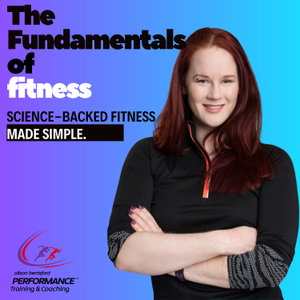
In this episode of The Fundamentals of Fitness, Alison Berrisford explores what stress really is, why your body doesn't distinguish between different types of stress, and why cortisol has been unfairly blamed by social media.
You'll discover:
- What stress actually is
- Why your body treats work stress and workout stress similarly
- The truth about cortisol
- What allostatic load means (in simple English!)
- How chronic stress affects recovery, sleep and performance
- Practical ways to build resilience without adding more to your to-do list
Featuring Science Simplified, Research Spotlight, Coach's Corner, From the Pit Wall, and This Week's Challenge, this episode will help you stop fighting your body and start working with it.
Because stress isn't the enemy.
Living under constant stress without recovery is.
THIS WEEK'S CHALLENGE
Every evening ask yourself two questions:
What filled my stress bucket today?
What helped empty it?
Awareness is the first step towards building resilience.
CONNECT WITH ALISON
For no-nonsense fitness, training, and mindset support, you can find me here:
Instagram: @abperformancetraining
TikTok: @abperformancetraining
Facebook: AB Performance Training & Coaching
Website: abperformance.training
DISCLAIMER
The information shared on The Fundamentals of Fitness podcast is for educational purposes only and should not be taken as medical advice. Always consult a qualified healthcare professional before making changes to your training, nutrition, or health routines.
References:
McEwen, B.S. (1998) ‘Protective and damaging effects of stress mediators’, New England Journal of Medicine, 338(3), pp. 171–179.
McEwen, B.S. and Stellar, E. (1993) ‘Stress and the individual: Mechanisms leading to disease’, Archives of Internal Medicine, 153(18), pp. 2093–2101.
Selye, H. (1950) ‘Stress and the General Adaptation Syndrome’, British Medical Journal, 1(4667), pp. 1383–1392.
Stubbs, B. et al. (2017) ‘An examination of the anxiolytic effects of exercise for people with anxiety and stress-related disorders: A meta-analysis’, Psychiatry Research, 249, pp. 102–108.
American College of Sports Medicine (2022) ACSM's Guidelines for Exercise Testing and Prescription. 11th edn. Philadelphia: Wolters Kluwer.