Dela
“What is difficult is the offering.”
—Astrologer Sarah Fontaine joins KP and Chelsea for a conversation that was supposed to be about the air element and became, instead, about conception, ego death, tormentors, and what it takes to let a life change you.
Quick note: parts of the video and audio are not fully operational but the episode as a whole is here, in tact <3
Be sure to subscribe here on Substack and follow — available on Apple Podcasts, Spotify, and wherever you get your podcasts.
Parts & Charts is a reader-supported publication. To receive new posts and support my work, consider becoming a free or paid subscriber.
Sarah Fontaine is an astrologer working from the shores of the Pacific in San Francisco. She learned astrology as a teenager in 1990s Louisiana, where and when it was decidedly not in fashion, and has made it her work for the past nine years — a through-line she describes as a way of contacting the fabric of the universe, even though she doesn’t claim to understand why.
Her readings open with a short guided meditation, move through the key themes of the birth chart and the current transits of the outer planets, and leave room for any question at all. There is no future prediction and, as she puts it on her site, no doom — the goal is the opposite of doom. She also reads for parents, caregivers, and couples, looking at the dynamics between charts rather than transits. Her spiritual ground is humility: each person is the singular expert on their own life. You don’t have to believe in astrology to get something from it; it’s a language, not a protocol.
Her working life has included farming, teaching, raft guiding, abolition and prison-justice legal aid, office managing, long Buddhist retreats, and always the writing. She uses the Placidus house system. Her newsletter is called Psychic Hearth — hearth = heart + earth.
www.existingtogether.com | sf@existingtogether.com
A note before the episode
KP opens with a confession: the recording fell apart. Chunks of audio are gone, most of the video is gone, and the seams are marked with what she’s calling a bounce — a few bars of the theme. Her theory is that the devices got overexcited. She also uses the occasion to say something to everyone who’s been asking how to start a podcast: she and Chelsea didn’t know what they were doing either, the setup is still unsophisticated, and the only thing that has kept it going for a year and a half is that it stayed fun. Book the guests you actually want to talk to. Please make a podcast.
And please be patient with the blown out audio — this might not be the episode to listen to on full blast with AirPods in <3
Episode Summary
The plan was the air element. Sarah had written a series of blog posts on elemental practice that KP found illuminating, and the three of them had emailed about it. Then, before the recording started, they began talking about spirit babies — and that’s where the hour went.
What follows is a conversation about the family as a system: how a chart can open spaciousness between people who live in the same house, and how quickly it can close possibility down if you let it decide who your child is. Sarah’s discipline is to not think she knows anything about her children because she has seen their charts. At its best, she says, astrology supports the celebration of how different everyone in a house actually is.
Chelsea offers the IFS-adjacent framing of tormentors — the people, often our children, who torment and mentor simultaneously, showing us precisely where we still have work. Sarah hears it as another way of saying the thing she keeps returning to: what is difficult is the offering. She traces it back through conception, pregnancy, and postpartum — a stretch she describes without euphemism as the underworld, six weeks of nausea that never lifted, an able-bodied person suddenly needing help every day, ego death a thousand times over. She is not nostalgic about it. She is grateful for it, which is a different thing.
From there: the cultural expectation that you emerge from all of this looking unchanged, and why KP has come to hear “bounce back” as a theft. The absence of ritual around the two-week wait. The paradox that accepting your own limits makes you a better parent, not a worse one, because your kid gets to see a person rather than a neutral surface. Chelsea asks the question she’s asking from the other side of the decision — how do you grieve the independence? — and Sarah answers it honestly, including the part where the fear came true, and then she lived through it, and then it was fine.
The astrology sharpens in the back half. Sarah’s Aquarius Moon and Capricorn rising, and the rigidity underneath Aquarius’s apparent openness: the conviction that a feeling only counts if it can be justified intellectually. KP’s read on Aquarian refusal as a positive act rather than a reflex. Sarah’s most exact aspect, Saturn square Venus — the kind of placement an older style of astrology would have handed someone as a sentence, and which she experiences instead as the site of the most pain and the most richness, but only if she engages it as that.
It closes on culture-making. Sarah is tired of the washing machine of critique — she names the pull of it, and that it’s an Instagram thing, and that she doesn’t want to stop there. Her ambitions have gotten smaller and more focused: the house, the four people in it, the crucible. She’s lighting candles with her kids before the school year because she doesn’t want to wait for the culture to catch up and hand her a form. And the humblest practices — drink some water, make yourself food, put your legs up the wall — turn out to be how you court the mystery.
Key Takeaways
* “What is difficult is the offering.” Sarah’s central frame, and the spine of the episode. Not that life should be hard, but that difficulty is built in, and the hard places are the ones that show you the next step. The caveat is essential: it only works if you engage it as that. Otherwise it’s just suffering you’re trying to get through, followed by avoiding the next one.
* A chart can open a house or close it. Sarah’s practice with her own family is to hold placements as spaciousness — a tree is a tree, Aries is Aries — rather than as knowledge about who someone is. Used well, it makes room for how radically different four people in one house actually are.
* Tormentors. Chelsea’s term for the people who torment and mentor at once. Children qualify most reliably, because they expose the exact places we haven’t finished learning.
* “What is mine to do” changes every year. Sarah’s codependence practice — from twelve-step work — is a daily recalibration. Newborn care is total surrender; what’s needed at three is different from four is different from seven. Overstepping, her own default, robs everyone in the family of joy and of the feeling of capacity.
* The bounce-back script is a missed teaching. The cultural ideal of coming through conception, pregnancy, and birth looking unchanged treats an ego death as an interruption. KP names the rage about it; Sarah names wanting to metabolize the rage rather than live in it.
* There is no ceremony for the two-week wait. One of the most vulnerable, life-reorganizing stretches a person goes through, and we spend it alone on our phones. Sarah is building in-person work — food, humming, transits, a container — for exactly these states. Not a retreat you leave your life for; a form for householders.
* Independence was a brief delusion. Sarah’s account of needing help every day, having been obliviously able-bodied her whole life, and coming out the other side unconvinced that independence is a real category. What exists is the ability to navigate the world in certain ways and mistake that for self-sufficiency.
* Children are fifth house, and so is everything else you make. Sarah on being a conduit rather than an author: she was pregnant, and then there was a baby, and she didn’t do anything. She reads it as a teaching about the creative process generally — which reframes the fear of losing making-time into something more interesting.
* Hard aspects as invitation, not verdict. Saturn square Venus is Sarah’s most exact aspect and would have been delivered as doom in an older idiom. Her experience: a lot of pain in relationships of all kinds, and also the richest material she has. The aspect keeps returning her to the subject until she learns it.
* Uncomfortable placements get resourceful. KP’s framing of the Aquarius Moon — a planet in an uncomfortable condition often has to find more resources, and over time that becomes the strength.
* Aquarian rigidity hides inside Aquarian openness. Sarah on the fixed edge of it: a conviction about how a thing should be, and a feeling that’s only permitted if it can be intellectually justified. Her kids keep breaking the conceptual boxes, including the ones about how to parent and where to go to school.
* Rebellion is still the thing it rebels against. Sarah’s current question: the fighting reproduces a certain kind of suffering, and the critique is compelling and easy to stay inside. So what’s the thing that isn’t either pole? Mostly, right now, it’s making the culture directly — candles, a ceremony before school, the humility of not waiting.
* Courting the mystery is unglamorous. Chelsea brings back advice from a channeling workshop; Sarah lands it on the most ordinary practices she gives people in readings. Drink some water. Make yourself food. Legs up the wall. The rituals say I’m here for it.
Key Quotes
“What is difficult is the offering. Everything else is too, but that one is the way towards more freedom.” — Sarah Fontaine
“It’s so important in this dance to not think I know anything about them because I look at their chart.” — Sarah Fontaine, on her children
“Your children are your tormentors — something that’s tormenting you, but also mentoring you.” — Chelsea Owens
“You wouldn’t want to be the same after grad school as you were before. So why would conception and raising a human being be you taking a vacation and going back?” — KP Kaszubowski
“My tendency is to overstep and do more than is needed. And that robs everybody in the family of joy and of the feeling of capacity.” — Sarah Fontaine
“There’s no such thing as independence. There’s such a thing as being able to navigate the world in certain ways and kind of think that that’s happening.” — Sarah Fontaine
“I was pregnant and then I had the baby, but I didn’t do anything... I was a conduit for that life. And I feel like that’s the creative process.” — Sarah Fontaine
“Those places that feel hard, they push us or they guide us or they invite us to that place over and over to really learn about it. But only if I engage with it as that.” — Sarah Fontaine, on Saturn square Venus
“Rebelling is just another side of following. They’re the same thing.” — Sarah Fontaine
“I don’t want to wait until the culture catches up to have something to offer me... We make the culture. So let’s make it.” — Sarah Fontaine
“I’ve lost the plot when I think that it’s a burden to go get food to cook for myself and my family.” — Sarah Fontaine
“What if I naturally was someone who needed to say no less?” — KP Kaszubowski
Resources & Links
* Sarah Fontaine / Existing Together — existingtogether.com. Astrology readings for individuals, parents and caregivers, and couples. Not on Instagram.
* Psychic Hearth — Sarah’s newsletter, and a phrase she uses in this episode for the practice itself. Sign up at existingtogether.com/psychic-hearth.
* Stephen Jenkinson, Die Wise: A Manifesto for Sanity and Soul — the book Sarah is currently obsessed with, on how a death-phobic culture leaves us untrained for dying. She reads it as equally true of birth.
* Rupert Spira — non-dual teacher, source of the line Sarah quotes: we are verbs more than nouns.
* Andrea Gibson, “Tincture”
* “Chop wood, carry water.” — the Zen instruction that got KP through a long stretch of unemployment, once she stopped trying to out-apply it.
About This Podcast
Parts & Charts is co-hosted by astrologer KP Kaszubowski and licensed therapist Chelsea Owens, exploring the intersection of astrology and Internal Family Systems.
For those applying to grad programs in counseling:
* Chelsea Owens pulled together a deeeeeep dive into all the practical elements of this decision, for the price of a cute cafe lunch ($25) — follow this link: https://chelseawow.gumroad.com/l/bfbiau
Chelsea’s Oracle deck, Outer Realms for Inner Archives :
a collage deck shaped by exactly this work, made the way she makes images of her own parts. Pre-orders coming; this email sign-up form gets you deck news only, no spam. → subscribe here
Meet your Moon.
If the Moon is the tender spot for everyone, this is the guided audio course for meeting yours as an inner figure — KP’s active-imagination approach, on your own time. ($42) → https://kpkaszu.gumroad.com/l/meetyourmoon
Work with Chelsea.
If you’re in California and you’ve been looking for a therapist who will actually go there with you — the deep stuff, the weird stuff, the stuff you’ve never quite found the words for — Chelsea Owens is your person. Licensed therapist, Leo moon, first house everything, art supplies on every surface. She brings clinical rigor and genuine delight to the work in equal measure, which turns out to be exactly what the hard stuff needs.
Work with KP.
Astrology readings (written, voice note, or live; in person if you’re in Wisconsin), Astro Parts sessions.
Book Doula — a monthly retainer for people serious about making the book real.
→ Book Doula Waitlist: forms.gle/3LwpmAinnBN2Q4aY8
Schedule a 1:1 session → https://app.acuityscheduling.com/schedule.php?owner=22372975
Thanks for reading Parts & Charts! This post is public so feel free to share it.
🌟 Credits
Music “Vape Juice Dave’s Bistro” composed by Scott Cary (Wild Western Avenue) for the feature film RINGOLEVIO (2020) directed by KP Kaszubowski — performed by Scott Cary, Max Wikoff, Else Albeck Gasparka, and Sarah Luther.
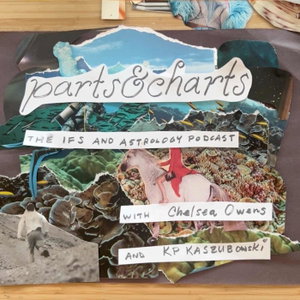
Collage cover art by Chelsea Owens.
Get full access to Parts & Charts at partsandcharts.substack.com/subscribe
Avsnitt sparat!
Du hittar sparade avsnitt på Mina sidor.
Kunde inte spara avsnitt
Något gick fel. Försök igen.