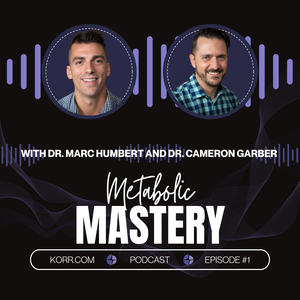
Is Zone 2 training the answer or should you spend your limited workout time doing high-intensity intervals? The research can make almost any popular workout sound like the best option, but that advice often overlooks the most important variable: the individual doing the training.
In this episode of Metabolic Mastery, Dr. Marc Humbert and Dr. Cameron Garber explain why effective exercise prescription begins with your goals, physiology, injury history, available time, recovery capacity, and current fitness. They break down how the body’s energy systems work together, why heart rate zone terminology creates confusion, and how social media can turn narrow research findings into sweeping recommendations.
You’ll also learn how frequency, duration, and intensity shape an effective training plan; why progressive overload must be balanced with recovery; and what low-intensity exercise uniquely contributes to aerobic capacity, mitochondrial function, and consistency. Marc and Cameron also discuss how metabolic testing with CardioCoach can provide individualized data for selecting the training methods most relevant to a person’s needs.
The goal is not to choose the winning exercise camp. It is to find the right combination—and the right dose—for the person in front of you.
What You Will Learn
Why there is no single best workout for every person or goal
How goals, time, recovery, and injury history influence exercise selection
Why the body’s energy systems behave more like dials than switches
What different heart rate zone models mean when they refer to “Zone 2”
How social media can overgeneralize narrowly focused exercise research
Why frequency and duration often matter before increasing intensity
How progressive overload drives adaptation—and when training becomes too much
What low-intensity exercise does for aerobic metabolism and mitochondrial function
Why moderate-intensity training may produce fewer new adaptations for some people
How metabolic testing can support a more personalized exercise prescription
Chapters
00:00 Is there a best workout? 02:23 Why popular workouts become universal recommendations 04:45 Building a personalized exercise prescription 07:00 Energy systems work together 09:28 How the body uses different fuels 11:55 Matching energy systems to your goals 14:18 Why “Zone 2” can mean different things 16:34 What HIIT research does—and does not—tell us 18:55 Frequency, duration, and intensity 21:19 How your training history changes your starting point 23:36 Looking beyond fitness advice on social media 26:02 Adapting exercise to individual limitations 30:43 Treating exercise like a precise prescription 32:59 Specific adaptation and progressive overload 35:08 Finding the right training dose 37:31 The benefits of low-intensity exercise 39:49 Volume, adaptation, and injury risk 42:08 Balancing training stimulus with recovery 44:34 The limitations of moderate-intensity training 46:59 Choosing intensity based on time and goals 49:23 Progressing from walking to higher intensity 51:49 Using individualized data to guide training 54:11 Stop choosing camps and start choosing the right dose
Podden och tillhörande omslagsbild på den här sidan tillhör
KORR Medical Technologies. Innehållet i podden är skapat av KORR Medical Technologies och inte av,
eller tillsammans med, Poddtoppen.