Dela
AfD’s Don’t poke the bear troll - final part of Chapter Three of Outflank Dugin
In 2024 Alice Weidel, co-leader of the AfD, at that point the second largest party in the Bundestag, gave a parliamentary speech. Germany’s continued military support for Ukraine, she said, was poking the bear. The bear, russia, had legitimate security interests in its near abroad. The West’s expansion of NATO since 1991 had been a provocation. Responsible German statecraft would consist of stepping back and acknowledging the bear’s domain.
“As ever, there’s multiple parts to this episode. Each is stand-alone - you don’t need to have tuned into the previous episodes of any of these series, to understand what I’m talking about. In case you do want to go back: Today, we’re completing chapter two of my monograph Outflank Dugin, Don’t Rebut (Episodes One, Two, and three of this series, an essential introduction to the ‘Outflank’ dimension of the Disinfolklore method are linked to here). Today is the second part of Principles of Infolklore series, episode four (the first part of episode four is here) - episodes One and Two of the Principles of Infolklore). And the second part of my comparison of Ukraine’s counter Disinformation system development experience with my experience developing Disinfolklore system, using the July 2026 Springer Press book as my spring board (the first part is here).
Recently I used the ‘Outflank’ method in another context:
Weidel’s speech is the third example in chapter two of Outflank Dugin, the book I started reading to you here about two months ago. This is the fourth episode of it, and the end of the chapter.
The line “don’t poke the bear” is the russian security apparatus’s signature. It is archetypal Disinfolklore. It is not Weidel’s coinage. It is not the AfD’s coinage. It is a line that has circulated in russian state-aligned Western European political discourse, in various translations, for at least two decades. It is the canonical Provocation Logic deployment at the geopolitical scale.
This is Part 5 of Outflank Dugin, Don’t Rebut. Continued from:
The outflanking response to Weidel’s speech was not to rebut her account of NATO expansion. The outflanking response was to name the deployment, as I have just done. Here is the “don’t poke the bear” signature. It surfaces in this speech. Its Mana, its energy, is immanent in this speech, in that report, in this podcast, in that op-ed. The signature is the same in every case. It is the russian security service apparatus’s. To repeat the signature is to deploy the apparatus’s vocabulary. Whether the speaker is a Ruscist state operative, openly, or a Bundestag party leader who lives in Switzerland, or a captured Nobel NGO like Amnesty, or a children’s-cartoon-demonology-writing fake philosopher in Moscow, is structurally beside the point. The deployment is the deployment.
This is what looking for the Mana in the meme means. Once we begin to look for the Mana in the meme, and we see such a deployment, we take it on the surface. On the level of what is immanent in the meme, in the lexical unit. It does not matter who is saying it. Your best friend, your mother, your father, or the leader of a political party in Germany. Once the signature is named, once the Mana is named, a reader has the equipment to recognise it again in different clothes, in a different costume. They do not need to rebut every fresh deployment. They register that the signature is present here. That is what we can do in our lives, to our friends and among our friends. Talk about what I have just talked about. Do not refute the nonsense about NATO expansion. Do not use folkloric tropes to demonstrate our approval of russia’s war of annihilation. Decline to amplify it in those terms. The deployment loses its purchase by being correctly named.
Mana-stripping the sorcerers
Outflanking operates, finally, at the level of vocabulary. This strand concerns what I call the russian security apparatus’s senior actors.
Dugin, in my book, is also referred to as Sorcerer Dugin. Saucerer Dugin. The actor philosopher. Putin’s Rasputin. The russian security apparatus’s primary philosopher. The captured philosopher. The wise-counsellor operator. The demonology writer. The demon-of-the-moon inventor. The anti-Semite. The children’s-cartoon defamer. The manufactured philosopher. None of these is an insult for the sake of it. Each is a calculated Mana-stripping. A removal of the gravitas vocabulary the russian security apparatus has built around this fake philosopher, and a substitution of working vocabulary that names what he actually does. He acts. He performs the role of a philosopher, of a wise-counsellor archetype, on behalf of the russian security service, in order to reach minds that would not be reached by other kinds of memes. His job is to justify the continuation of the war of annihilation against humanity. He does it with his long beard and his robes.
The same move applies to the other russian apparatus actors. Putler himself is the Chief Sorcerer. Duncey Putin. The Village Dunce. The failed emperor. The cosplay Tsar. Margarita Simonyan I call Maid Maryon Simonyan, the bridge-troll-in-chief of russia Today. The Wagner founder Prigozhin was, until his airplane apparently fell out of the sky in August 2023, the Chef Saucerer. That is sauce, as in what a chef cooks up. A play on his earlier career as Putin’s caterer. Another archetype which entered our minds. And notice how that folkloric trope, the idea of the cook, the chef, put everyone off understanding that he, in my view, was Putler’s chosen successor. He was about to succeed Putler when he had his disastrous experience in Bakhmut. But we all thought of him, and all the russia experts thought of him, as a mere chef.
That is how names, the symbolic energy in names, can disarm us or trick us. The word philosopher, applied to Dugin, is itself a piece of russian security apparatus marketing. Every time a Western journalist writes “the Russian philosopher Aleksandr Dugin”, they mint that idea. The journalist is performing a small piece of free marketing for the russian security apparatus. They do not understand what they are doing. What they are repeating is a hyper-normalised phrase which does not correspond to reality. This is a person who spends his time calling a beloved cartoon character, Cheburashka, a demon of the moon, with a fake Semitic, and anti-Semitic, etymology to boot. Whether they know it or not, the journalist is a ventriloquist for the russian security state. The vocabulary is part of the deployment. To use the working vocabulary, to call Dugin the children’s-cartoon defamer instead of the russian philosopher, is to refuse to perform the apparatus’s marketing. To call russia’s senior leader Duncey Putler is to deny him the gravitas the apparatus has constructed around him at enormous expense, in blood and treasure, over 25 years. The Mana-strip is small, repeated, deliberate and structurally important.
It is also old. The English language has been doing this to bullying authority figures since before there was an England. Old Boney was the English working-class moniker for Napoleon Bonaparte. Wee Georgie for King George IV. Stupid Don for an American president of the early 21st century in his second term. Ratko the Butcher for the Serbian general who organised the Srebrenica massacre. The Mana-strip is part of the English-speaking culture’s historical resistance to authoritarian self-mythologising. It is a tradition. I am drawing on it deliberately. You are invited to draw on it too. The next time you find yourself about to write “the Russian philosopher Aleksandr Dugin”, pause. Find more accurate vocabulary. Judge anyone who uses those terms accordingly. If you have a way into their mind, try to explain to them what they are doing and how they are doing it. After a few times, maybe they will understand. The apparatus’s senior fake philosopher. The children’s-cartoon demonologist. The wise-counsellor archetype operator. The fake-Orthodox sanctioned individual. Any of them is more accurate than philosopher. Any of them does the small, repeated Mana-strip work that the outflank, don’t rebut method calls for.
Outflank, don’t rebut. Five steps
The method, in its compact form, is three words. Outflank, don’t rebut. In practice it is five steps.
One. When a russian state apparatus deployment surfaces, or a MAGA apparatus deployment surfaces, do not rebut it. Do not amplify it by writing the counter-essay. Do not share the meme unadulterated. Do not transmit it by explaining while refuting.
Two. Name the deployment for what it is. Name its type. Provocation Logic. Accusation in a Mirror. What archetype is it? What archetypal identity is inside it? Look for its Mana. Try to understand what its energy is. Is it an alibi for stealth genocide? Necropolitical conqueror? Manufactured wound? Captured-philosopher demonology? Merciless sovereign? Merciful sovereign? Chapter three gives more vocabulary for the naming.
Three. Direct the attention of the people listening to you, or reading you, to the substrate. The underlying level the deployment is parasitising. That is for future weeks.
Four. Strip the deployer’s Mana. Refuse the russian security apparatus’s vocabulary about its own actors. Use working vocabulary instead. Mint your own terms for these ne’er-do-wells.
Five. Apply the Code of Positive Trolls, the six-perfection ethical instrument I introduce in chapter three, and apply it symmetrically. Generosity. Right. Is it right to kill so many people? Is it right to take land? Is it right to lie? Patience. Is it patient to overcome all of the planning regulations to knock down the East Wing? Is it patient to make it impossible for the first Black leader of the Smithsonian to keep their position? No, it is not patient. Mana. What is the energy in the meme? Focus. What is it focusing on? Insight. Is there any insight in what they are saying? Apply all of it to our own side’s deployments, and to our own writing. I expect everyone to hold me to that myself. The Code of Positive Trolls is the discipline that prevents the outflanking method from becoming an apparatus in its own right.
That is the method. Five steps. They cohere into one move. Outflank. Don’t rebut.
The resistance
A reader trained in the well-established Western intellectual disciplines of refutation may feel an uneasy resistance to “don’t rebut”. Surely, the resistance whispers, the obligation of the responsible writer is to refute falsehood. Surely the obligation of the responsible democrat is to argue with the deployer. Surely the obligation of the responsible scholar is to engage with the text on its own terms.
The resistance is correct in most cases. It is wrong in this specific case. The case is specific because the russian state security apparatus, and indeed MAGA, engineer their deployments to elicit refutation as their distribution mechanism. How many people saw Donald’s tweets the other day on their timeline because someone was expressing their disapproval of them? Engaging them as if they were arguments is doing what the engineering specifies. Outflanking them is the move the engineering did not anticipate. It breaks the apparatus’s distribution mechanism by refusing the mechanism its input.
You may have to do this with mistrust at first. That is fine. By the time we have read chapter three’s twelve-tool dissection, and watched the apparatus’s deployments fail uniformly against the six-perfection Code of Positive Trolls, you will know what you are doing. By the time we have read chapter four’s foundation defence and chapter seven’s decolonial counterweight, you and I will have the substrate work in hand. By chapter thirteen we will be doing the move ourselves, in our own writing and our own work, with practised hands. I know I am teaching Granny to suck eggs here, I think that is the idiomatic expression, because most of us on Volya already do this. For now, all I ask is that you accept the method on credit for one more chapter. Chapter three, next week, is the demonstration. The Cheburashka artefact, run through the twelve tools, collapses uniformly. So does the Mausoleum-Emperor. So does the Europe-projection. So does the Mariupol boat, where Dugin’s daughter declared that, well, we will get into that next week. By the end of that chapter you will have seen the method work on the four canonical artefacts of the apparatus’s mid-2020s deployment cycle. The method will no longer be on credit. It will be in our hands and in our minds, evidenced. Then we go to the substrate.
Part two. Where the canon stands
Back to the Principles of Infolklore, which I started a couple of weeks ago. Infolklore, as the canon states it, and I rather grandly call it the canon. Mana in the Meme, chapter 17. Folklore-like archetypes deployed in observance of the Code of Positive Trolls. The conscious, generative, Code-observant colonisation of the Rch. A first-order creative act, and not a shield. The difference from Disinfolklore is the direction of the energy.
Infolklore is the act of naming Right Mana. The verdict is reached by two acts of naming. Allocation to the true pole, is it Right or is it deception. And proofing the unit’s Mana against the Code of Positive Trolls at that pole. Right is measured against the post-1945 legal standard. When we talk about genocide, Jenny often quotes the Genocide Convention in the context of the news cycle. Will does likewise. Mockers introduced the duty to prevent genocide as a campaigning focus for their work on the Illumina stuff. Neutral is no movement. If there is no movement in a meme, no emotion-moving activity, no affective charge, that is fine. Once we know that, we move on.
Right, technically, is the post-war legal order in its totality and its minutiae. The UN Charter. The laws of war, the Geneva Conventions with their Additional Protocols, the Hague law, the Law of the Sea. The Genocide Convention. The human rights conventions, including the Universal Declaration and the two Covenants, with the inalienable human right that applies universally and that no one can take from us, the right to take part in public life and in decision-making, ICCPR Article 25. The regional conventions. The Rome Statute, which founded the International Criminal Court. And the jurisprudence of the ICJ, the ICC, the European Court of Human Rights, and indeed the European Court of Justice, which ruled today that Abramovich has no standing to dispute his exit from doing business in the EU. The engine’s Right rubric is built as a reference file with article-level entries. We can teach a computer to adjudicate whether the energy in a particular meme is Right against this set of laws and rules, which by now runs to tens of millions of words, all of which a computer can read and apply.
Energy, measurably. The affective charge of a unit, a lexical unit, a meme, whether it is visual or in language, is recorded on four axes. Valence. Arousal. The MAIM channel, which is how it moves our moods, our attitudes, our intentions and our motivations.
Moods and malaise
I have been thinking a lot about moods. I have a model for how information enters our mind and joins with our Mana. When we feel our moods, our attitudes, our intentions and our motivations altered by a particular piece of information, that is when the incoming troll radar can be triggered, and we can think about whether we want to let this into our inner mind.
Those of us who have studied the rise of the Nazis know the mood in Germany then. Peter Sloterdijk, the great German philosopher, writes about that malaise in Critique of Cynical Reason. It is in The Magic Mountain too, Thomas Mann’s great novel of the run-up to the war. Just this sense of malaise. Whenever I go to Germany it blows my mind what an amazing country it is, how everything works. And then to hear Germans in this mood of malaise. This artificial mood of malaise, which we know very well from America in the run-up to Donald’s election. This is the trick they play. They create the mood. The mood is made of millions and millions and millions of memes, broadcast directly into our minds. And it spreads from one of us to the next. If I am a bit depressed I pass it on to others, and they pass it on to others, and a negative vibe is created. Ming may remember it in the UK coming up to the referendum.
It is not Right, in the sense that it is not correct. It is not true. It is not a true reflection of where we are in our development as a species, in this amazing world where there is so much beauty, and so many ways of having amazing lives that were never available to any creatures before. And it is also a trick that has been played on us. Those of us who spend our days on X can become aware of how our moods, over the longue durée, are shifted by tweaks to the algorithm. Mood is the long-duration form of these affective charges, and it works on us individually and collectively, as a community, as a society, as a civilisation. The AfD. In Ireland, the same negative vibe. Reform in England, it’s all bad, it’s all negative. National Rally, it should be like this and immigrants are coming in. Donald himself, always promoting the negative. That, I believe, is the means they use to create the same malaise that helped the Nazis rise, and gave the Nazis something to heal.
I saw a lot of this in eastern Ukraine. Distress the damsel, then offer to assuage her pain. That is basically all russia ever does. It causes the misery, then it offers a solution to it. That is what authoritarians do. They create the violence, then they bring you to the hospital and pretend to heal you, and before you know it you are dependent on them.
So that is the canon as it stands, in its own words, and it is dense. Here it is in this space’s words, Volya’s words. Right is the law the world wrote down after 1945, read article by article and not by feeling. Energy is which way a story moves the person hearing it, toward that law or away from it, whatever the words say. Those two are what the whole of this reading turns on. And the book of the dead is the place in the Volya broadcasts where you can hear both at once.
The names
Back to where I stopped last time, with Victoria Amelina’s line, read on World Poetry Day, the 21st of March 2025.
“Still I want to not forget and I want to learn the names.”
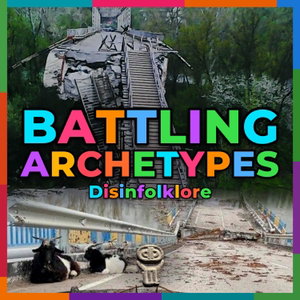
I wrote about Victoria Amelina on Substack in November 2023, and I gave the piece a kindergarten for a title. She had written about fairy tales, and about Stanytsia Luhanska, where, as many of you know, I spent three years of my life, from 2015 to 2018, standing on that bridge. That bridge is where I discovered the existence of Disinfolklore.
Here we are talking about Infolklore. It would not be necessary to talk about it if we were not so pickled by Disinfolklore. There would be no need to theorise how we create Infolklore if it were not for the Disinfolklore. Volya would not exist if there were no war, if there were no Disinfolklore. I am sorry we are in a world so surrounded by Disinfolklore that we need to understand a first-rate creative practice which has the power to anaesthetise the Disinfolklorists, immunise us against them, and promote another universe. Consciously, carefully, strategically. But that is where we are.
The opening act of the full-scale war, on the 17th of February 2022, was a shell through the wall of a kindergarten in Stanytsia Luhanska, five days before the tanks. I wrote at the time: “I knew that kindergarten well. It was called the Faery Tale kindergarten.” It was part of the soup of experiences and impressions of those years, 2015 to 2018, when I detected there was something folkloric about the whole situation. It took until a year into the full-scale invasion for me to come up with the portmanteau Disinfolklore. It has taken a further two years to come up with the portmanteau Infolklore. Lore which informs.
Victoria Amelina wrote of the shell hole in the fairy tale. The hole in that wall is where the fairy tale and the war first met, and she had seen it too. She went east to write the names down. The names are what she left us. She was the naming register’s own theorist, and she is in the ledger herself. Not only a writer, an emerging writer, but a writer of names, recording war crimes and first-hand testimony of what the war did to people. She was naming what had happened to them.
The fair grade for the names on Volya is this. Often, on our daily shows, from the first winter through to June this year. In the most recent month the morning shows carried ages, counts and condolences rather than names.
The number you never say
russia’s dead arrive every morning as a figure. Ming has been tracking this very insightfully, using his rate-of-increase metric to test the accuracy of the different counts. The figure is read on Volya, set against the day before, and everyone moves on. Ukraine’s dead arrive as names. The iconic image of the man on the bicycle that Will was talking about on today’s show. And Ukraine’s military dead, the soldiers, as a total, never arrive at all. Not once in two years does anyone on Volya give a number for how many Ukrainian soldiers have been killed. Not a rounded one. Not a guessed one. Not one read off somebody else’s estimate. Not once.
What is said instead is a ratio. This Week in Absurdistan, the 4th of April 2025, 41 minutes in.
“One Ukrainian killed or permanently disabled for every four to five of a Russian.”
Four months later, a different show and a different voice, reading a report off one part of the front and putting a video of it in the nest.
“So for every one Ukrainian soldier that was killed or injured, 66 Russians were also killed and injured.”
July 2025. Sixty-six to one. He said his jaw hit the floor. We all remember that. I think it refers to Pokrovsk, around that time. And he still did not say the number on the left of that ratio. Nobody does. Every time our own side’s losses are quantified on these shows, they are quantified as the bottom half of a fraction. This is the intuitive understanding of how moods are moved by these terrible numbers, and moved differently according to which side the numbers are from. I read 39 such sentences in the transcripts of Volya shows. All 39 are ratios. Zero are a figure.
The norm was said out loud once, by a listener, in the act of breaking it. The Boom Report, the 21st of May 2025, a man totting up what Putler owes. How many millions of people has Putler killed? That has been on my mind all week.
“Probably committed 100,000 dead, even though I know Ukraine doesn’t broadcast exact numbers.”
Even though I know Ukraine doesn’t broadcast exact numbers. He is not keeping a ledger. He is costing a debt. He knows, and he says, that the figure is not a thing any of us deal in. He says so and moves on.
Here is the part that makes it a choice and not a gap in the data. Both states withhold their own dead. russia does. Ukraine does. We fill the gap on one side and leave it open on the other. For russia’s dead we name our sources. The outlets that count obituaries. The volunteers who track the cemeteries. The database of names. Ming’s rate of increase. In 59 of the Volya passages I read, someone names one of those sources for russian losses. In one passage, somebody names one for Ukrainian losses. Fifty-nine to one. That is not an accident of what was available. The sources exist for both sides. We reach for them on one side only.
Why? Because the state we support has asked for it. OPSEC. We have honoured the ask. That is Right, plainly. Operational security is a rule, and the rule binds a friendly broadcaster as much as a friendly map-maker. And here is Energy, in the same act. The ratio is the only form in which our side’s losses can be spoken and still move a listener toward the fight rather than away from it. One to four. One to sixty-six. The shape does the work.
The ratio flatters. I will say that plainly too. It is sourced. It is corrected downward on air when it needs to be. And none of us, anywhere, in two years, has audited the asymmetry itself. That is an open edge. I leave it open.
The occupied city keeps the book the same way. RIA Melitopol, another great source, one of the few sources of Infolklore I found in all my millions of attempts to find one. The 23rd of February 2024, the eve of the second anniversary. Ukraine’s losses are five times lower than russia’s, the president tells Fox News. A ratio, and no figure. Six months earlier the same channel carried the other form of the same refusal. The National Security Secretary rejecting the Western press’s numbers as exaggerated and unreliable, and supplying no number of his own. Two communities, one Ukrainian in Melitopol and one English-speaking, which is us, that have never met. And one number that neither of them ever says.
One voice did give a count, at a scale a person can hold. A serving soldier on the Boom Report, the 17th of July 2025, describing his own unit.
“From my close circle of 20 people, four guys were killed in six months. Another five were wounded, some like me, and can no longer be soldiers after that.”
Then he said, so calculate for yourself what the turnover rate is. Twenty men. Four dead. Five wounded, one of them the man speaking. That is the whole account of Ukraine’s soldiers, given once in two years, by the only person with standing to give it, at the only scale where it does not become a statistic. The unit scale. The patrol group. The platoon. It is the one number that would cost us the most to hear.
Read as a series, not as a score
Now the number we do say every morning, because what we do to it after we have said it is the half of the practice you only see when you put the mornings side by side. Last time I gave you the aggregate read, with the reader’s own check on her appetite. This is the other half.
The figure is never left standing alone. It is set against the day before, the running total, the average, the record. Where a category is unusual, a cause is offered. I love that Mockers is so interested in special equipment. Every time I hear the term special equipment I think of Mockers. And the cause nearly always sits in russia’s own supply or conduct rather than in Ukraine’s prowess. This Week in Absurdistan then Booms & Woe, the 12th of December 2025, four hours and nineteen minutes in.
“Would you like to do some numbers, Jenny? Would that be a good idea?”
The slot is handed over, by name. The person receiving it does the same reading the person handing it would have done. Fourteen hundred personnel. Quite high. Back up there. Yesterday was around this too. The russians must be having a push somewhere. Number, series, cause. A different mouth, the same order. Booms & Woe, the 30th of March 2026, and the figure has gone the other way.
“We’ve only got 870 personnel today, which is not usual, but there you go. Four lovely tanks though. That’s a result.”
Only 870. Not usual. The delight goes straight to the machines. That is the line we hold about where the exclamation marks land, and I will come to what happens when it does not hold. Booms & Woe then Will & Ioana, the 12th of January 2026, the reader translating the whole tally into something a listener can walk.
“They will cover more than 12,000 kilometres, so the road from Kyiv to Moscow and back.”
Every vehicle russia has lost, end to end, is the road from Kyiv to Moscow and back. That is Insight, the sixth practice of the Code of Positive Trolls, done on a Monday with a calculator. We know more afterwards, and more accurately. The number was never the point. The reading was.
What the target did
Now the test I built the first hour around, in my previous talks, because the whole of the two years has something to say about how often it is run. I told you that we run the law on our own strikes, out loud, so that we could be hard on Ukraine if we ever had to be. That is true. Will said it on the last morning of the data set I have. How often? Out of nearly 600 mornings where a Ukrainian strike is enjoyed on our shows, the vocabulary of the law appears beside the cheer on six of them. On two of those there is an argument. The rest of the time, four mornings in five, what gets said is something else, and it is worth hearing what.
What gets said is what the target did for the war. Its type. Its output. The unit that used it. What it had been firing at. Snoopin & Poopin with the Boom Report, the 16th of October 2025, a substation in Belgorod.
“And the substation, just to note, is a 500 kilovolt high voltage node, part of the main network providing electricity transmission between regions.”
Then the reader worked out what a node is, and only then did the delight arrive.
“So that’s a substation that supplies electricity to other substations. Nice.”
Nice. One word of pleasure, and it comes after the function, not before it. Booms & Woe then Will & Ming, the 29th of June 2026, an oil farm near the front with thirteen tanks about to catch.
“What a lovely hit that is.”
And then, in the same breath, why it matters.
“So near the front, was known to supply not only Crimea, but also to supply kerosene.”
Kerosene to the aviation bases in Krasnodar, he went on. The ones that send the glide bombs. Will was doing the same thing on today’s show. Saratov refinery, I think it was, the 23rd largest refinery. Why does it matter? Because it sits opposite Engels air base. That is why Ukraine keeps hitting it, and that is why it helps us.
And when the enemy says the place was nothing, the job is argued against his denial. SBU Crime and Punishment with the Boom Report, the 3rd of July 2025.
“Said it was a disused ammunition dump, but it was protected with a Tor missile launcher.”
You do not guard a disused dump with a Tor. So it was not disused. The joke waited for that. That is the licence we actually state, morning after morning. It is military and it is factual. It is not, most mornings, legal.
The same is true in Melitopol, in the occupied city’s own channel, in more than half the strikes it celebrates. RIA Melitopol now operates as RIA Pivden, from Zaporizhzhia city, with exactly the spirit it had from the beginning of the war. I used its work when I was one of the main sources for the OSCE’s Moscow Mechanism report, the first report commissioned by 44 states, the first report from an international organisation on behalf of sovereign states on russia’s war crimes in Ukraine. It was published in early April 2022. A lot of my leads came from the minutiae of RIA Melitopol. That is how I discovered it, and why, when I was looking for a source of Infolklore, I decided to test it. RIA Melitopol, September 2023, a strike on the launchers that had been firing at Kharkiv. The place is licensed by what it had been doing to people. Same move, other language, other city.
So the floor is real. The conventions are named on Volya more than on any other station or media source I know. The promised ending is still a courtroom in The Hague. But the strike-by-strike legal audit is the exception, and the job description is the rule. It holds in both cities. Look for the legal argument in Melitopol and you find the same thing, a target with its job written beside it. The joke waits until the target has been given a job. I will continue that next week.
Part three. The story that would not die
I also wanted to go back to something I started a couple of weeks ago, because I think it is very important. The book recently published on counter-disinformation system development in Ukraine, from Springer, this year. And James is here. Amazing. We have a celebrity in our midst. I presume James is either planning how to win the next congressional election, or painting a wall, as he listens, and I want to ask for his intervention. It was James who brought this brilliant book to my attention. Counter Disinformation System Development in Ukraine. What I started doing last time was comparing counter-disinformation system development in Ukraine, as described by the book’s legally trained authors, with my own Disinfolklore system development over the same period.
The book’s best case study shows it better than anything I could have invented. The CCD, Ukraine’s Center for Countering Disinformation, tracked a conspiracy narrative they call clandestine transplantation. The claim is that Ukrainians are having their organs harvested and trafficked. I dealt with a lot of this in Kosovo. Not harvesting organs or trafficking them, I hasten to add, but the stories about that, which had allegedly gone on. There is a family resemblance. The same tropes rising up again. The authors and the CCD traced it from falsified testimonies in Donbas, to attacks on healthcare reform during the tenure of Ulana Suprun, who led Ukraine’s health ministry through its reform, to fabrications after 2022 accusing Red Cross personnel of organ trafficking. RT, russia’s state international broadcaster, made a documentary of it called Tanks for Kidneys. Nice.
Their finding. “Its persistence is a reminder that certain myths are too emotionally charged ever to die out and can be reactivated in times of crisis.” And the operational conclusion they drew in the same passage. “In addressing this case, the CCD highlighted a crucial insight: some disinformation cannot be entirely removed and must instead be managed and inoculated against, so that any recurrence encounters an audience already sceptical.” That is exactly right. It is the best thinking in the book.
Now. The organ theft story is not new. It is not Ukrainian and it is not russian. It is one of the most heavily documented contemporary legends we have. Folklorists have been cataloguing it since the 1980s, when it ran through Latin America as a rumour about stolen babies, and through the 1990s, when it became the kidney heist tale that half of us heard at school and half of us repeated. It has a known shape. It has known triggers. It has a known reactivation condition, and that condition is crisis. So the CCD established empirically, from scratch, during the full-scale invasion, at wartime analytical cost, something a very different discipline had written down forty years earlier.
Nobody in that building was lazy. They did outstanding forensic work. They mapped the network, followed the content across languages, and named the operator. But they were not looking for archetypes, or for archetypal Disinfolklore. What I am describing is a missing shelf in the library, and not a failure of the people whose brilliant work this great book documents.
The count
The book runs to about 82,000 words. The word narrative appears about 190 times. Many of you will remember that narrative is a word I try to avoid. It was common parlance when I was a postgraduate studying postmodernism at Georgetown in the mid-nineties. To see it taken up by the anti-vaxxers, and by everyone basically, is a source of great joy to me, and it means I am not going to use the word any more. It used to be the word of the intellectual elite, and it spread from them into the mouths of conspiracy theorists. And it does not tell us very much about what I mean when I talk about Mana in memes, about lexical units, about energy and the particular kinds of energy a meme carries. The authors are deeply engaged with stories as the unit of the problem. Stories as the unit. Not the lexical units those stories are made of, or the forms of those stories.
The word folklore appears zero times. Archetype, zero. Meme, zero. Ethnography, anthropology, and Wendy, you will be surprised to know, mythology, philology, motif, fairy, legend and ritual, zero each. Remember, the authors, and the people behind the CCD, are lawyers, like me. Myth appears eleven times, and in ten of them it means a falsehood that needs busting. Exactly once does it carry the sense a folklorist means, and that once is the sentence about the organ story that would not die.
Eighty-two thousand words about the stories russia tells Ukraine, and no folklore in it. That is a discipline boundary, not a scandal. These are lawyers, historians, security researchers and communications professionals. They do not have time to read folklore, or to work out what Disinfolklore is. They wrote a superb book inside their own field. The instrument for the layer underneath belongs to another field. My field. Somebody has to carry it across the bridge.
The third question
A lie has to be believed before it can do any damage. What makes a lie believable is not its evidence. It is its familiarity. A story shaped like one you learnt when you were four walks straight past your mental defences, straight past your non-existent incoming troll radar. By the time you start evaluating it, your emotions have already voted.
Disinfolklore is my name for that. Folklore-like information told with meanness. Stories built to bend our moods, our motivations, our intentions and our attitudes until they serve somebody else’s plan. Its opposite is Infolklore, and I will come back to it, because Ukraine makes the best Infolklore in the world, as does Volya, and Ukraine does not yet know it is a strategic asset.
russian information operations are folkloric nearly all of the time, and the tell never changes. There is an Inner Realm, warm and ours. There is an Outer Realm, out there, full of Nazis, people who break taboos. And the Outer Realm is coming for three things. Your bread, which is your prosperity. Your body, which is your safety. And your children, which is your future. The three come from Georges Dumézil, the great Indo-Europeanist, who understood that these three aspects of the Indo-European mind are immanent in the governance systems and the myths of every living Indo-European tradition. Hold the organ story up against them. Organs are the body. Trafficked children are the future. The UkrLeaks network the CCD exposed in 2024, and attributed to a sanctioned russian figure called Vasyl Prozorov, ran organ trafficking and child trafficking together. That is not creativity and it is not coincidence. It is repertoire. And a repertoire is finite, which means it can be catalogued.
The bridge item
Now the piece of it that no fact-checker can reach. On the 24th of May 2016 the occupiers’ own outlet, lug-info, published this. I collected it. I have the item, with its web address, in my Luhansk Well corpus.
“An elderly man died while standing in a queue artificially created by Ukrainian custom service at Stanytsia Luhanska crossing point, said People’s Militia representative Major Andrei Marochko.”
I do not know whether that man died. Take it that he did. RIP. Now every fact in the item checks out, and there is nothing left for a fact-checker to do. And look at who is speaking. The People’s Militia. The armed men holding the far end of my bridge. The men whose war made the queue. Stepping forward as the grieving advocate of the people standing in it. Distress the maiden, then save her. The troll under the bridge put on a Red Cross armband and wept for the goats.
You cannot fact-check that. It is the shape that is doing the work.
The twelve tools
I have spent ten years building the instrument that reads that layer. Twelve tools. The first five read what comes at us. Tools six to eleven are the Code of Positive Trolls, which decides the verdict. The twelfth is newer.
Tool one is Archetypal Literacy. Learning the old shapes so you recognise one on sight.
Tool two is the Troll Radars, incoming and outgoing. What you let into your mind, and what you put into other people’s. Both, because this is a two-way illness, and people who study it long enough are at risk of becoming carriers.
Tool three is Look for the Mana in the Meme. Mana is the charge a story carries between people. Every artefact carries two payloads, the information and the charge, and the charge is the one that does the damage. Ask what a story is doing to you before you ask what it says.
Tool four is the Inner Realm and Outer Realm matrix. The bread, the body, the child.
Tool five is Trigger, Experience, Reaction. It comes out of a collaboration in 2003 between the Dalai Lama and Paul Ekman, the late, great American psychologist who pioneered the study of facial expressions and emotion. Between the experience and the reaction there is a gap. In that gap is our freedom. Disinfolklore is engineered to close that gap to nothing, to hack our emotions before system two can kick in and work out what is actually going on. Or system one. I always mix those up.
Tools six to eleven are the Code of Positive Trolls. Six ancient practices, the six perfections, carried onto the information battlefield, by me, for the first time.
Six is Generosity. Does the utterance make room for the other person, or does it only take?
Seven is Right, and this is the one people mishear. Not, is the claim true. Is the conduct lawful, measured against a standard somebody else published and everyone can read. The UN Charter. The Universal Declaration of Human Rights. The Helsinki Final Act. The Budapest Memorandum. That is why the bridge item fails. Every fact in it is true, and the conduct behind it breaches the Geneva Conventions, which require an occupier to let the people under occupation leave unmolested.
Eight is Patience. Is this thing manufacturing urgency, and what is the urgency hiding? Donald, why must you plant those trees in place of the ancient ones, 47 of them, so suddenly? Why must you build this appalling arch? Why must you install the monarchical archetype, in architectural form, on the ceremonial axis of our Republic, in sight and hearing of Arlington Cemetery? So that the families of the soldiers your unlawful war in Iran is killing, as they mourn, as they watch their sons and daughters buried at Arlington, must listen to the incessant thunder of the contractors building your arch. This McDonald’s arch.
Nine is Mana, Energy and Implicit Archetypes. The perfection underneath it is joyous perseverance. What archetypes is the charge carrying, underneath the one on the surface? The Mother and the Maiden, for instance.
Ten is Focus. Does this concentrate our attention or scatter it? Should I let it into my mind at all?
Eleven is Insight. Does this deepen understanding, or flatten reality into a fairy tale, a piece of Disinfolklore?
The test takes all six at once. Fail one, and the item falls to Disinfolklore, whole. There is no partial credit. If it passes, it is Infolklore.
Tool twelve is Cryptotypic Literacy, which reads the sound-and-meaning code underneath the words, below the level any writer is choosing. That one is a longer conversation, for another evening.
Outflank Dugin, Don’t Rebut (first episode):
Second episode: Outflank Dugin, Don’t Rebut:
Get full access to Disinfolklore at www.disinfolklore.net/subscribe
Avsnitt sparat!
Du hittar sparade avsnitt på Mina sidor.
Kunde inte spara avsnitt
Något gick fel. Försök igen.