Dela
Principles of Infolklore (Ep 6)
Let’s go back to the principles of Infolklore.
Some of you will remember how I am deducing The principles of Infolklore.
Previous episodes:
Ep 1 - Aug 20
Ep 2 - Aug 27
Ep 3 - 3 Sept
Ep 4 - 10 Sept
Ep 5 - 17 Sept
I use a combination of my own written work, what scholars would call a vocabulary. I use that as a lens to look at the transcripts of Volya Radio, of RIA Melitopol and of RIA Pivden. I had noticed that they are particularly interesting artefacts. They appear to practise what I call the Code of Positive Trolls. I have theorised it since February 2020.
I am using a neural network algorithm, a frontier model, in a kind of recursive loop, which I think is the technical term. It goes through the archive again and again and again. We start with some principles in mind and look for them in the words spoken on Volya Radio. Then we find out whether they are general principles of Infolklore that turn up elsewhere in the text. Then, with those in mind, we go back through the whole data set again, and again.
So every week I speak to you, new and interesting aspects of the data set are emerging. So are new understandings, on my part, of what constitutes Infolklore.
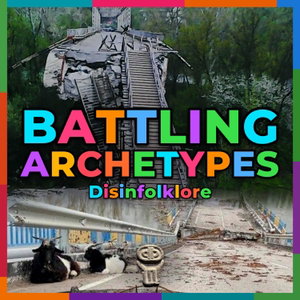
Many of you know I have been writing about Disinfolklore for three to four years. I was writing about it without that moniker for almost a decade. That began when I was posted to eastern Ukraine, at the end of January and early February 2015. I spent that time, as I am always banging on about, in russia-occupied Luhansk and on that bridge.
What the Law Is For
I want to continue where I left off, under the heading of what the law is for.
Ukrainian Arts and Culture, the 15th of June 2025. Some of us might remember that show. Two guests, Tatiana and Alexey, and a host asking them about a grandmother’s house. The talk is of rushnyky, the embroidered towels.
“Ukrainian embroidered Rusniki”
Given at weddings, the guest says. They symbolise prosperity.
“And they hang them around the icons.”
Then the old house at grandma’s.
“and it’s made out of clay, the walls out of clay,”
Flowers painted on the walls, as a charm.
I remember well visiting Petrykivka, about fifty kilometres from Dnipro. That form of flower painting is protected by UNESCO. Some russian nesting dolls adopt it as if it were russian. In fact it is Ukrainian. Perhaps all of us remember that amazing painted house in Kherson region, flooded and destroyed when the russians blew the dam.
So, flowers painted on the walls as a charm. It was never winter there, one of them says. It was always spring. And the wind in the grass.
“and the grass, shepochka, whispered.”
“how can you not be a poet when you hear the grass whispering?”
And then, without any change of tone, the year of the independence vote. Alexey was a student, he remembered, going door to door.
“and giving the pamphlets or leaflets”
“for like going to vote for independence”
He knocked on the door where Tatiana lived, and nobody opened. He went further down the street. Then he came back and knocked again.
“I was persistent.”
That is what he told Ukrainian Arts and Culture, on Volya, on the 15th of June 2025.
They met leafleting for independence.
Nothing in that whole hour looks like law, or like Right as the post-World War II legal order defines it. No European human rights convention is named. No crime is charged against the Ruschists. Nothing is argued. It is a lawful hour from end to end. A lawless hour, you might say.
And yet it is a morally lawful and pleasant hour, from end to end.
The right to take part in the cultural life of your own community is in the Covenant of 1966, in article fifteen. The right of a people to determine its own future is the first article of both Covenants: the International Covenant on Civil and Political Rights and its twin.
A clay house. Icons under embroidered towels. A boy with leaflets who would not go away.
That is not the law being honoured in the way Will or Mockers honour it when they speak about the law of the sea. That is the thing the law exists to protect. Said out loud on a Sunday, with no enemy in the sentence.
The swans
The war is in the hour all the same. Tatiana’s brother is at the front as they talk.
The painted walls took Mockers straight to another house, in Oleshky. The artist Polina Raiko painted her whole house. It was partly destroyed.
Near the war, flowers painted on a clay wall take on a beauty that the same flowers far from it do not have to that extent.
At the time, I posted pictures of Polina’s house, showing the swans on its walls. I also posted the photos of the swans going by the town hall after the russians blew the dam. The fake governor of the day was speaking to camera, saying everything is fine, as the swans went by.
Apollo flew on swans to the Azov Sea in Greek myth. Back, as the Greeks did not know then, to where the Greeks came from. A thousand years before the Greek language was formed, out of a daughter language, from Ukraine.
Right, over the longue durée
And so, Right. Right is the second of the elements in the Code of Positive Trolls. The Code of Positive Trolls is the mental algorithm I use to help me discern Disinfolklore, Infolklore and neutral Mana, neutral energy, in memes. The second element is Ethical Discipline.
Right often means the post-World War II legal order. But Right is not only the honouring or the breach of the law of war. A story that carries the thing the whole order was written to keep safe supports that order.
In this hour, that thing is a clay house. The boy with the leaflets was asking a people to choose its own future. A house like that is only safe in a country free to make that choice.
Over the longue durée, the vote and the front are one act of independence, decades apart. The story moves the listener towards the law without ever naming it.
Where no law is invoked, we judge a story by the whole Code of Positive Trolls. It is a moral judgement. That is the deepest sense the word Right carries. Deeper than the article in the Covenant. Right, in the end, is whether a thing passes the whole Code of Positive Trolls.
The Energy in this one moves towards what is Right. Not away from it. Towards it.
One book counts. One book remembers. And the book that says why either of them is worth keeping is a grandmother’s house, with flowers painted on the clay.
The grass whispered. And he knocked on the door, and he was persistent.
I Won’t Say Winning
Good Morning Kyiv, the 14th of September 2025, an hour and thirty-five minutes in. A host is running through what the autumn holds for russia, and it is good. Then he reaches for the obvious word and stops.
“I won’t say winning.”
He says it once more, longer, with the reason and a replacement in the same breath.
“I’m not going to say winning until we’re won, until the full territories would be taken back, but on the ascendancy, you’d have to say, wouldn’t you?”
That was Good Morning Kyiv, on the 14th of September 2025.
And the co-host takes the replacement without a pause. Yeah, absolutely. On the ascendancy. Not winning.
That is the whole practice of Infolklore on Volya, in real time, in ten seconds.
Here is the claim in one sentence. The discipline we can hear best on this station, on Volya Radio, runs on our own first choice of word, spoken aloud, cancelled, and replaced in the same breath. And it runs one way. The refusal falls on Ukraine’s winning and never on russia’s losing.
Two sorts of folk-shaped story travel this war. One is told to work on you, for somebody who will not give his name. The other, the kind I call Infolklore, is told in the open by people who give their own time and energy to defending the law the world wrote down after 1945. What they tell has to pass every practice of the Code of Positive Trolls.
This hour is about how they choose their words.
The Word Cancelled
Nine months after that morning, a different show and a different voice, and the same word goes back in the box. Booms & Woe then Ming and Will, the 8th of June 2026.
“I’m not going to say winning. I’m going to say Ukraine is on the ascendancy in a number of areas. Russia is clearly losing.”
There it is, both halves in one mouth. Ukraine is not winning. russia is clearly losing. He does not hedge the second.
The refusal to say winning turns up six times, on five separate mornings, across fifteen months, in at least three different voices. The refusal to say losing turns up nought times.
A rule that only runs one way is not a tic. When a word is taken back, the doubt goes against our own side’s success. Never against the enemy’s collapse.
The cancellation is not always about modesty. Often it is about precision. Sometimes the precision runs against russia in a way that costs a good line.
Booms & Woe then Will & Ioana, the 6th of April 2026, on the Ruschist economy.
“I won’t say small business failings.”
“But they’re not failings. Those businesses are just going underground to the black market.”
The russian press was saying failings. Failings would have been a lovely word to read out on a show that enjoys russia’s woes. He put it down, because the shops had not failed. They had gone under the counter. That is a smaller and truer thing.
Sometimes there is no side to it at all. Good Morning Kyiv, the 21st of March 2026, a host on how Ukraine is using a particular missile.
“I won’t call it air defense because they’re essentially using it like you would use close air support.”
The first word was wrong for the job the thing was doing. I won’t call it air defence. So it went. That is all. The habit fires on any word. That is what tells me it is a habit.
And once, the cancellation ran the other way, upwards, towards the grander word. The person doing it said so. This Week in Absurdistan then Booms & Woe, the 12th of December 2025, a host reading a summary of somebody else’s analysis.
“I wouldn’t call it suffering and dying. I would call it fighting off Russia. I’d make that sound a little bit more valiant than it is, but I take his point.”
I’d make that sound a little more valiant than it is. He heard himself promoting the word and told you he was doing it.
So the practice is not a rule that words may only go down. It is a rule that a word may not change without the change being spoken. Every one of these is the speaker’s own first choice, not the enemy’s. Refusing the enemy’s words is the easier half. The harder half is refusing one’s own.
Punitive and reparations
The finest one is about reparations. The Week in Absurdistan and Booms and Woes, the 18th of July 2025. A host has just said russia must pay. Then he draws a line through the next word before it arrives.
“I’m never going to say that Russia needs to pay a punitive penalty for starting the war. I’m not going to say that because that is the thing that leads people to grudging, you know, that you’re just taking it out on us because we’re Russian.”
“You’re simply going to pay reparations for all the reasonable damages you’ve caused”
Punitive is cancelled. Reparations is installed. The reason he gives is a reason about the russians: a punishment breeds a grudge, and a bill does not.
That is Generosity, the first practice of the Code of Positive Trolls, the first element. It arrives disguised as a word choice on a Friday. He gave the enemy the more exact word. The more exact word was also the kinder one.
Winning is refused. Losing never is.
The Arrest Is the News
Now the hardest test any friendly broadcaster ever faces. A scandal on the side you are broadcasting for. Here is how Volya passed it, in November 2025, the month the corruption case reached the president’s own circle.
This Week in Absurdistan then Booms & Woe, the 28th of November, three hours and thirty-nine minutes in. The news had just broken that morning.
“Well NABU and SAP are currently searching all the presidential offices in the government district on the morning of the 28th of November.”
NABU, as we know, is Ukraine’s anti-corruption bureau. SAP is its anti-corruption prosecutor. They were searching the president’s own offices. What came next was not a defence.
“And I’m just gonna say respect, because if there is somebody in there that is doing something they shouldn’t, then they need to go.”
Respect. For the raid.
Two weeks earlier, when the case was new, the same show had read the president’s response as the news. Two ministers gone. Sanctions on two of his own friends. In that order.
“President Zelensky immediately dismissed the two ministers implicated in the scandal, the Minister of justice and the minister of energy and impose personal sanctions on two of his own long-time associates, Mindich and Zuckerman,”
Two M-N-s there, I add myself.
Five days after that, on a different show, a host named where the enforcement had failed, in the same breath as praising it. Accidental Ukrainian, the 18th of November.
“And somehow he managed to get a heads up and got out of the country before he was arrested.”
There have been some pulled punches, he said. The man got a tip and left. He said it on air, on a show for Ukraine, in the week that mattered most.
In two years on this station, the wrongdoing in a Ukrainian case is never denied. Not once. Not by anyone. Not in the week the case reached the president’s own comedy troupe. The body that caught it is named. The stage of the case is given. The arrest is the news. Nobody argues.
The occupied city keeps the same book
RIA Melitopol is Melitopol’s own Ukrainian newsroom. It publishes in russian and Ukrainian from exile, in Zaporizhzhia city. Here it is on the former head of the president’s office, this May.
The appeals chamber of the anti-corruption court considered the complaint of the former head of the Office of the President.
No epithet. No timing. No framing.
The city has russian soldiers in its streets. Its newsroom reports the prosecution of the second most powerful man in the country the city is waiting to rejoin. Flat, as a court report.
The people of that city are scattered across all of Europe and all of Ukraine. Many were forcibly transferred to the Ruschist Federation. That includes children I would have given presentations to in Melitopol. The people of that city are told through their own media organ, RIA Melitopol, now renamed RIA Pivden. Support them if you can.
The people of that city are told, in one plain sentence, that the law reaches the president’s own office.
It is one of the practices that turns up in both places, on Volya and in RIA Melitopol. It is the one with the clearest opposite in the enemy’s own channels.
The russians were so scared of RIA Melitopol that, at the beginning of the occupation, they kidnapped the owner, the amazing editor’s father, to hold him to ransom. Eventually they managed to get him released. Then they spent two years trying to capture the outlet. One day they did capture it, briefly, for a few hours.
What the Ruschists published that day is what I call the counterfeit of that same outlet. It carried six corruption stories in fifteen hundred posts, and audited its own side in none of them.
The defect
The practice has a defect, and it shows twice, in two different ways.
“No, they’re kicking out the corrupt people,” someone said in January 2026. “They’re publicizing it, so they’re not corrupt”.
Is Ukraine corrupt? No, because they arrest the corrupt. That is the enforcement offered as an acquittal. It does not always, necessarily, follow.
When this station names Ukraine’s own anti-corruption bodies, more than one time in four it reaches for that move. The co-host answers in the next breath. Well, obviously, they’re doing their due process and investigations. The co-host does not take the inference. The co-host goes back to the procedure. The person sitting beside the speaker catches it.
None of this was new in November. The first winter had it already, on SBU Crime and Punishment, the 22nd of January 2025. A host was reading that Ukrainian companies had been caught in russia’s supply chain.
“what I think is fantastic is that they’re so transparent about this and they publicize this and this is what we should be doing in our countries”
This is what we should be doing in our countries. The transparency is admired as the thing, and turned on the speaker’s own government in the same sentence.
Ethical Discipline, the second practice of the Code of Positive Trolls, is turning away from harming others and from the sources of such harm. It is easy to perform on the enemy. This is it performed on the friend. The friend was not spared.
In the worst week, nobody looked away.
The Record, Audited
A threat is a claim about the future. On Volya we treat it like any other claim. We check the record. This one matters, because the enemy’s whole method of frightening us depends on nobody checking.
This Week in Absurdistan with the Boom Report, the 22nd of November 2024. The first winter of Volya. The week Western missiles were first fired into russia.
“Increasingly, we find that these red lines of Putler’s only exist in the minds of Western politicians.”
Then the host did something I have never heard a newsreader do. He went through the red lines one by one, each with its date and what happened after it.
“Bit late for that one. If Ukraine strikes an oil refinery in Russia, I’m just going to say the amount of them we’ve seen on fire, I feel that red line’s been dusted.”
Dusted. Each threat is laid beside the thing that was supposed to follow it and did not. That is the catalogue. The catalogue is what takes the fear out of the next threat.
Twenty months later, on Booms & Woe, the 27th of July 2026, a host reads a Ukrainian commentator doing the same audit. The list is longer.
“Four years of this sentence we have heard and it is time to audit it.”
“They said this about Stingers, about HIMARS, about tanks.”
HIMARS are the American rocket launchers. Then the F-16s. Then the long-range missiles. Then strikes inside russia.
“And every single time the weapons arrived to us late, but the red line evaporated. The promised apocalypse failed to attend.”
The promised apocalypse failed to attend. That sentence is worth the whole catalogue.
It is not a thing we say every time. About one time in three, when the enemy declares a line, somebody here walks the record. The rest of the time, the threat is simply shrugged at. I count the shrug as a smaller version of the same thing. It may just be a shrug.
The other half of that practice is what we do not do. We do not give dates. In the passages where somebody here makes a prediction they own, a date or a horizon is attached one time in seven. The enemy’s future is audited against his record. Ours is left undated.
One kind of Patience, the third practice of the Code of Positive Trolls, is disregarding harm done to you. Both halves of this are patience. The threat is not allowed to hurry us. The hope is not allowed to set a clock.
That is not a rule against urgency. When lives are on the clock, saying so is not impatience.
We keep the enemy’s promises on file, and our own predictions in pencil.
Tired, and Not Giving Up
Now a charge that could be brought against us, and the answer the whole two years gives it.
The charge is that this community idealises Ukrainians. That every time somebody here says what Ukrainians are like, the answer is warm and flat and total. Read a week of these shows and you might believe it. Read the whole two years and it is not so.
SBU’s Gurza and News with Tracey, the first winter of Volya. A host is closing an appeal.
“Ukrainians are tired, we’re tired, but Ukraine is not going to give up and neither are we.”
Tired first. Then not giving up. In that order, every time. Here is the shape again, a year later, on Accidental Ukrainian.
“if you speak to Ukrainians, of course they’re tired. It’s discouraging sometimes, but they don’t wallow in self-pity.”
And again in Lviv, this May, a host speaking from the country itself.
“Ukrainians are tired. Ukrainians really want this over. They want to be able to have their own country back.”
Tired, in forty-one different broadcasts. Fed up or angry, in nearly fifty passages. The draft-dodging and the recruitment officers, in more than fifty.
When somebody here describes Ukrainians as a people, about four descriptions in five are warm. One in five admits the fatigue, or the anger, or the bluntness. The one in five has a shape. The fatigue is named, and the resolve is put back beside it in the same sentence. Nobody pretends. Nobody leaves the pretence standing either.
Why has the country not folded? Good Morning Kyiv, the 8th of February 2026, a host on that question.
“it’s not that Ukrainians are superhuman. It’s just that they’re free people.”
Not superhuman. Free. That is the whole answer in one line. The community made it itself, unprompted.
The practice this belongs to is Insight, the sixth practice of the Code of Positive Trolls. Idealising a friend is not a failure of kindness. It is a failure to see. A friend who is tired and keeps going is more worth supporting than a friend who is never tired. We know which one we have.
Tired. Not giving up. In that order.
Counter Disinformation System Development (Ep 3)
So that is today’s bit on the Volya Infolklore. Now I am going back to the second series I have been doing, which I have neglected for the past couple of weeks.
Previous episodes:
Ep 1 - 27 Aug 2026
Ep 2 - 10 Sept
I was spurred on to return to it today because it is important, and I think the analysis is quite interesting. But also because, finally, after, what is it, eleven years of not acknowledging the foreign influence on the most catastrophic decision ever made in modern Britain, today the government announced the establishment of a counter-disinformation agency.
You might remember that I started this series about a month ago. James had tweeted about a book published by Springer, which publishes Nature and a heap of really important scientific journals. The book is called Counter Disinformation System Development in Ukraine.
I see it as similar. In my own modest way I am developing a counter-disinformation system too. It is the Disinfolklore analytical method, and Infolklore sits inside it. I built it because of my time in Ukraine. Now the British government is establishing a similar agency, and I expect they will draw on Ukraine’s experience to do it.
I have done two episodes on it so far.
FIMI and DIMI
The book itself uses a term I started using about two years ago, DIMI. The authors of the Springer monograph talk about FIMI.
FIMI has the word foreign built into its definition. Some of you might remember a piece I did on it about three months ago.
I post these podcasts on Disinfolklore.net. My main website is Disinfolklore.eu, where I also blog. On DecodingTrolls.net I posted quite an important podcast a couple of days ago. And on PowerofMana.net I do the Finding Manuland Atlas series. You can subscribe to my work there.
The piece was on FIMI, the European Union’s term for what we call disinformation: foreign information manipulation and interference. It has the word foreign built into its definition. Given that the European Union established it, the reason is pretty clear. The European Union has no mandate to deal with internal information warfare. So I talk about DIMI and FIMI either in the context of the nation state, or in the context of particular regional groups and intergovernmental organisations.
FIMI has the word foreign built into its definition. If the manipulation comes from outside, it counts. I wrote about the problem before this book existed:
“Alas, Russia is brilliant at disguising the origin of its Disinfolklore, it gets knowing and unknowing domestic agents to parrot its nonsense, so it’s only by characterising the qualities immanent in the linguistic or visual or mental memes being so propagated and not their domestic or foreign origins that we can truly determine what is bad FIMI or (what I call) DIMI, where the ‘D’ stands for Domestic.”
Some of you might remember that I talk about the Mana in the meme. The system I am trying to build, for a neural network to run automatically, replicates what I try to do. It just looks for the energy in the particular meme.
It doesn’t matter who is sharing it, or why they are sharing it. It is learning to identify what the meme consists of. Its energy, its power, its charge. Then we can begin to stop worrying about sources.
Nation states and the European Union, for good constitutional reasons, have to be very careful not to interfere in their own constituent elements, in national policies. So they spend an inordinate amount of time trying to demonstrate and prove the source of particular trolls or memes.
We, on the other hand, are private citizens operating in this area. We practise our anti-disinformation work as Shiba Inu dogs, as part of Volya, or just as individuals on X, Substack, Bluesky or Mastodon. We can take a view on particular memes.
Most of us were pretty clear when we saw Francesca Albanese this week, speaking her nonsense. She was basically saying Ukraine can do without weapons to defend itself, while modelling care for the Palestinian people. She did so without ever properly criticising Hamas, who hold the Palestinian people hostage. I looked for it.
When we hear what she said, we don’t really need to take a view on whether she is paid by the russians or just brainwashed, like so many others. We can just look for the energy in the meme. You are talking about peace and justice for one people. Then, on the other hand, you are saying Ukraine should not have the weapons to defend itself.
Because we live in this world all the time, we take a view on this immediately. The energy of this is pro-russian.
Other people, in our normal lives, probably have difficulty seeing this. Nation states, and Ukraine’s counter-disinformation system, have to be a bit more careful about sourcing. But that doesn’t stop those of us trying to keep hygienic minds in the world we operate in.
The meme, not the passport
DIMI. Domestic Information Manipulation and Interference. The same poison arriving in the mouth of your own neighbour, your own broadcaster, your own mother, your own member of parliament.
A framework keyed to foreignness misses it by construction. russia knows that perfectly well. That is why laundering it through domestic voices is the whole craft.
Some of you might have seen the post I have been promoting a lot, “American Faces, Russian Mafia Minds”. In it I play off that great book by the brilliant Algerian French scholar Frantz Fanon, where he talked about white masks and black minds. His idea is that the occupiers can get the occupied to parrot their messages, by educating them in certain universities.
The effect is the same. We must learn to see through very fancy Manhattan aristocratic real estate dealers. We hear one and think, oh God, he’s got an American accent, he’s American. No, he’s not. He’s russian. It’s russian mafia. That is the voice we are hearing, through a very posh Harvard-educated accent.
Reading the meme instead of the passport solves this. The Code of Positive Trolls does not care where a story came from. It asks what the story is doing inside our minds. What is its intention? What is its Mana?
The worry the book raises about itself
The Code of Positive Trolls also answers a worry that the Ukrainian book on counter-disinformation system development raises about itself.
I predict we are going to see this worry in the context of the British decision to set up a counter-disinformation agency. We are going to see all the pro-American, pro-russian voices go on about freedom of speech. You can’t say anything these days. Who’s going to get banned. All of this malarkey.
It is precisely that hysteria, set up by the people who want their hate speech protected by law, that has prevented Britain facing why it ended up Brexiting.
Thankfully the new Prime Minister, who I think is on record as saying there was foreign influence in Brexit, is grasping the nettle. Hopefully they will say that it’s not about freedom of speech. Hate speech has always been unlawful. The Genocide Convention prevents it. You can’t go around provoking other people to commit crimes.
There are whole areas of speech which are protected, regulated and criminalised. Indeed, you couldn’t have one criminal conviction on planet Earth if you didn’t allow words to prove unlawfulness. We need to really get a grip.
The authors write that a state institution calling material false will always be charged with censorship or political bias. That worry is real. It has followed the counter-disinformation system in Ukraine since it first opened.
A standard the state did not write, that any citizen can apply to any message, including the government’s own, is a better answer to it than any assurance a ministry can issue about itself.
Same act, opposite verdicts
My own worked pair is two surface-identical acts. Andriy Pyrohov opening the Kozarovychi dam to flood the approach to Kyiv, in February and March 2022. And the russian forces at Nova Kakhovka in June 2023. The same act, releasing the waters. Opposite verdicts.
Some of you will remember I told this story a few months ago, when I talked about Trita, the Trita myth. Colonel Spencer’s account was my archetypal text for Infolklore, until I started looking at the Volya archive and RIA Melitopol.
Colonel Spencer tells the story of Andriy, who ran a four-by-four business in the forests and around the floodplain by the Kozarovychi dam. On the very first day of the invasion, the 24th of February, he immediately concocted a plan. If we blew up the dam, we could flood the whole area.
He knew the area intimately from his business. It was rough motocross biking, I don’t know what you call it, where you go for your away day and ride around in the mud. Because of this speciality, he knew the area perfectly.
Through one of his relatives, who worked in the palace kitchen, he got to Syrskyi. That’s the Infolklore version. Somehow he knew someone who could get him to Syrskyi that very day, on the busiest day of Syrskyi’s whole life, running his amazing defence of Kyiv.
He got an audience with him. He set out his plan to General Syrskyi. He left with a ton of explosive. He went off with his father-in-law and a couple of his employees, and with sovereign assent they blew up the Kozarovychi dam.
It is that sovereign assent, given in the form of General Syrskyi, that differentiates the two releases of the waters. This one prevented the russians reaching Kyiv properly. It is that sovereign assent that differentiates it from the russians blowing up Nova Kakhovka in June 2023.
The same act. Opposite verdicts. The verdict comes from adjudicating the conduct, never from the identity of the actor.
Telegram
The book names the hardest practical problem in Ukraine’s information space, and it is a wall. More than seventy per cent of Ukrainians get their news on Telegram.
This isn’t just Ukraine’s problem. Silicon Valley absolutely shocks me. Half of my timeline is full of AI news and news from Silicon Valley.
Everyone there seems unaware that these Chinese open-weights models, as tempting as they are, are a national and commercial security nightmare. They are all tying their agents, their Chinese AI agents, into Telegram. They think this is really cool.
I have given up trying to point out to them that Telegram was created by the russian security services. It was created to penetrate networks, both metaphorical networks and networks like the Silicon Valley companies, and to get into people’s phones.
So, seven people in ten. This isn’t just a Ukrainian problem. This is a global problem at this point. Seven people in ten, on a platform with no algorithmic moderation to flag a falsehood and no partnership arrangement to negotiate.
I recently met a very prominent and well-bred Irish farmer who had Telegram on his phone, which slightly shocked me. Then it turned out he was also tied into the russian defence ministry’s channels. He was getting their material. He said to me, oh, I’m just doing this to get the other side.
I had to try to warn him. I couldn’t find the right words to do it. We’ll see. I am looking forward to meeting him again in a year or two, to see whether he’s completely brainwashed or not.
Many official Ukrainian bodies use Telegram themselves, which lends it credibility it has not earned. Every remedy that depends on a platform’s cooperation stops dead at that wall.
Reading the shape does not. The shape is in the text. Nobody needs a company’s permission to notice that a story about stolen kidneys is the stolen kidneys story again. We have seen it for decades.
Four limits
The method has been tested on Indo-European material. I mean my method, the Code of Positive Trolls and the Disinfolklore analytical method. Its whole definition names Indo-European-trained minds.
For the Global South, in languages and story traditions outside that inheritance, it is untested. The authors name that audience as one of their hardest problems. I cannot help them there until somebody tests it there. I’ll get to that.
The legal chapters belong entirely to the authors. Two of them are lawyers. Ukrainian law still carries no legal definition of disinformation. Nothing in the twelve tools, which you can find on Disinfolklore.eu, drafts a statute.
A twelve-tool pass is analyst time, or computer time, on a queue that is already overloaded. It makes the workload worse before it makes it better. But I am building a neural network algorithm to process this automatically. I may have a primitive minimum viable product online quite soon. The real shape is one analyst, one day a week, not a new department.
There is no trained Disinfolklore model yet. I’m getting there. The training corpus is built. The frozen evaluation set is built, a rudimentary one, hashed and stamped. The gold standard and the test constitution are built. The machine to train on has arrived.
I am contemplating the first primitive detector. Perhaps I will make it available to the Meta Muse agents. Their users will soon number hundreds of millions. The aim is that when those users ask a Muse agent to interpret a particular article, the agent will learn to trust the Disinfolklore detector. I’ll talk about that over the next few weeks.
This is addressed to the Centre for Countering Disinformation, to the Centre for Strategic Communication and Information Security, and to the International Information Academy. I’ll come back to it next week.
Outflank Dugin, Don’t Rebut: Tool Two, Troll Radars (Ep 7)
I want to get back to Outflank Dugin, Don’t Rebut, because I think it is worth going on with.
Last week, you’ll remember, I looked at archetypal literacy, the first of the twelve tools of Disinfolklore.eu. I talked a bit about recognising the archetypes in, for instance, “don’t poke the bear“.
Previous episodes:
Outflank Dugin, Don’t Rebut Episode 1
Episode 2 - July 23
Ep 3 - July 30
Ep 4 - Aug 6
Ep 5 - 10 Sept
Ep 6 - 16 Sept
That seemingly folkloric phrase connects our minds, whatever we are doing, the moment we hear it, with six-thousand-year-old stories. With warnings from grandma not to go into the forest. And if you do see a bear, not that many people would need this advice, don’t run towards it.
So, Tool Two is Troll Radars. Incoming or outgoing?
The question: is the artefact I am encountering incoming to my mind? Is it a russian, a Ruschist, apparatus deployment directed at me? Or is it outgoing from my mind, something I am about to transmit?
Am I about to share a tweet that someone else has trolled me into sharing? Am I about to keep the energy alive in a negative troll? Am I writing against a particular person or meme?
There are some people I won’t name, ardent pro-Ukraine supporters, no one here I may add, who constantly share text and then pictures of, for instance, a certain French woman, whose name I don’t know. Every time they share the photograph of her, they are unknowingly normalising russian propaganda. We know they are against it. But most people just see the photo and go, oh gosh, she’s quite fetching. It is a piece of the russian apparatus.
The Cheburashka artefact
Then there is the Cheburashka artefact. I think that is a slightly better pronunciation. Someone wrote to me during the week to ask me to pronounce it differently, and I am trying to follow that. Thank you for your help.
Some of you will remember the Cheburashka artefact. Dugin attempts, on behalf of the Ruschist security services, to undermine russia’s Mickey Mouse. They allege that Cheburashka, this cartoon character, is undermining the russian archetype, and that he is a demon of the moon.
The Cheburashka artefact, asked this question, is incoming. It is a piece of the Ruschist apparatus’s communications, promoted by Dugin, their fake actor-philosopher, playing the wise man with his robes and his fake beard.
It is a piece of apparatus communications directed at a reader, requiring immediate cognitive gatekeeping. Tool Two licenses the conscious gatekeeping that follows.
The bridge
The name, Troll Radars, comes from my Stanytsia Luhanska bridge years.
The Ruschist occupation forces on the far side of the bridge included, by their own designation, bridge-troll operators. Their function was to harass, demoralise and confuse the Ukrainians approaching the crossing, and OSCE personnel like me. They subjected us to searches, sometimes unlawful. They held us against our will for hours under fake pretexts. They did even worse to ordinary citizens.
So I and my colleagues learned fast to develop radars for the bridge-troll deployments. Well, I did especially. We had to distinguish a genuine logistical question from a Ruschist state information deployment designed to confuse. A genuine concern from a deployment designed to delay.
The detection tool I used was a literal radar. I learned to switch it on every morning when I left my hotel room.
The tool transfers exactly to information-space work. Switch the Incoming Troll Radar on when you are reading your timeline. Some of what comes in is genuine reporting. Some is apparatus deployment. Not mentioning Donald’s name. The radar discriminates.
The Outgoing Troll Radar
There is also an Outgoing Troll Radar. It is the question one asks of one’s own work, one’s own outputs, one’s own tweets. Am I about to deploy something by accident?
I don’t mean to do it. I am posting this picture of someone, and it is going to normalise Ruschism, even though I don’t mean it to.
This paragraph I am writing. This paragraph I am about to retweet. This paragraph I am about to forward to a friend, or phone my parents about. Is it generous? Is it right? Is it patient? Is it focused? What is the Mana in it? Is it insightful? Or am I about to transmit an apparatus deployment unwittingly?
The Outgoing radar prevents the unwitting transmission. It is the more important of the two. Tool Two, in full operation, switches both radars on continuously.
Many of us will have seen this theme coming from our allies in the Baltic countries. Guys, chill out. We are dealing with this. We are ready for this. You don’t need to broadcast russian scary-monster propaganda constantly right back to us.
And the irony of it. Us spending the last ten years telling you that russia is a real threat, and you telling us to pipe down. And now you becoming conveyors of russian Disinfolklore, constantly banging on about how this or that scenario is about to take place.
Think of the Lithuanian living near the border with Belarus, having these worries rained down on them constantly, when they already have as much as they can take. Rather than doing this constant worry-mongering on behalf of the russians, unknowingly, perhaps we should send a few more divisions to Lithuania and the Baltic states. Perhaps we should send some Ukrainians there.
So these are the questions to ask of our own work. Our leaders, those in the information space, all of us, can try to remember to ask them. Are we being generous by doing this? Ethical? Patient? Focused? Insightful? Or are we just sharing the latest scenario, which looks convincing, from someone who is trying to be informative and interesting?
For the poor people in the Baltics, this has been going on for ten years. You can’t live that way.
Tool Three: Look for the Mana in the Meme
Tool Three is Look for the Mana in the Meme.
Mana is the word I use. What it names is universal in human cognition. It appears, under different names, in every human society we have evidence for.
The Romans had numen, as in numinous power.
I was interested to see that Donald’s website designer, Brad Parscale, runs a company called Numen. I think he went a bit nuts at one point and was arrested for running naked across the street, or something like that. Anyway, he has been renovated now. His company is involved in a tremendous scandal in South America at the moment, after someone tried a failed hit on their girlfriend. I think it is the Argentinian police who have got their hands on his iPhone, and everything is on there. So a massive scandal is unfolding. So they actually chose the name Numen for their company. As in numinous power.
The Sanskrit-speaking Vedic Indians had Brahman, sacred force, and prana, vital breath-power. The Chinese had, and have, chi, the vital animating energy that moves through bodies, places and texts. The Tibetan Buddhists have byin rlabs, blessing-power transmissible from teacher to student. The Avestan-speaking Iranians had khvarenah, the glory that legitimates the sovereign. The Hebrew Bible has kavod, the glory that fills the tabernacle.
The Christians have grace. The Quakers have the light. The Wiccans have power.
The Polynesian and Maori speakers, from whom the English word is borrowed, have Mana. Robert Codrington introduced the term to Western anthropology in 1891. Marcel Mauss universalised it in his Essai sur le don of 1925.
The Jungians have psychic energy. The surrealists have X-energy. This is what we are looking for in memes.
The synchronicity readers, Police fans everywhere, have the unobserved coincidence-pattern.
English speakers, under a hundred different working names, have it too. Charisma. Aura. Gravitas. Authority. Energy. Charge. Different words, same underlying observation. There is some quality that attaches to certain people, places, objects, texts and memes, and gives them outsized effect on the people they encounter.
I use the word Mana as the shortest working English term for that universal observation. It is a deliberate echo of Mauss and others. That is not because the Polynesian tradition is its origin. It is not. The observation is much older than the Polynesians, who colonised those islands around 1,300 years into the Common Era.
It is because Mana is the shortest available English word that already carries the right working meaning.
In the Indo-European inheritance, the same observation is carried by the M-N- sound family, as I will show in Chapter Four. The family includes Mind, Meaning, human, monarch, mantra and moon. All of them descend from one Proto-Indo-European root, spoken on the Ukrainian steppe roughly six thousand years ago. Mana sits at the headwaters of that river.
Mana, chi, prana, numen, byin rlabs, khvarenah, grace, X-energy. The same phenomenon, observed independently by every cognitively serious human tradition. The same immanence is in every tweet and meme we read that moves our emotions.
So, for the purposes of my book, Mana is the working name I use for that quality.
The third tool asks: what is the Mana in this meme? What energy does the artefact carry? Is the energy positive or negative? Is it generative or destructive? Is the artefact uplifting or degrading?
The Cheburashka artefact, asked this question, returns strongly negative Mana. The artefact’s energy is directed at destroying a beloved object of childhood affection. It does so to reroute tender attachment as suspicion of one’s own community’s hidden enemies. The Mana is annihilation dressed as fighting-all-my-life. The verdict is uniformly negative.
Two sentences
A second example, to fix the tool. Consider this artefact.
“Saint Patrick crossed the Irish Sea in a small open boat with a handful of monks, carrying a Latin book, and converted a pre-Christian island to a Christian one in about a hundred and fifty years.”
Despite my critique, which I won’t go into now, the Mana of that sentence is positive: generative, brave and civilising. The deployment, if any, would be a deployment in the service of a hopeful and uplifting view of Irish cultural inheritance.
Compare that with this:
“The Welsh people are essentially a remnant population of slaves descended from the conquered Britons, displaced by superior Anglo-Saxon stock to the marginal western mountains.”
That sentence carries strongly negative Mana. It is degrading. It dehumanises. It dispossesses.
It is not right, given the history of the Celtic peoples on the island of Britain. It is untrue archaeogenetically and linguistically. But I’ll talk about the truth tool next week.
Tool Three asks only about the Mana, the energy and direction of the meme. Tool Seven will ask about the truth.
I’ll leave it there for this week.
Previous episode:
And:
Get full access to Disinfolklore at www.disinfolklore.net/subscribe
Avsnitt sparat!
Du hittar sparade avsnitt på Mina sidor.
Kunde inte spara avsnitt
Något gick fel. Försök igen.