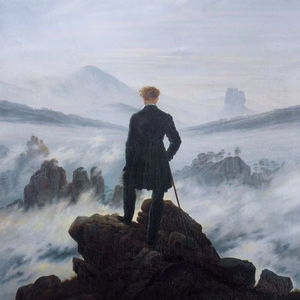
What happens when wonder is reduced to curiosity, and curiosity becomes a drive to master everything?
In this second conversation with William Desmond, John Vervaeke returns to the question of astonishment: not as a passing emotional state, but as a deeper opening of the mind to reality. Desmond frames scientism as a philosophical interpretation of science that tries to make all essential questions answerable through determinate method, precision, and control. Science remains valuable, but scientism forgets the more original wonder from which inquiry arises.
The conversation distinguishes astonishment, perplexity, and curiosity. Curiosity seeks determinate answers, while astonishment opens us to what exceeds our mastery. Vervaeke connects this with his own distinction between the having mode and the being mode, arguing that genuine wonder is bound up with transformation rather than mere information.
From there, the dialogue turns to Plato, Aristotle, Hegel, logical positivism, AI, computation, relevance realization, and insight. Desmond and Vervaeke ask whether intelligibility can be reduced to determination, or whether the most important forms of understanding depend on a living act of insight that formal systems cannot generate on their own.
The final movement turns toward spiritual practice, Socrates, Jesus, the Buddha, religion, trust, and forgiveness. If modern culture suffers from a dearth of astonishment, then the recovery of meaning may require more than better arguments. It may require practices, communities, and forms of dialogue that reawaken porosity, reverence, and an openness to the sacred.
Timestamps
- 00:00 - Introduction and the Desmond conversation so far
- 03:00 - Science, scientism, and the desire to make everything univocal
- 06:30 - Astonishment, perplexity, and curiosity
- 14:00 - Plato, Aristotle, and the purpose of philosophical wonder
- 16:30 - Having, being, mystery, and transformation
- 22:20 - Whether knowledge dissolves wonder
- 26:10 - Logical positivism and the failure of total certainty
- 31:30 - The four kinds of knowing and propositional tyranny
- 34:00 - Insight, inference, and logical systems
- 41:40 - Relevance realization, computation, and AI
- 46:30 - What intelligibility means beyond determination
- 50:40 - Inexhaustibility and the hyper-intelligible
- 58:20 - Dialectic, dialogos, and the practice of astonishment
- 01:03:40 - Porosity, the buffered self, and vulnerability
- 01:07:00 - Meaninglessness, spiritual practice, and cultural homelessness
- 01:12:30 - Reawakening astonishment without commodifying experience
- 01:14:10 - Ancient dialogue as a response to skepticism
- 01:17:30 - Socrates, Jesus, the Buddha, and embodied wisdom
- 01:22:00 - Religion, the sacred, and suspicion of God
- 01:27:30 - Trust, forgiveness, and cultural metanoia
- 01:30:20 - Closing thoughts and the next conversation
Key Insights
- Scientism totalizes science by treating scientific method as the answer to every essential question.
- Astonishment is more original than curiosity because it opens inquiry rather than merely directing it toward control.
- Perplexity matters because some mysteries are not failures of explanation but enduring features of the human condition.
- Insight depends on living participation in intelligibility, not only inference or computation.
- AI and formal systems can imitate aspects of thought, but they do not resolve the deeper question of living noetic activity.
- Modern meaninglessness is intensified when institutions, practices, and role models no longer help people recover reverence and connectedness.
- Religion must be discussed at the level of human vulnerability, longing, trust, failure, and mystery, not only at the level of institutional critique.
Resources
- Astonishments and Science: Engagements with William Desmond - edited by Paul Tyson
- William Desmond, "The Dearth of Astonishment: On Curiosity, Scientism and Thinking as Negativity"
- William Desmond, God and the Between
- Gabriel Marcel, Being and Having
- Bernard Lonergan, Insight
- Charles Taylor, A Secular Age
- Augustine's Cassiciacum dialogues
About William Desmond
William Desmond is a philosopher whose work engages metaphysics, religion, art, science, and transcendence. In this conversation, he and John Vervaeke continue their exploration of astonishment, scientism, the between, and philosophical practice.
Follow The Lectern for conversations on philosophy, meaning, wisdom, and the recovery of deeper forms of knowing.
Thanks for listening!