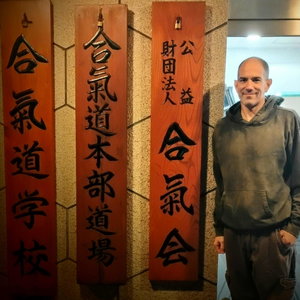
Last week, I came across a video online titled “State of Aikido & Modern Society.”
It was a raw, provocative, and deeply honest commentary which struck such a resonant chord in me that I immediately reached out to its creator and asked him to come back on the show.
Nick Regnier Sensei, chief instructor of Aspire Aikido London, has been a huge inspiration to me since back when (if you’re a day one listener, you’ll remember) he was my very first guest.
Please go back and listen to that riveting conversation here: First interview, it’s already nostalgic for me. Way back in January of 2025. You can also check out his blog here: Aspire Aikido Blog
In the meantime, let me briefly remind you why Nick Sensei’s story is such a poignant example of how Aikido practice can transform a perceived limitation into a profound personal gift.
He was born with severe hearing loss. Growing up (in Brittany, France) he had to navigate a quiet landscape by lip-reading and wearing bulky, uncomfortable, analog hearing aids. In a society built predominantly around verbalization, everyday communication was a grueling process, having to concentrate twice as hard to snatch a few fleeting words from a sentence to mentally piece the rest of the meaning together.
By the end of a normal day, his brain was often completely fried.
But when he incidentally walked into an Aikido dojo as a teenager, his entire reality shifted.
Once training began, Nick Sensei realized something revolutionary: he didn’t need his hearing aids at all. He could take them off entirely, leaving the struggle of spoken word deciphering behind. On the tatami, he could communicate through more purely somatic language. He trained his eyes to study the geometry of the instructor’s movements, and relied on his physical sense of touch, distance, and partner attunement to understand.
For the first time in his life, he felt completely whole, not a “disabled” person trying to catch up; but flowing and centered. In fact, because his non-verbal attunement and proprioception were so highly sensitized, he discovered he could execute breakfalls and throws with a level of coordination and skill that surpassed many of his able-bodied peers.
That breakthrough assuaged his internal fears. He recognized that the only thing holding him back was the anxiety in which he’d enveloped himself.
This newfound physical and mental confidence gave him the courage (a few years later) to pack his bags and relocate to London to build a successful career in the hospitality and security industries, which ultimately led him to establish his own dojo, Aspire Aikido.
He chose the name “Aspire” aptly as a tribute to his own transformation.
Since we last spoke, a lot has changed. Aspire Aikido has moved to a beautiful, residential neighborhood in Finchley Central (North London). Nick Sensei’s technical prowess has also continued to bloom. In both our talks, he lays his impressive lineage out clearly, explaining how he spent years refining his center, diving deep into traditional weapons to master the body’s structural alignment, and even cross-training in Shotokan Karate to further test his posture.
This rich foundation and constant search for deeper precision set the stage perfectly for a technical and creative collaboration forged during the isolation of Covid. That’s when Nick Sensei came upon the videos of Said Sebbagh Sensei, who has built an extraordinary, thriving movement in Algeria.
When he first watched Sebbagh Sensei’s movement, he recounts how he was immediately shocked and deeply inspired. What stood out to him was a level of fluidity, martial integrity, and dynamic power that he had rarely seen captured on screen; where weapons and empty-handed skills were completely and seamlessly integrated.
To Nick Sensei, who’d been actively searching for a way to show the world that Aikido has real, undeniable martial efficacy, Sebbagh Sensei represented the ultimate standard. He saw an instructor who successfully commanded an incredibly electric, high-energy dojo full of young, passionate students—proving that a dynamically honest, martially sound approach could successfully capture the attention of the younger generation.
What began as a chance online discovery during lockdown quickly evolved into a genuine, real-world partnership:
Inspired, Nick Sensei reached out directly, sparking a dialogue. Once travel restrictions eased, he brought his vision to life, hosting Sebbagh Sensei in the U.K. for a series of highly successful, sold-out seminars starting in August 2022.
He’s also traveled directly to Sebbagh Sensei’s dojo in Algeria to train in person, experiencing firsthand the high-vibe, and explosive energy of the local students.
If you visit Nick Sensei’s YouTube channel, you’ll see the fruits of this collaboration: dozens of beautifully edited, high-retention clips of Sebbagh Sensei’s dynamic training.
That’s also where you’ll see the video, mentioned at the opening, which catalyzed this episode.
In “State of Aikido and Modern Society”. Nick Sensei addresses the critical crisis of dojo enrollment and links it directly to our generational “war on focus.” We’re living in a society dominated by smartphones and video games—an ecosystem designed for immediate, effortless gratification. If we want food, if we want entertainment, we touch a button on a screen.
The basic human capacity to commit to a difficult, long-term, and demanding discipline is being systematically eroded.
This is where the concept of Kaizen—continuous, incremental improvement—becomes our daily medicine….
Want to hear more about that?
Check out the episode!!!
(Just one quick technical note: Nick Sensei’s hearing aid caused a little echo in my voice that I couldn’t do anything with post edit. Sorry about that.)
And….
Aikido calls us to do more than just train.
For some of us, simply getting on the mat is where we are right now—and that’s important. But the deeper I’ve gotten into Aikido, the more I’ve felt that it has something to offer beyond the dojo.
That’s the main reason I started this podcast. I love Aikido, and I want to explore more of what positive effects it can have in society.
One of the organizations that has greatly supported this work is Aiki Extensions. They believe in Harmony in Action—that Aikido was meant to help heal a sick world, and that what we practice is much more than a collection of techniques.
If you have an idea or a project that takes aikido principles beyond the mat, Aiki Extensions offers seed grants that can help you get your project off the ground. I highly recommend reaching out. You can find them at www.aikiextensions.org/seed-grants.
Learn more, get connected, and build your Aiki project.
Also, please consider becoming a paid subscriber. It would help a lot!
Get full access to Ki to the City at kitothecity.substack.com/subscribe