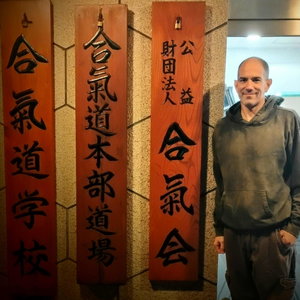
When Richard Moon Sensei reaches out and personally recommends a guest like, “You have to talk to this guy, he was one of my very first training partners back in the day”—you don’t hesitate. So I didn’t.
His latest brilliant recommendation is David Brown, whose lineage traces directly back to the illustrious dawn of the 70s California Aikido happening.
He began his Aikido practice in 1971 at Aikido of Mountain View under Robert Nadeau Sensei.
David describes eloquently the Bay Area at a time when Vietnam protests were peaking, Beatniks and Hippies were morphing and flowering further as counterculture movements, and Aikido dojos were few and far between.
As he recalls, all his early teachers were Americans who’d traveled to Japan, trained with O-Sensei, Tohei sensei, and other senior Hombu instructors, bringing back a revolutionary, energy-first approach to movement.
Before Aikido, David was a Stanford student competing in track and field as a pole vaulter. That unique background gave him a leg-up when it came to ukemi.
While most beginners freeze at the prospect of being thrown through the air, David was already accustomed to flinging his body up 14 feet high and landing (relatively, I assume) safely on a mat.
Being upside down, inside out, or twisted in mid-air was second nature to him.
This aerial aptitude allowed David to become one of Robert Nadeau Sensei’s go-to demonstration uke.
He describes being thrown by Nadeau Sensei as a visceral, intoxicating sensation—like a surfer being caught and carried effortlessly by an ocean wave. It was this undeniable, tangible experience of an invisible field of energy that hooked David on Aikido for life.
Over the years, he’s had the fortune to take ukemi for a “who’s-who” of legends—including Tohei sensei, Hikitsuchi sensei, Saito sensei, Saotome sensei, and first Doshu, Kisshomaru Ueshiba sensei.
During our talk, David dropped this episode’s titular phrase; a gem that succinctly encapsulates martial practice extending beyond the mundane:
“Waza to survive, Ki to thrive.”
Mechanics, techniques, and forms are essential building blocks—survival tools that can keep us safe when physical pressure arrives/arises. But if training stops at technical execution, we might miss the entire transformative promise of the art. Ki—bringing deep, core-centered awareness and aligning with the life force—is what allows a human being to flourish, connect, and thrive. (I think…)
What makes David such a compelling guest is his complete lack of pretension. He doesn’t sanitize history or treat luminary figures as untouchable gods; he regards them as extraordinary human beings, albeit not without flaws and foibles.
Here’s a small sample of various vignettes he shares from his eclectic journey:
Meeting Coco the Gorilla! While studying at Stanford, David literally met the famous sign-language-trained gorilla in a campus parking lot. This is probably the most jealous I’ve ever been of a “celebrity encounter”. (Spoiler, he doesn’t think he could’ve applied nikkyo…)
Rooming with Peter Ralston: During a week-long Dominican College Aikido retreat, Nadeau Sensei assigned David to room with Peter Ralston (the first non-Asian to win the World Full-Contact Martial Arts Tournament). David recalls deep late-night talks where Ralston paraphrased his core life philosophy: “The purpose of life is to be. To increase our ability to be present for the event in the cosmos that is our existence.” That’s what I’m talkin’ about!
As president of the Stanford Aikido Club, David hosted Tohei Sensei, taking ukemi for his entire class and sitting next to him at the faculty club. He vividly recalls a poignant evening at the South San Francisco dojo where Tohei—sitting with a tumbler of bourbon after his historic split with Hombu Dojo—pointed to O-Sensei’s portrait and lamented the heartbreak of organizational division.
Perhaps most inspiring of all was David’s personal choice of life path…
Coming from a prominent background, everyone assumed he was destined for law school, politics, or high public office. But when family upheaval hit and he experienced the profound depth of Aikido, he made a conscious decision to walk away from corporate ambition. He took a job as a medical machinist at Stanford Medical Center—a career that allowed him to work with his hands and earn just enough to fund his true life’s passion: training.
I’m grateful to have received a few glimpses of wisdom from this ongoing life-training, and hope to convey and carry it forward as best as I can.
Enjoy the episode!
Aaaaand…
I’m deeply grateful to my (surprisingly) global audience for keeping these dialogues alive.
Extra special thanks to Aiki Extensions for their continual support of this podcast.
Aiki Extensions is a 501(c)(3) non-profit dedicated to taking Aikido off the mat through grassroots Seed Grants for community peacemaking, outreach, and trauma recovery.
Learn more or apply for a grant at aikiextensions.org.
If you draw inspiration from these weekly conversations, please consider signing up to be a paid subscriber on our Substack.
And don’t forget to check out the brand new Bookstore!!!
Get full access to Ki to the City at kitothecity.substack.com/subscribe