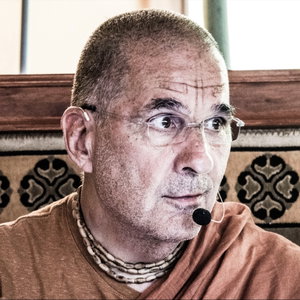
Questions on today's Swami call:
Dandavat Pranams Guru Maharaja! Recently I came across Guru Gita from the Skanda Purana, and it made me wonder if we have any such texts in our tradition that comprehensively speak of the Glories of Sri Guru and explain the Guru Tattva that practitioners can read and meditate upon.
There is this discussion in Jaiva Dharma, chapter 9, that confuses me: Adwaita dasa says: " You have said that śakti is the embodiment of consciousness, that it possesses will, and that it is beyond the influence of the three qualities of material nature. This is correct, but only insofar as śakti operates fully under the support of a pure conscious entity, and is thus considered identical with that powerful entity. Desire and consciousness depend on the Supreme Being. Desire cannot exist in śakti; rather, śakti acts in accordance with the desire of the Supreme Being." This passage seems to say that śakti has a will but no desire, which is really confusing to me, as it would make her less "alive" than jiva who obviously has a will and has desires. Perhaps it is my English that clouds the meaning. Could Guru Maharaj clarify this thing more, please? Thank you.
I have been studying Gaudiya Vaishnavism and practicing in the tradition for a few years but have yet to take the leap into initiation. How does one know when the time is right? Is any decision made without any shadow of uncertainty? Or is uncertainty the only thing that is certain? Thank you.
You mentioned last time, that for your confirmation in the Catholic church you chose St Francis as a patron saint. That is amazing! If you like to share with us; how old were you, what exactly made you choose him from all the others and what did choosing a patron saint actually practically mean for your young life?
I would very much like to know what happened to Bhakti Ananda Sagara Maharaj.
Ultimately, what is the reason Arjuna decides to fight? Could it be said that he fights for the many reasons Krishna gives him throughout the Gita conversation, or does he ultimately do it for bhakti? I also wondered, based on several verses of the Gita and other scriptures, to what extent Bhakti, by aiming for the highest, ends up including the benefits of other processes in the resulting benefits of bhakti.
My other question is somewhat related to this: Is bhakti limited to expressing itself only through the angas, or processes of bhakti? This relates to the initial point: if one studies the angas of bhakti, nowhere does it say "go and kill your relatives."
I say all this because some Vaishnava sects mock the "Vinod Parivar preaching campaigns" and other details that we could say differentiate us as a sect, but since some of these details aren't directly related to bhakti, they consider it a deviation.