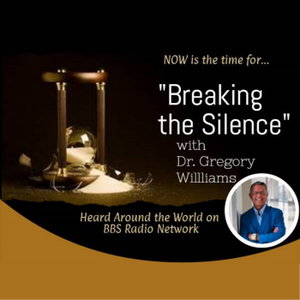
Breaking the Silence with Dr. Gregory Williams
A Life Shaped by Poetry: From Paris and India to the Smithsonian with Lee Woodman
Poet Lee Woodman joins Dr. Gregory Williams for a full hour on Breaking the Silence, reading from her Heartscapes collection and tracing a global childhood in Paris and India through a long career at the Smithsonian into the healing craft of poetry.
A Rescheduled Guest and a Full Hour
Dr. Gregory Williams opens the broadcast from his home in Houston, Texas, overlooking the Texas Medical Center, and tells listeners the show survived a bit of technical difficulty before tonight's guest arrived. He explains that last week's scheduled guest had to cancel after her father and her husband's father both passed away in the same week, and he reassures listeners that he and the guest have already rescheduled her appearance for the middle of November. Williams calls out the station's number, 888-627-6008, reminding callers that BBS Radio and BBS TV can patch them straight through to him and his guest, and notes the program streams live on the Shattered by the Darkness Facebook page and will reach more than 150 podcast platforms within days. He decides to give tonight's guest the entire hour rather than working through a prepared list of questions, saying he wants the conversation to feel like coffee between friends rather than a rehearsed interview.
Introducing Poet Lee Woodman
Williams introduces Lee Woodman as the author of a series of poetry collections he calls the "Scapes" books: Heartscapes, Colorscapes, Soulscapes, Artscapes, Lifescapes, Homescapes, and Mindscapes, with Heartscapes released that August. He jokes that if he had written that many books the next one would be called Escape, and Woodman laughs along. Williams reads through a long list of honors, including the Indie Reader Discovery Award, the Independent Press Gold Award, the Nautilus Gold Award for Poetry, the William Meredith Prize for Poetry, the Atlanta Review International Poetry Competition Merit Award, and a first prize from Carve Magazine. Woodman thanks him and says she finds it interesting to talk with someone who mixes medical knowledge, mental health, and ministry, predicting a good conversation. Williams admits he saw her face for the first time only a minute before the broadcast began, since he prefers not to hold pre-interviews and wants their talk to come from the heart rather than from a publisher's prepared questions.
What Makes Poetry Special
Williams asks Woodman why people hesitate to give poetry a chance, and she says many were taught difficult poems too early without enough instruction in sound, rhythm, and rhyme, so the form feels scary rather than musical. She describes her own process as rooted in specific observation, staring for long stretches at nature, cities, architecture, or overheard conversation in a museum or marketplace, then jotting notes in a small notebook before researching the subject further, whether it is a peacock's mating habits or a culture's walk and speech patterns. Williams asks whether an exceptional poet simply sees past the surface of an object more deeply than most people do, and Woodman agrees, pointing to differences in gait, tone, and language across cultures as the kind of detail she chases. She calls the final stage of shaping a poem into free verse or a traditional form like a haiku or sonnet "puzzle fixing," something she finds genuinely fun.
Poetry as Ancient Medicine
Williams compares reading poetry to reading scripture, noting that the same verse can feel flat one week and strike with sudden truth the next, and asks whether good poetry works the same way. Woodman agrees and traces the idea back before written language, to shamans who used poems as prayers and to the biblical King David, who soothed King Saul's depression through poetry and reading. She says communities need that slowing down now more than ever, and cites studies showing that listening to or reading poetry lowers stress hormones in the body. Williams then asks her to read live, and after the show's single commercial break, featuring an advertisement for his own book, Embracing Your Scars, Woodman reads "A Mulch Pile Prayer," a poem about her father's garden and his quiet, humor-laced faith, built as a parody of the Lord's Prayer involving Brussels sprouts, tomatoes, and rutabagas. She also discusses "Recompose," a poem about returning a body to the earth through natural burial.
A Childhood in Paris and India
Woodman traces her path into poetry back to an unusual childhood. Her father, a World War II veteran who landed on Omaha Beach, became a Fulbright professor of psychology in Strasbourg, taking the family to Paris, where French became Woodman's first language. The State Department later sent them to India, first to Madras and then New Delhi, and Woodman and her sister did not move to the United States until their teens, growing up instead as global citizens surrounded by many languages, dances, and cultures. She studied art in college, danced seriously in her mother's international ballet school, and eventually built a long career in Washington, D.C., spending twenty years at the Smithsonian Institution and ten years running her own media company for clients including the Library of Congress and the World Bank. She later served as deputy director for American History at the Smithsonian before retiring at sixty-six to return to the creative passions of her childhood.
Reading Hallelujah's Echo and Closing
After retirement, Woodman took her first poetry classes since college and found herself "sublimely thrilled," spending the next twelve years studying with poets including Richard Blanco, President Obama's inaugural poet, while citing influences from William Carlos Williams and Elizabeth Bishop to Li-Young Lee. She reads "A Kind of Gospel," written during COVID and inspired by Leonard Cohen's "Hallelujah," prompting Williams to recall k.d. lang's performance of the song at the Olympics, and Woodman shares that Cohen himself praised lang's rendition backstage that night. She closes with "Strange Currency," a playful poem about falling in love after divorce. Woodman directs listeners to her website, poetleewoodman.com, where her books, an artist's statement, and audio recordings are available, and reveals that her eighth collection will be titled "Escapes." Williams thanks her for a joyful, unhurried hour and closes the broadcast with his standing reminder that no matter what listeners are facing, there is always hope, inviting them back next week.