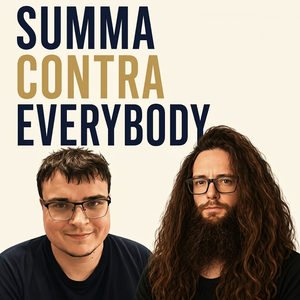
In the third episode of Summa Contra Infallibility, Pat Flynn and Ethan Muse go deep into the doctrine of Papal Infallibility, what it means, what it doesn't mean, and how to understand important historical examples often invoked to disprove the doctrine.

00:00 Introduction
03:40 The surprising consistency of Catholic doctrine
08:55 What papal infallibility actually means
14:47 Indefectibility explained
20:03 The logic behind infallibility
20:39 What exactly is the Church?
30:33 The Church as a perfect society
35:54 Why indefectibility entails infallibility
37:40 Infallibility protects the Church from the Pope
46:21 Why the limits of infallibility aren't ad hoc
49:50 Authority vs. credibility
57:17 Did Israel need an infallible authority?
1:02:24
Infallibility in the Old Testament
1:05:24 Alleged counterexamples
1:06:32 Maximalist vs. minimalist errors
1:08:59 How often is papal infallibility used?
1:12:59 Documents aren't infallible—definitions are
1:17:39 Pope Honorius
1:22:38 The SSPX and Vatican II
1:26:10 How reliable must the Magisterium be?
1:30:14 Can the Novus Ordo be harmful?
1:34:17 Are canonizations infallible?
1:39:53 The death penalty
1:46:09 Natural law vs. the evangelical law
1:52:05 Vatican II and religious liberty
1:55:21 Does "error have no rights" contradict Vatican II?
1:58:44 What Dignitatis Humanae actually says
2:02:03 The limits of religious liberty
2:05:47 Does Vatican II reject integralism?
2:08:04 Why infallibility is evidence for Catholicism
2:10:32 Conclusion

Podden och tillhörande omslagsbild på den här sidan tillhör Patrick Flynn, Ethan Muse. Innehållet i podden är skapat av Patrick Flynn, Ethan Muse och inte av, eller tillsammans med, Poddtoppen.