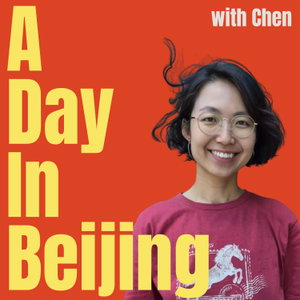
A Day In Beijing is an English-language Beijing podcast inspired by the history, innovations, and people and everything beyond Beijing.
It's created and hosted by a born-and-raised Beijinger. We exist not only as your virtual travel guide, your dictionary to China, but also to challenge and break the colonial narratives that have been shaping Beijing and China.
There's a hill directly behind the Forbidden City.
Man-made, built from the earth they dug out of the palace moat 600 years ago. Most people climb it for the famous view. This episode is about everything else — the feng shui reason this hill exists and the imperial hall on the north side that only opened to the public a few years ago.
📪 Next Wednesday — 北海公园, Běihǎi Gōngyuán. Over 1,000 years old. Older than the Forbidden City by centuries. That white pagoda on the island — you've seen it in photos, but you don't know the story. Hit Follow so you don't miss it.
Who is this podcast for?🌍 World travellers who want more than a guidebook — cultural travel, responsible tourism, real local perspectives🇨🇳 Planning a trip to China or Beijing — the Forbidden City, the Great Wall, the Summer Palace, the Temple of Heaven, and the places guidebooks miss🥾 Anyone planning to visit Jingshan Park — this episode tells you what every other guide leaves out📚 History lovers — feng shui, the fall of the Ming Dynasty, the Chongzhen Emperor, Beijing's Central Axis🎙️ Anyone who wants to hear about China from someone who actually lives there
What this episode covers:🔹 Why the hill is man-made. The Yongle Emperor built it in the early 1400s from earth dug out of the Forbidden City moat. Carried up by hand, layer by layer. In feng shui, a palace needs a mountain to its north — a guardian behind it, facing south. This is that mountain.🔹 The view from 万春亭, Wànchūn Tíng — the Pavilion of Everlasting Spring. Every golden rooftop. The Central Axis — Beijing's invisible north-south line — stretching from Tiananmen Gate to the horizon in both directions. No photo does it justice.🔹 The last Ming emperor. In 1644, a rebel army entered Beijing. The Chongzhen Emperor, 崇祯, was 33 years old. He climbed this hill and hanged himself from a tree. The tree is still marked. 罪槐, Zuì Huái — the guilty locust tree.🔹 寿皇殿, Shòuhuáng Diàn — the Hall of Imperial Longevity. On the north side of the hill. Only opened to the public in the last few years. Over 21,000 square metres. Where the portraits of every emperor were kept — and where French troops took jade seals in 1900.🔹 What locals actually do. This is a park, not a museum. 二胡 players on the path. Tai chi at dawn. The café on the back hill. Peonies in spring — 500 varieties. Ginkgo trees turning gold in autumn. This is where Beijingers go on a weekday afternoon to breathe.
New here?Listen to the trailer (3 minutes) and the pilot episode (15 minutes) for the full story of who I am, why I'm doing this, and what this podcast is about.EP1-3: The Forbidden CityEP4-5: The Great Wall of ChinaEP6-7: The Summer PalaceEP8-9: The Temple of HeavenEP10: Can't Get Forbidden City Tickets? Go Here InsteadEP11: Jingshan Park (you are here)EP12: Beihai Park (coming next Wednesday
🙏 I'm no historian — I research every episode the best I can. If anything sounds off, let me know. I'm always learning and this podcast gets better with your help.
🌏 Planning a trip to Beijing? We run small, responsible cultural experiences that support independent businesses and local communities. DM me!
🎧 Search "A Day In Beijing", it's also available on: Spotify / Apple Podcasts / YouTube Music / Goodpods / 小宇宙 / Substack📸 Instagram: @a_day_in_beijing / @chen_backinbeijing✉️ urchineseconnection@gmail.com
🌐 adayinbeijing.carrd.co