Dela
How can organic writing and leaning into the pivot help your stories stand out? And how can you pitch a story as a discovery writer if you genuinely don't know what's going to happen next. Steven James gives his writing tips after more than 20 years as an author.
In the intro, Better Than Free in an Age of AI [Kevin Kelly on Tim Ferriss; Kevin Kelly on The Creative Penn]; Future Vision XPrize; A Different Kind of Bucket List.

Today's show is sponsored by Draft2Digital, self-publishing with support, where you can get free formatting, free distribution to multiple stores, and a host of other benefits. Just go to www.draft2digital.com to get started.
This show is also supported by my Patrons. Join my Community at Patreon.com/thecreativepenn
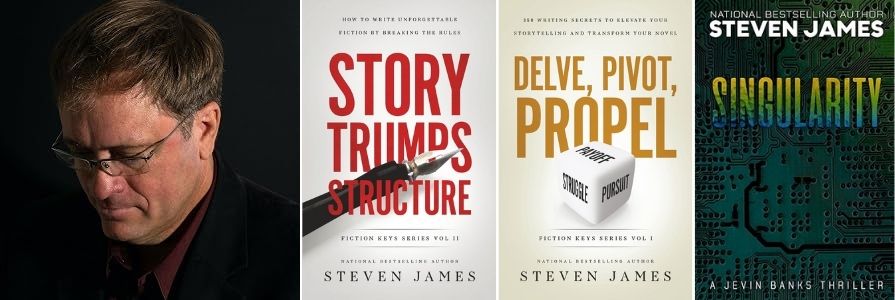
Steven James is the multi-award-winning and international bestselling author of 21 novels across thrillers, YA, and science fiction, with more than a million copies sold, as well as the author of non-fiction craft books for writers, a writing teacher, and the host of The Story Blender podcast.
You can listen above or on your favorite podcast app or read the notes and links below. Here are the highlights and the full transcript is below.
Show Notes
You can find Steven at StevenJames.net.
Transcript of the interview with Steven James
Jo: Steven James is the multi-award-winning and international bestselling author of 21 novels across thrillers, YA, and science fiction, with more than a million copies sold, as well as the author of non-fiction craft books for writers, a writing teacher, and the host of The Story Blender Podcast. So welcome to the show, Steven.
Steven: Thanks for having me, Jo. Good to be here.
Jo: Great to have you on the show. First up—
Tell us a bit more about you and how you got into writing and publishing.
Steven: Oh, gosh. Well, the thing is, when I was a kid, I fell in love with stories.
My uncle would always, whenever we got together for the holidays—Christmas, New Year's and so on—he would take my sister, my brother and myself into a corner of the room while the other adults had coffee, and we would just sit there, and he would get this look in his eye and he'd say, “I'm going to tell you a story.”
We were transported to another world. We were swashbuckling with pirates, or facing down a grizzly bear in Alaska, or flying over the desert on a flying carpet, or whatever. I fell in love with imagination and stories and everything.
So I started reading as much as I could, mostly short stories. They had a programme at our library called the paperback book exchange, where you bring a paperback book and you leave it, and you can take any one of the paperback books that they had.
You could keep it as long as you wanted. If you wanted it for your life, that's fine, or you could just bring it back as soon as you finished reading it.
Anyway, I went crazy over the summers reading short stories, mainly. As I got older, I was like, “I think I want to be a storyteller.” So I actually got my master's degree in storytelling.
Then I started to travel and tell stories, but I had three little daughters at home, and I was like, “I don't want to be gone 300 days a year when they are growing up.” So I ended up starting to write stories instead of travel, and then it just kind of shifted in that direction.
That was in '97. Oh my goodness, that's long. '97, '98. So then I started to write books, and then eventually in 2007, I think, my first novel came out. Now, mainly, I've been writing novels ever since.
Jo: It's so interesting.
Was it a job, storytelling? Is that what you did before you became a book writer? Or did you have a different job?
Steven: I mostly would go to events, conferences, schools and so on, and do a family-friendly storytelling show. So I would tell personal stories, some folktales reimagined. I would go to different events around the country. Mostly it was that.
Then I started to shift. I wrote for magazines for a while—80 different magazines I wrote for over those years, a couple of hundred different articles, stories.
I was like, “I'm just going to try to make a living telling stories.” So the shift has gone back and forth between actually telling stories and writing stories, but these days, I don't know. I'm still speaking. I'm still out there teaching.
Jo: That's so interesting, because it's obviously a completely different thing to tell a story in person than it is to write a story.
So when you decided to shift that way, what did you have to learn and unlearn?
Because your thoughts on the page are so different to when you can make eye contact with an audience.
Steven: That's a good point. I kind of started by telling stories back when I was in college, so I sort of moved from telling to writing. And you're right, there's so much that's lost, whether it's eye contact or pauses.
On a printed page, there's always the same amount of space between every word—a space. But when you tell stories, obviously you pause for effect in different places, different areas, and so it's quite different.
So if I have an idea for a story, I usually have to decide, is this going to be written or told? And then I do it in that medium. Then if I want to, let's say, tell a written story, I almost have to relearn it, or retell it very differently.
You have gestures, body language. All of those things are obviously lost in text, so they are very different.
I think for me it's been good, because when I tell stories, I hear different characters speaking, so that when I write, usually dialogue comes fast to me. I can hear what people are saying.
I don't always know where they are. I don't always know the setting. I don't even know the scene necessarily, but I can hear the dialogue.
Then it also helps me to step into the characters, like when I'm writing different points of view, so that I think I can do a good job of getting into that character's mind, as if I were that person. I think some of that comes from just telling stories.
Jo: You've taught so many writers over the years, and it's interesting you said that you hear characters' dialogue. I see visual film in my mind. I don't hear any voice at all. It's all silent.
I struggle with dialogue, but I do great world building. Do you find that this really is different by the author?
I feel like we fall into these different groups.
Steven: Yes, I do. I kind of feel like that's very true as far as what comes first, whether it's a description of a place, whether it's the action.
I mean, basically a story has dialogue, narration—or we call it sometimes exposition—and description. Those three things. Every story has those three things, and those are the three that we use to tell a story, a novel.
So some people tend to drift into one or the other as sort of their default setting: dialogue, description, or action. That's true.
I think also something else that's interesting about writers is they tend to fall into either the camp of being a wordsmith or a storyteller. Not everyone, but I feel like some people are wordsmiths, where I read what they're writing, and I'm like, “Man, this is so powerful, evocative,” whatever.
Maybe there's no story there. It's just really interesting writing.
Other people just are natural storytellers, and they have to really work on the wordsmithing. I think that's me. I'm more naturally just a storyteller, but it takes me a long time to get the descriptions to where I want them, to choose exactly the right word. That takes me more effort.
Some people have to build up the storytelling muscles. I have to build up the wordsmithing muscles.
Jo: Well, part of the reason I wanted to talk to you is because you talk about this thing called organic writing in your book Story Trumps Structure, which is out now in a second edition. I call it discovery writing, so similar to you. But most people in the writing community seem to obsess about plotting and planning.
So talk about your process of organic writing. You say in the book, “Trust the fluidity of the process.” Tell us more about that.
Steven: Well, I remember in high school even, when my teacher got up front and he kind of got this very almost wise look on his face, and he goes, “A story is something with a beginning, a middle, and an end.”
I'm sitting there in high school like, “Well, so does a bratwurst. What are you talking about here?” A description of a chair has a beginning, a middle, and an end. The sentence, “Preheat the oven to 450 degrees,” has a beginning, a middle, and an end.
My view is that saying a story is something that has three acts is like saying that a pizza is something with three toppings. It might have three. It might have one. It might have five.
So the idea for me is not to worry about structure, trying to tick off the boxes of a template, a formula you find online, a fill-in-the-blanks kind of a thing. But instead, to actually look at what lies at the heart of the story—the character, the tension, the struggle, the pursuit, the pivots and plot twists, and the payoff at the end.
As you develop those aspects of the story, I feel like you need to worry less and less about following a formula. The more you understand what lies at the heart of a story, I feel like the less you need to plot and the less you need to write by the seat of your pants.
A lot of people say, “Oh, you write by the seat of…” No, I don't write by the seat of my pants, because I know what a story contains, so I know that in a certain scene a character will make certain choices that are unpredictable but that escalate the tension, and different things like that.
I'm a huge proponent of discovery, as you say, or organic writing.
I won't get the quote exactly right, but Ray Bradbury said something along the lines of, “Plot is the tracks left in the snow after your characters have run by on their incredible destinations. It cannot precede action. It is the chart that remains when an action is through.”
So he's saying plot is not what precedes action. After the action, you have plot. So the whole idea of trying to plot out a story before you write it is going about writing exactly backwards. Plot doesn't precede action. It's the result.
So I always tell people, “Don't worry so much about the plot. I want you to look at the pursuit.”
A plotter might say, “Well, what should happen?” And they'll just come up with something. But an organic writer—a pursuit-based question would be, what does the character want? Now, when I know what the character wants, I will know what should happen. So literally, it will lead me to the story.
Focusing on plot will not necessarily lead you to the story. It might lead you down the wrong track.
Jo: Then in terms of your actual writing process—
Do you start writing without knowing the ending? Do you write in order? Is the organic side also in the process?
Steven: I've never started a book where I know how it will end. So I usually start with either a character that's fascinating or, in some cases, a premise, a question. Then as I write, I explore the possibilities of where it might go.
I've tried to outline a scene—like one scene, not a whole book—and it never works. I can't even outline one scene. I've tried, and I'm like, okay, that's… What I end up with is completely different from it, so it's just a waste of time and effort for me to try to outline or plot out a story.
I'm much more interested in the pathway the characters will take as they face obstacles and setbacks in their pursuit. As the struggles and the tension develop, what choices will they make? That's how the story will unfold for me.
Jo: I'm similar. Then I also wonder—
Do you do character sheets and character bios, or do the characters also unfold organically?
Steven: Absolutely, I don't do any of the sheets and bios and stuff. The characters really come to me as I write. I begin to get to know them.
I always tell people, a character with an attitude is more interesting than a character with a background. So a lot of people will spend a lot of time on, like, where's this character gone to college, and what's their first pet's name, all that stuff.
I'm not trying to dump on that idea. I get that that can be helpful. But I'm like, how would I know that until I've spent time with them?
Then once I begin to spend time with them, I'm writing and I'm like, “Nah, this doesn't seem like what that character would really say or do,” so I have to go back and rejigger the story to hopefully make it fit with that character.
Then I like to give the characters some sort of attitude. I'm not talking about a negative or judgy attitude, but an attitude about something that is unique or different, and that makes them not a template character, not an archetype or whatever, but unique.
Sort of this constellation of unique traits, characteristics, maybe wounds, flaws and so on, that create a character where you're like, “This is a character like none I've ever seen before. I want to spend time with this character.”
Jo: Then you're spending time with the character by writing what's happening, as opposed to writing loads of stuff beforehand and then starting to write.
You're actually finding all of this out during the process of writing.
Steven: Yes, and I think it's kind of like getting to know someone. If I were to say, “Okay, I'm going to write down Jo's bio,” or whatever—okay, I'm making stuff up, because I don't know you super well.
If we were to spend time together, hang out, whatever, talk, over the course of time I would start to know, oh, she likes this, she doesn't like that. This is important to her. This is what she would weep or pound the table over—whatever, all of the things that come with time. It's like a friendship in real life to me.
So I can't sit down and tell you what a character in real life would think and say and do if I don't know them, but the more time I spend with them, then the more I'm able to predict that accurately.
I think the mistake a lot of people make is they think, “I'm going to get to know this character with a background,” and then they start writing it, and instead of looking at the context, they look back at the—I don't know what you call it—the background or something like that.
I always feel like what you mentioned earlier is, like, hold it loosely in your hand. Trust the fluidity of the process.
As you're writing, you have an instinct. “Ah, I think this character would say this or do this.” So trust that. Trust that instinct. Trust that moment in the story, instead of trying to go back to an outline, back to a character description, or whatever it might be.
So I'm a big proponent of looking at the context—not just what happened, but what is the result? So looking at the impetus and the implication of the choices and the activities. When something occurs, what would the character naturally say or do or think or respond?
Then what would that cause? What's the implication that that would have on the rest of the story, on the rest of the characters? So, really trying to keep your finger on the pulse of the story, and adapt as you move forward through it.
Jo: I love all of that, but I also am very aware that you've been in traditional publishing for over 20 years, and one of the things with agents and publishers is that they often ask for an outline.
So how do you manage that? Or how did you more earlier in your career, because I imagine they just trust you now.
Earlier in your career, or people listening who want to pitch but they write in this organic way, how do we deal with that kind of thing?
Steven: Well, okay, so there's two good questions. One is about producing an outline for an agent or editor or publisher and so on. The other is how to pitch a story.
So the first: I would write the premise down, and maybe a paragraph or two, and then where I think it might go. Basically, I would focus on the questions that the characters will face, maybe the moral dilemmas, the sacrifices they have to make, the world they live in.
I kind of know that stuff, and I can write a couple of paragraphs about that. But beyond that, I just don't know what's going to happen, so I can't really provide more.
I'm looking at my shelf at the books that I've done, and mostly that's what I've done is kind of a couple of paragraphs focusing on the premise and the problem, the struggle, and so on like that.
As far as pitching a story, I always tell people, “Don't pitch the plot, pitch the pivot.”
I think that there's a screenwriter—I think that he talks about this a little bit. I've not read the book Save the Cat, but people have told me, “Oh, he kind of brings this up in that book.”
The idea is to pitch the irony instead of what occurs. So sometimes when I tell people to pitch, or I give them ideas, one process that you can use is: when, must, before, or else. So, when this occurs, this character must do something before this, or else.
So you have the character, you have the struggle, you have the inciting incident, you have the stakes, and you have the countdown. It works well for thrillers.
So for instance, like Jaws. When a man-eating shark starts eating people in a small seaside village, the sheriff must stop him before more people die and the town loses its economy. So there you have when, must, before, or else.
Now, no one's going to buy the story based on that, because there's no irony, there's no pivot. It's just a description of the plot, and that's what most people pitch.
So I always tell people, pitch the part of the story that you wouldn't expect. So for instance, in there you might pitch: when a shark starts eating people in a small seaside village, the only one who can stop him is afraid of the water.
Now you're like, “Oh, well, that's interesting. How does that happen? What happens there?”
With my book Broker of Lies, the pitch was something like, when a high-level Pentagon redactor ends up on the run, he must stop a terrorist attack before he's neutralised by the people he trusts the most.
So the pivot is that the people he trusts at the Pentagon the most are actually trying to neutralise him because he's on the run, and all that kind of stuff. So why would they be trying to do that? Well, that's interesting.
So it's always looking for the irony, the pivot. Why is this character the last one in the world who would ever be equipped to tackle this problem or face this issue?
So that's one way to do a pitch. Obviously there's lots of them, but I think your goal with a pitch is to get them to say, “Tell me more.” It's not necessarily to summarise the whole story.
Jo: That's great advice. So you teach writers—I first saw you at ThrillerFest, I think it was 2012—and you do events, you run writing retreats. So you work with a lot of authors, and I wondered, what are the challenges that you see from authors with, say, five books?
So not the beginner authors, because obviously there's a lot of challenges. But those who, let's say they've got the three to five books, things are going all right, but they're like, “How do I get to the next level?”
What are the craft issues, or the business issues as well, that mid-list authors face?
Steven: Well, business, I'm not the guy to ask. I could try to answer that, but I mean, basically: meet your deadlines and write something amazing. Try to be easy to work with, but also stand up for what you wrote as far as working with editors. It's sort of a fine line you have to walk.
The one thing that over the last few years I've really noticed in a lot of writers who are in that space is that they don't have many pivots. They tend to write predictable stories, and that's why they tend to stay where they're at—whether it's because they're following an outline or a plot formula or whatever it is.
So when I talk about a pivot, I mean a moment in the story where something happens that's both unexpected and inevitable.
For instance, if you're reading a story, you want things to make sense. You want them to be logical. That's one thing. But you don't want them to be too predictable. If it's too predictable, it's boring. It's like, I'm not interested.
So we also want surprises. We want these two things. We want logic, and we want surprise. When those two things meet and you have a moment in the story where it's like, “I didn't see that coming, but that totally makes sense,” that's what we want, and we want that in every scene.
I feel like a lot of authors don't have that in every scene. Now, you might say, “Well, every scene?” Well, yes, because basically those two factors, logic and surprise, can only meet in four different ways.
You could have something that's very logical but has no surprises. That's going to be boring. It's going to be too predictable. We don't want that.
You could have something that is very surprising but not logical. It makes no sense. A lot of stuff is surprising, but that's not what we want, because it's unbelievable, and it's like, what is going on here?
You could have something that has neither logic nor surprise, which obviously we don't want that.
The only other option is to have a moment that is both logical and surprising. So you have a choice in every scene. You have four choices, actually. You can have it be predictable and boring. You can have it be nonsensical. You can have it be unbelievable. Or you can have a pivot.
So I find myself trying to really coach people on pivots.
They'll say, “Oh, well, do I need it in every scene?” I'm like, “You can choose, but do you want it to be predictable or boring or nonsensical, or do you want it to really drive the story forward?”
I think it's because people have been taught structure and plot and three acts and all this kind of stuff, but they haven't been taught this idea—even though it's not something I made up.
Aristotle, in Poetics, thousands of years ago, put it a little bit differently, but he said, “The reversal of the situation”—what I call the pivot—”is the moment at which the action veers around to its opposite”—that would be what I call surprise—”subject always to a rule of probability or necessity”—which is the logic.
So he's basically saying the same thing in just a little bit different language, but you have these three factors. You have logic, you have surprise, and you have them come together in a specific moment.
I don't know why it's not taught more. I have never found anyone who teaches pivots. I have not found any books, so I wrote a book recently about how to use pivots.
It's so central, and I think great storytellers naturally do it. You'll read a book, or you'll maybe watch a show, and you're like, “Oh, I didn't see that coming. That totally makes sense.” I don't see anyone else out there really focusing on teaching that.
So that's a huge thing for me, really, to help people move up in their writing, elevate it to a different level.
Jo: Is that Delve, Pivot, Propel?
Steven: Yes. That book came out a couple years ago. We just re-released it. I updated it some, but it talks pretty much in depth about pivots and how to actually use those to propel the stories forward.
Jo: Maybe you could just give us one tip on how to do that, because going back to the organic writing—let's say I've been organically writing, and every time a character has a decision to make, I think at that point about what I want to write and I write it.
Are you suggesting that we go back in the edit and look at the end of every scene and redo it?
Because I can't imagine that I would get this right every time. I would need to do that in an edit, I think.
Steven: I think for me, when I'm writing, I'm always asking myself a series of questions. One is, what would the character naturally do? I want to make it believable and natural. Let them do it.
I want to escalate the tension, so I'll ask myself, “How can I make things worse?”
Then I'll always ask myself, how can I add a pivot to this scene? So as I'm writing a scene—again, I don't know how it will end when I start it—but if I use the first idea that comes to mind, probably a lot of readers would guess that as well, because it's the first idea that comes to mind. It's probably logical and probably predictable.
That's why most stories end up being too predictable. It's because we go with the first idea that maybe we had. So I try to discard that. Maybe the second idea, just discard it. Then I start thinking, okay, now if I've discarded the obvious, what is going on? What's below the surface?
So to answer your question, I'm looking for what isn't what it appears to be, or who isn't who they appear to be, or a surprising way to bring together plot threads that I didn't see related before. So it's always looking for the unexpected, the surprise, because most of the time that is what we're missing.
Now, if you have a great surprise, then you have to lean into making it believable. So you've got to move into that idea of, well, what would the character naturally do? You can't just have him do something ridiculous and then say, “Oh, it's for my twist.” No, you can't do that. You've got to play fair.
So it has to be believable, causally related, logical, and surprising. That's what you're shooting for.
Those are the questions going through my mind. So as I'm working on a scene, I'm like, “How could I end this?” Or include something that people won't see coming right away. The best ideas always come to me then.
It's so interesting. A lot of people will say, “Oh, don't write organically,” or, quote, “by the seat of your pants,” whatever they'll say, “because then you might write yourself into a corner.”
I'm like, “Yes, absolutely write yourself into a corner. That's what I'm trying to do in every scene.” And then you write yourself out of a corner in a way that's logical and surprising.
The best twists I've ever come up with have been when I'm in a corner. So why would I warn people against going to the place where the best ideas await them? That just seems mean. Why would I do that?
No, I want you to have the best possible ideas. So yes, look for corners, write yourself into them, and then write yourself out of them in a way that's both logical and surprising.
Jo: I guess also it needs to be genre specific. We write mainly thrillers, and there is this fine line, isn't there?
I love Stephen King, but one of the most unbelievable endings is Under the Dome. I still remember feeling betrayed. I don't know if you've read that one, but—
Steven: Oh, no.
Jo: I was like, “I'm sorry, you've just changed genre in the last chapter of the book. What is going on here?”
Steven: That's actually interesting. The fourth question I ask… So I ask, what would the character naturally do? How can I make things worse? How can I add a pivot? But the fourth question is, what promises have I made that I have not yet kept?
So genre, to me, is a promise. You build up a promise in your writing at the beginning of the book, and then I feel like as we write, we have to honour that. So if we bring something up that's super interesting, bring it back or whatever. Keep your promises. Keep your narrative promises.
It's true of really any genre. Let's say you're writing a romance. You want to respect the conventions, but not fall into the clichés. So there's going to be a moment where the lovers meet, right? They haven't met before. I don't know what they call it, a meet cute or a cute meet. I think they call it a meet cute, I guess.
Jo: Yes. They do.
Steven: Anyway. So they're going to meet, right? And you're like, “Oh, I'll just have them meet.” Well, try to do it in a way we haven't seen before. Add something else to the scene. Add a third element, as my friend Bob Dugoni likes to say.
Add something a little bit that we're like, “Huh, I've never seen that before.” We know they're going to meet, but let them meet in a way that we don't anticipate, that we can't predict right away, that isn't exactly by the numbers, and then you're going to be on the right track.
Jo: So then, talking about reader expectations and genre, I wondered if I could also ask you about your Christian faith, because many people listening are people of faith, and some people want to write a Christian book.
Other people want to bring their faith into, say, a mainstream type thriller in an authentic way.
So how do you balance your faith and your writing?
Because I think you have some series that are more sort of Christian than others.
Steven: It's interesting. When my first novel came out—The Pawn, like a chess piece, The Pawn—back almost 20 years ago. Gosh, 20 years ago. Nineteen. But anyway, when it came out, someone wrote to me and said, “Is this a Christian book?”
I'm like, “What would make a book not Christian?” I'm like, maybe if it has a lot of idolatry, or witchcraft, or maybe sexuality or graphic violence. Then I'm like, oh, wait, that's… No, that's the Old Testament.
So it's interesting, because people have asked me similar questions over the years. My books are not sermons in disguise. I'm trying to write great stories that anyone of any background or faith will enjoy.
I always ask big questions. I let my characters wrestle with questions that matter, I think. Do my choices matter? Is there hope? Is there a God? Is there no God? Do I have free will? Can I find forgiveness? Can I offer forgiveness? Can I extend it, or whatever? So I always try to base the stories on something deeper.
I do believe that there is good and there's evil in the world. That's part of my worldview. So when people talk about moral ambiguity, I don't want to write or read something that's morally ambiguous. I want moral complexity, but I also want moral clarity.
So whenever you write, the question is, what are you justifying and what are you condemning? And if you're justifying something that's morally—I would say wrong, actually—then I don't feel like that's the kind of book I would want to write.
So I want to write stories that explore good and evil, that explore our world, human nature, in an honest way. I feel like when you write honest stories, people, no matter what their background or whatever faith, then they will connect with it.
I think a lot of people, if they start off with an agenda—whatever that agenda might be, let's say it is a Christian agenda, like I want people to trust in Jesus, let's say—so they write a story. Well, what you're doing, you're actually starting your story with an answer, and drama is not built on answers, it's built on questions.
So you're actually diminishing the amount of tension. You're also diminishing the possibility of a pivot, because we all get where you're going. It's predictable, but there's probably no surprise. You're diminishing the payoff at the end, because we're like, “I saw that coming. I exactly knew where you were going with this.”
So instead, I don't start with an answer. I always start with a question, or in some cases a moral dilemma, like, what's more important, protecting the innocent or telling the truth? That's interesting to me. If I had to choose between the two, would I tell the truth or would I protect the innocent?
It's interesting, because people might come down on different sides of it. They might say, “Oh, you should always tell the truth,” or they say, “You always should protect the innocent.” I'm like, okay, well, let's explore it. Let's literally ask the question.
So I come from a certain worldview, but I've written characters who have very different worldviews from me.
I'm always just trying to be honest with the character, ask big questions, tell a story that examines human nature and sort of the paradoxes of the human condition in a way that will resonate with really whoever the readers might be.
Jo: And of course that worldview is part of your author voice and part of what readers come to you for. I also notice that you have some pretty diverse different series.
How do you manage that diversity of series under your one brand? Do you find your readers move from one to the other, or do you have different readerships?
Steven: You mentioned the B word—brand. That's what publishers are always telling me: “What's your brand?”
I'm like, “I don't know. You tell me what my brand is.” I've done fantasy, science fiction, conspiracy. I've done spies and police procedurals and crime and suspense, thrills, whatever.
So I would say the one thing that really ties all my stories together is probably just suspense. They are stories with suspense. Some are more high concept thrillers, some are more dark fantasy, but they're built around suspense.
So I guess that would be intelligent suspense, maybe, if I was trying to come up with a brand. Something like that. Because I don't want them to be dumbed down. They're not dumbed down stories, so they're a little bit more complex than you might find in other places, but always built around the idea of suspense.
Suspense to me is basically—my definition is apprehension born of concern. So we're concerned about a character, and we're apprehensive because there's peril around the bend, or right in front of them.
So I want the readers to really care about a character, and then try to build the story and the suspense around that empathy or sympathy that we have for the character.
Jo: I think it's really interesting, because again, you mentioned 2007—we're coming up on 20 years since first published. The publishing industry has changed a lot.
So what do you think has changed most in publishing for you, and what are your thoughts on routes to market for new authors these days?
Or even established authors who are finding that things have changed, which they obviously have.
Steven: Well, I'm not a marketer, I'm not a businessman. I'm just a storyteller at heart. So I just keep writing stories that I would be intrigued with reading, stories that I feel like are resonant. Then I look for publishers for those.
I've been to a variety of different publishers over the last decade. I've done some different types of stories. I feel like you have to just write the story instead of trying to write for a specific market trend or something like that.
So I might not make as much as some of my friends, I might not sell as many books, but I feel like I have to write certain stories if they grab ahold of me.
There's a Native American—I think the Pawnee tribe, anyway, in the United States—but they were saying that all the stories that exist are out there already, and when one finds you, it's your job to share it with the world. I think that's kind of interesting.
Sometimes—maybe it's just true for you, I don't know, Jo—but it's like a story will grab hold of me, or an idea, and I'm like, “I can't shake it.” That's a story that I want to tell the world.
I would say that stories are becoming shorter, dumber. People are trying to write faster. They're trying to write several books a year, and as a result of that, some of the quality has gone down. This is all unfortunate.
I'm still sort of a dinosaur. I still tend to write longer, complex stories. But people have shorter attention spans and whatever, and they're not reading as much.
The structure of stories, I think, is changing slightly, where people will have to spend more time on a hook to really grab the attention of the readers. Then there might be a longer slow period, or more info dumping, which I'm not a fan of.
So they kind of look like, “I want to get readers hooked at the beginning, and then get them to flip pages.”
So I tend to set up my stories a little bit differently than that. So I'm not the best guy to ask about marketing and sales and stuff like that.
I feel like, write a story that will not let you go. And if you do that, I feel like that's the kind of story that will resonate with readers, because there's a deep honesty to it. You care, you're passionate about it. It's not just something you're trying to spin out just to sell books. That's my view.
Jo: I guess I also feel that writers are doing other things. So you have non-fiction, you have your podcast, you do events. I see you sell books direct from your website.
It's like the business expands into multiple streams of income, so that the art doesn't have to pay all the bills.
Steven: That's interesting. I do love to teach writing at conferences, events, and speak at different things.
So I guess if you think about it that way, my brand might be just story, or storytelling, or something like that. Really trying to get out there, and whether it's speaking or writing, just tell a great story.
So it's so interesting when I work with publishers and they'll ask, “What's your brand?” Basically it's like, “What's your box?” is really what they're asking. What box can we stick you in that will make it easy for us to package you and sell you?
I know myself, and just a lot of authors that I know, we don't think in a box. Every one of my stories is not boxy. It's not the same. They're different. I know a lot of authors like that too.
So it's unfortunate. I get it, that it's part of them trying to market and sell the books. I understand that, but I think being honest, genuine with the story, doing the very best you can, writing a worthy book, and then letting them come up with a way to categorise it, is probably the best bet. I don't know.
Jo: We're almost out of time, but this is obviously a podcast, and you have a podcast.
So tell us about The Story Blender Podcast and what people might find over there.
Steven: Yes, I appreciate it. Basically, I interview some of the leading writers and storytellers in the world every week, and the goal is for great storytellers to share the secrets of great storytelling.
So I basically pick their brains, kind of like what you were doing with me today, and find out what projects they're working on, and really just try to get insights into storytelling.
So it's tons of fun. I've been doing it now for a number of years, and I guess I've interviewed over 250 different authors and writers from around the world, and so I always enjoy it. It's a ton of fun. It's The Story Blender, and people can find it anywhere.
Jo: So where can people find you and your books and everything you do online?
Steven: Probably the best place is StevenJames.net. I think I'm on different socials @readstevenjames, so you can look me up there—Facebook, Instagram, X, and so on. I think they're all under readstevenjames.
Check out the website, drop me a note. I always enjoy hearing from readers.
Jo: Well, thanks so much for your time, Steven. That was great.
Steven: Thanks, Jo. I appreciate it. Good luck.
The post Organic Writing And The Power Of The Pivot In Fiction With Steven James first appeared on The Creative Penn.
Avsnitt sparat!
Du hittar sparade avsnitt på Mina sidor.
Kunde inte spara avsnitt
Något gick fel. Försök igen.