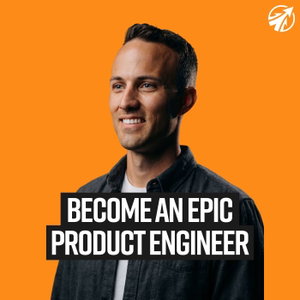
If shipping got cheap and you are still not sure you are building the right thing, this episode is for you. Kent talks with Peppe Silletti, independent product engineer and host of The Product Engineers Podcast, about why customer discovery still comes first when AI can write the code in a day.
They cover startup vs scale-up trade-offs, raising the MVP baseline without adding noise, how PostHog treats product engineers vs product managers, and the durable skills that stay valuable when agents take more of the implementation.
(00:00) - Meet Peppe Silletti
(01:13) - Startup exploration vs scale-up bottlenecks
(04:04) - Trade-offs before you paint yourself into a corner
(06:07) - AI raises the MVP baseline
(09:47) - Do not add so much that the data gets noisy
(11:13) - AI is a tool, not a silver bullet
(13:47) - Product engineers are not just managers
(16:06) - How you know you built too much
(18:49) - Prioritizing after product-market fit
(24:30) - PM as compass, engineer as slice owner
(27:08) - What Peppe learned hosting a podcast
(29:25) - Durable skills as agents take the code
(33:06) - Product engineering for backend engineers
(38:26) - Homework: ally with your PM
Peppe Silletti is an independent product engineer and host of The Product Engineers Podcast. In this conversation, he and Kent dig into what changes when you move from a startup hunting for product-market fit to a scale-up fixing bottlenecks - and what AI does and does not change about that work.
A major theme is that writing code got cheap, so the old lean-startup constraint loosened. You can ship more than a classic MVP, then sculpt features away like Instagram dropping everything but photos. The risk did not go away. It got worse. You can feel productive while running in the wrong direction, because AI will happily agree with you. Discovery, customer interviews, and a tight feedback loop still decide whether you are learning or just shipping.
They also unpack the product manager vs product engineer split. Peppe points to PostHog: product engineers owned decisions for years before a PM showed up to hold the bigger picture. His model is a PM as compass, a product engineer owning one outcome end to end. For listeners who still take tickets over the wall, the durable skills are framing the problem, interviewing without jumping to solutions, and treating UX as more than pixels - including APIs and neighboring layers of the system.
Peppe's homework is deliberately social: shadow customer interviews, watch session replays with your team, and get into discovery before the roadmap is locked.
Homework
Ask your PM if you can shadow customer interviews and listen for how people describe the pain.
Set a weekly half hour to watch session replays with your team and name the friction you see.
Once those two are happening, ask to join discovery earlier - when requirements and the roadmap are still being shaped.
Podden och tillhörande omslagsbild på den här sidan tillhör
Kent C. Dodds. Innehållet i podden är skapat av Kent C. Dodds och inte av,
eller tillsammans med, Poddtoppen.