What if the futures a society can imagine depend partly on whose stories it has learned to see?
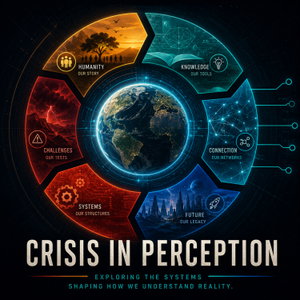
Welcome to Crisis in Perception, where we examine the systems shaping our world.
A People’s Future of the United States, edited by Victor LaValle and John Joseph Adams, brings together twenty-five speculative-fiction writers to imagine American futures through perspectives conventional narratives often leave at the margins.
This Deep Dive investigates narrative power: how representation, historical memory, information systems, identity, and institutions influence whose experiences become visible and which futures appear possible. Rather than treating the stories as predictions, we use them as thought experiments about the structures that shape perception.
Charlie Jane Anders’s “The Bookstore at the End of America” offers a particularly revealing model. A bookstore physically connects two rival countries while customers on either side inhabit different political cultures, information environments, and assumptions about reality. Elsewhere in the anthology, censorship, conformity, memory, exclusion, and resistance repeatedly raise the same larger question: who gets to participate in imagining what comes next?
The central systems include narrative gatekeeping, historical omission, polarized information environments, identity formation, and the feedback loop through which exclusion from dominant stories can make further exclusion appear normal.
📺 Watch on YouTube:
https://youtu.be/MpG8bOqqX8o
❤️ Support / Episode Post on Patreon:
https://www.patreon.com/CrisisinPerception/posts/peoples-future-168265219?utm_medium=clipboard_copy&utm_source=copyLink&utm_campaign=postshare_creator&utm_content=join_link
This episode discusses key plot outcomes from the referenced fictional work in order to analyze its underlying social, economic, and systemic themes.
If these ideas resonate, consider reading the work yourself or borrowing it from your local library. Supporting authors and libraries helps keep critical inquiry accessible.
If you value systems-level analysis like this, please follow, rate, and share the project.
This content was created using AI-assisted tools for research synthesis, structuring, and narration support. All analysis, framing, and editorial decisions are guided by human judgment as part of the Crisis in Perception project.