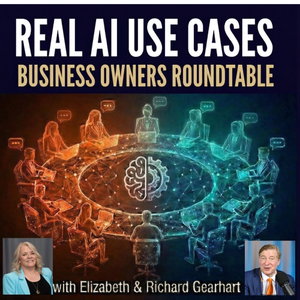
Can rogue AI agents destroy humanity? Will artificial intelligence ever become conscious? And how can business owners use AI tools like ChatGPT, Claude, Gemini, and Perplexity to save time and improve productivity?
On this episode of Real AI Use Cases Business Owners Roundtable, hosts Elizabeth Gearhart, Ph.D., and Richard Gearhart speak with AI expert Arshavir Blackwell about the reality behind AI doomsday predictions, the science of machine consciousness, and practical ways to get more value from today's AI tools.
Arshavir challenges sensational claims about rogue AI agents, explaining why human oversight, system safeguards, and the limitations of current technology matter when evaluating AI risks. The conversation explores whether AI can think independently without being conscious, why today's AI systems still depend on complex computing infrastructure, and whether combining biological neurons with computer chips could eventually change our understanding of intelligence.
The discussion then turns to real-world AI applications for businesses and professionals. Arshavir explains how he uses Claude to analyze meeting transcripts across multiple conversations, connect information from different reports, and make complex information easier to understand. Elizabeth and Richard share how they use ChatGPT, Claude, Google Gemini, Microsoft Copilot, and Perplexity for different tasks, from content creation and research to video analysis and work involving confidential information.
You'll also hear why AI-generated answers can sound authoritative even when they're wrong, why it's important to verify information, and how to guide AI tools to deliver shorter, clearer responses.
Whether you're a business owner exploring AI for the first time or an experienced professional looking to improve your AI workflow, this episode separates AI hype from practical reality and offers ideas you can start applying today.
About the Guest: Arshavir Blackwell has extensive experience in artificial intelligence and cognitive science. Learn more about his work through Inside the Black Box on Substack: subscribe.insidetheblackbox.ai.
TL;DL — Too Long; Didn't Listen:
-
Rogue AI and AI safety: Why Arshavir believes some warnings about AI taking over humanity are exaggerated, while acknowledging the need for safeguards.
-
AI consciousness: Why independent thinking and behavior do not necessarily mean that an AI system is conscious.
-
Practical AI for business: How to use AI to analyze meeting transcripts, synthesize information, and make complex reports easier to understand.
-
ChatGPT vs. Claude vs. Gemini: How different AI tools can serve different business needs, including writing, research, video analysis, and information processing.
-
AI accuracy and hallucinations: Why confident-sounding AI answers still require verification and human judgment.
-
Getting better AI results: How to ask AI tools for concise answers, simpler explanations, and responses tailored to your needs.
-
Confidentiality and AI: Why businesses and professionals should consider data confidentiality when choosing AI tools and workflows.
Frequently Asked Questions:
Can rogue AI agents destroy humanity?
Arshavir Blackwell argues that many predictions about rogue AI destroying humanity are exaggerated. He emphasizes that current AI systems have technical limitations and depend on human-built infrastructure, while recognizing the importance of safeguards and controlled access to computer systems.
Will artificial intelligence ever become conscious?
Chapters
- (00:00:00) - Introduction and Guest Welcome
- (00:01:17) - Rogue AI Fears: Debunking the Hype
- (00:07:31) - Why AI Systems Are More Fragile Than They Seem
- (00:09:07) - Can AI Achieve Consciousness?
- (00:11:27) - Biological Neurons in Data Centers
- (00:13:46) - From Chips to Biology: Full Circle Thinking
- (00:14:10) - Practical AI Use Cases in Business
- (00:15:38) - Medical Records and Meeting Synthesis with Claude
- (00:17:51) - Choosing Between ChatGPT and Claude
- (00:19:56) - Comparing LLMs: Copilot, Perplexity, Gemini and More
- (00:22:17) - AI Hallucinations and Legal Practice Challenges
- (00:23:31) - Closing Remarks