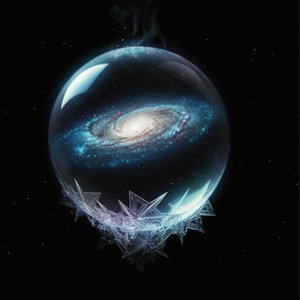
Tibet says that at the moment of death, before any threshold is crossed, before any destination is reached, before any journey begins, something appears. Something that was present throughout the entire life but was obscured by the constant activity of ordinary consciousness. Something that, if recognized for what it is, makes the rest of the journey unnecessary.
The clear light of the dharmata.
It appears at the moment the breath stops. It does not last long for the unprepared consciousness. For the prepared, it holds long enough. Recognition is the exit from the cycle entirely. One moment of clear seeing at the threshold of death, and the whole apparatus of judgment and journey and rebirth that every other tradition in the series has mapped falls away.
This episode describes what appears. The next episode describes how to prepare to recognize it.
The Bardo Thodol, Liberation Through Hearing in the Intermediate State, is attributed to Padmasambhava, the eighth-century tantric master who carried Buddhism into Tibet. It was concealed as a terma, a hidden treasure text, and discovered by Karma Lingpa in the fourteenth century. The assumption embedded in the title names the entire premise: the dead can hear. Consciousness does not cease at the moment of bodily death. The instructions can be delivered after the breath stops.
A lama sits beside the dying person, or, if the body is unavailable, beside an effigy, and reads the text aloud. The lama guides the consciousness of the dead through each stage of the bardo journey by voice, stage by stage, naming what is appearing and instructing the consciousness how to meet it. The guide accompanies the dead person through the intermediate state the way Ninshubur was instructed to accompany Inanna’s absence with lamentation, actively, verbally, with specific knowledge of what the territory contains.
This mechanism has no parallel in anything the series has examined so far. Egypt placed the Book of the Dead in the tomb for the dead person to use independently. The Orphic tablets were buried with the dead as a reminder of instructions learned in life. The Bardo Thodol is spoken aloud to the dead by a living guide who knows the territory and can navigate it in real time on the dying person’s behalf.
The text exists because the living guide’s voice can reach where the dying consciousness is. This is either the most sophisticated understanding of the nature of consciousness in the ancient world, or the most compassionate possible hedge against the one moment when the preparation might fail. In practice, for two thousand years of Tibetan Buddhist tradition, it has been both.
The Bardo Thodol describes three successive intermediate states through which consciousness passes after death.
The Chikhai bardo is the bardo of the moment of death itself. The clear light appears here. The duration is brief for the unprepared and extends for the prepared. This is the most critical moment in the entire journey; every other opportunity that follows is a secondary chance for someone who missed the first. The preparation system the next episode will examine is designed almost entirely for this moment.
The Chonyid bardo is the bardo of the experiencing of reality. Over fourteen days of symbolic time, the dead consciousness encounters a succession of deities, forty-two peaceful deities across the first seven days, fifty-eight wrathful deities across the second seven. These deities are the contents of the consciousness itself, the energies of awareness made vivid and overwhelming by the absence of the body that normally grounds and stabilizes the living person’s experience of mind.
The Sidpa bardo is the bardo of becoming. Here the consciousness, having missed the liberation opportunities of the first two bardos, moves toward the next incarnation. Yama, the lord of death, holds a mirror reflecting the complete record of the life just completed. The consciousness begins to be drawn toward rebirth in one of the six realms by the pull of accumulated karmic tendency.
Three stages. Three successive opportunities for recognition and liberation. Each one requires less clarity and more effort than the previous one. Each one further from the exit the clear light offered first.
At the moment of death, as the ordinary processes of consciousness dissolve, the ground luminosity arises.
The Tibetan tradition describes this as the fundamental nature of mind itself, the primordial awareness underlying all ordinary mental activity, the nature of consciousness revealed when the habitual overlays that normally obscure it fall away. During life, the ground luminosity is always present. Every moment of experience arises within it. The ordinary mind’s constant activity, thinking, perceiving, wanting, fearing, planning, reacting, runs on top of it without the living person ever encountering it directly, the way the surface of a lake is never still enough to reflect the sky perfectly.
The moment of death stills the surface. The ordinary activity of consciousness ceases as the body releases its hold. The ground luminosity appears spontaneously, unveiled by the cessation of what was obscuring it.
The meditator who has practiced recognition of the nature of mind across years of sustained training has met this before. In the deepest states of meditation, when the ordinary mental activity quiets sufficiently, the ground luminosity becomes briefly perceptible, as awareness itself recognized directly. The practice builds familiarity with this recognition over thousands of hours of sitting.
At the moment of death, what appears is what the practice was pointing toward. The meditator who has practiced recognition encounters the ground luminosity as something familiar. The recognition is possible. The liberation is immediate.
The unprepared consciousness encounters the same ground luminosity and cannot hold it. The openness is vertiginous. The brilliance is overwhelming. The absence of the familiar furniture of ordinary consciousness, the body, the sense of being a located self, the ongoing narrative of a life, feels like annihilation. The consciousness flinches, contracts, and moves away from the clear light toward the more manageable territories of the subsequent bardos. The opportunity passes. The journey begins.
This is the specific tragedy that Bardo Thodol was written to address. The exit was available. The consciousness did not recognize it. The lama reading at the bedside names it, calls the dying person toward it, instructs the consciousness to recognize the brilliance as its own nature rather than as an annihilating external force. The reading cannot substitute for the preparation. It can remind the dying person of what the preparation was for.
If the clear light passes unrecognized, the Chonyid bardo opens and the forty-two peaceful deities begin to appear.
The peaceful deities radiate light of extraordinary brilliance. Each deity embodies a specific aspect of awakened awareness, Vairochana in the center, the Dhyani Buddhas arrayed in the cardinal directions, each one radiating a specific color of brilliant light representing a specific quality of liberated mind. Alongside each brilliant light, a dimmer and more comfortable light appears, the light of one of the six realms, offering a familiar mode of existence as an alternative to the demanding path of full recognition.
The instruction in the Bardo Thodol is consistent at each appearance. The brilliant light is the display of the consciousness’s own awareness. Do not be drawn toward the comfortable dim lights; they are the doors back into cyclic existence, the invitation to trade liberation for familiarity. Turn toward the brilliant light. Recognize it as the nature of mind. Let the recognition open into liberation.
The parallel to the Orphic spring is structural. At each moment in the Chonyid bardo, the consciousness faces a choice between the demanding path, brilliant light, recognition, liberation, and the familiar path, the dim light leading back to the cycle. The choice is made by the character of the consciousness, by the accumulated habits and tendencies of the life just completed, by whatever degree of preparation has been done.
If the peaceful deities pass without recognition, the fifty-eight wrathful deities begin to appear.
The wrathful deities are blood-drinking, skull-crowned, flame-surrounded figures of overwhelming intensity. They carry implements of destruction. They trample. They consume. They are, to the unrecognizing consciousness, terrifying in a way that makes the peaceful deities seem approachable by comparison.
The Bardo Thodol’s instruction at this stage is the most counterintuitive in the entire text. Recognize the wrathful deities as the same peaceful deities in a different aspect. The blood-drinking Herukas are the Dhyani Buddhas; the same energies of awakened awareness that radiated as gentle brilliance in the peaceful bardo now appear as fierce intensity. They are the same light. The fierceness is proportional to the degree of the consciousness’s resistance. The more the consciousness contracts away from recognition, the more overwhelming the appearance.
The wrathful deities are compassion in a form calibrated to encounter resistance. They are what awakened awareness looks like to a mind that is running from it.
This is the most sophisticated psychological observation in the Bardo Thodol and one of the most sophisticated in any death literature. The obstacle is the habitual contraction of the consciousness away from what liberation actually requires, the complete openness, the recognition of the ground luminosity as one’s own nature, the release of the familiar bounded self into what was always already the case.
The wrathful deities are the universe refusing to let the consciousness avoid the encounter.
If both sets of deity visions pass without recognition, the consciousness enters the Sidpa bardo and approaches rebirth.
Yama, the lord of death, holds the Mirror of Karma. The mirror reflects the complete record of the life just completed, every act, intention, consequence accumulated across the lifetime. The White and Black Pebbles of virtue and non-virtue are counted. The judgment arrives.
The Bardo Thodol instructs the consciousness to recognize that the mirror, like everything else encountered in the bardos, is a projection of the consciousness’s own nature. Yama is not an external judge. The judgment is self-judgment. The record the mirror reflects is the record the consciousness itself carries.
The consciousness then moves toward one of the six realms, gods, demigods, humans, animals, hungry ghosts, or hell beings, pulled by the karmic weight of accumulated habits and tendencies. The cycling that Orpheus mapped and the Orphic tradition offered instructions for navigating, Tibet maps here in greater technical detail and with a clearer statement of what the cycling is for and what it would take to exit it.
Every tradition we have explored so far described death as a threshold leading to a destination and built preparation systems for the journey after the crossing.
Tibet says the most important moment in the entire death process is the moment of death itself. The clear light appears before any journey begins. The preparation systems of Egypt, Greece, and Orphism all prepare the person for a journey that the successfully prepared person will never need to take.
The exit from the cycle is available at the first instant of death. If that instant is navigated with recognition, the bardo journey does not occur. The peaceful deities do not need to be encountered. The wrathful deities do not need to be survived. The consciousness chooses no spring and crosses no scale, recites no Declarations of Innocence.
The preparation for that first instant is a lifetime of specific meditative training, undertaken within a tradition that has mapped the territory of mind in more technical detail than any of other traditions so far in the series. It requires a teacher. It requires practice sustained across years. It requires a particular kind of attention that most people, in most lives, do not develop.
This is the most demanding answer in the series and the most direct.
What that preparation requires, how it works, what the practitioner is actually training to do, and what the tradition offers the practitioner who undertakes it seriously, is Episode 10.YouTube Video Link
This is a public episode. If you would like to discuss this with other subscribers or get access to bonus episodes, visit consciousmythos.substack.com