Send us Fan Mail
You pass. At work, at school, in every room you walk into.
No one knows what it costs you. You read the room before you enter it, you copy the faces, you rehearse the small talk in the car so it comes out right.
And then you close your own front door and have nothing left. Not for the people you love the most.
Somewhere along the way, you quietly decided the problem was you.
Here is what almost no one tells you. There is nothing wrong with you. There never was. A woman named Grunya Sukhareva saw you clearly in 1927, and then the world spent ninety three years looking away.
You were not too much. You were performing a safety your body never felt, for years, and no one ever gave you a home that let you stop. This is not a discipline problem. It is a masked nervous system, and your environment is where it finally comes down.
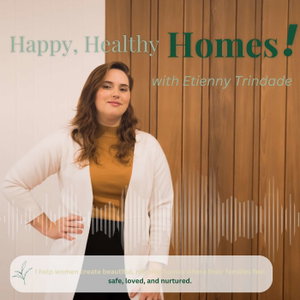
In this episode of Happy Healthy Homes, Nervous System Designer Etienny Trindade tells the buried history of how neurodivergence in women was missed for almost a century, why so many women are only discovering it now, and what masking is quietly doing to your nervous system, and then shows you how to build a home that finally lets the mask come down, without renovating, going minimalist, or trying harder.
In this episode you will learn
→ Who Grunya Sukhareva was, and why her 1927 paper on the girls was ignored for ninety three years
→ Why the world built its understanding of neurodivergence out of boys, and measured the girls against the wrong ruler
→ Why women are diagnosed on average five years later than men, and told it is anxiety or depression instead
→ What camouflaging is, and why it is the body performing a safety it does not feel
→ Why masking so often breaks open at adolescence, university and motherhood
→ Why home is meant to be the one place the mask comes off, and why most homes never got the memo
Where the Mask Comes Down
Most women perform all day and then come home to a space that asks just as much of their body as the world outside. Where the Mask Comes Down flips it. You build a home that tells the nervous system it is finally safe to stop. In this episode, Etienny shares the first changes to make tonight: give yourself the first ten minutes home with nothing asked of you, make one room where no one is watching, take the overhead lights out of the evening, and clear what your eyes have to hold.
This episode answers
→ Why was I only diagnosed as neurodivergent as an adult?
→ Why are autistic women and girls missed so often?
→ What is masking, or camouflaging, and why is it so exhausting?
→ Why do I feel like I have nothing left the moment I get home?
→ Why did this only surface for me at motherhood?
→ How do I make my home a place I can finally stop performing?
Why this matters
The exhaustion, the sense of being too much, the certainty that something is wrong with you, are symptoms. A world that built its ruler out of boys and measured you against it is the cause. Masking for years holds the nervous system on high alert until it breaks, and then it is called burnout, anxiety, or being a bad mother. This episode is for the woman who was told her whole life she was too sensitive, and who is only now realising the problem was never her. Nothing is wrong with you. No one ever built a world that could hold you. So we build the home.
About Etienny Trindade
Etienny Trindade is a Nervous System Designer with 20 years of experience, author of Creating Healing Spaces for Children, and the award winning creator of learning environments for neurodivergent children. She hosts Happy Healthy Homes, the only podcast at the intersection of environmental design, neuroaesthetics, and nervous system science.
Ready to go deeper?
www.happyhealthyhomes.au
Connect
Instagram: @etienny.trindade
Support the show