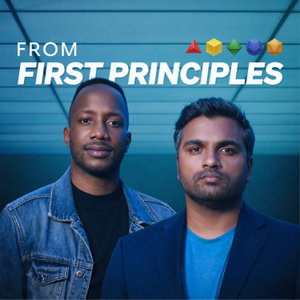
Who could win the 2026 Nobel Prizes? From the science behind Ozempic to quantum interference and droplets inside living cells, Lester Nare and Krishna Choudhary make their picks for Medicine, Physics and Chemistry, and explain the discoveries behind them.
In Episode 60 of From First Principles, we explore seven research areas with a case for Nobel recognition: GLP-1, optogenetics, optical coherence tomography, the Aharonov–Bohm effect, atomic force microscopy, biomolecular condensates and Buchwald–Hartwig coupling. We also discuss Michael Berry’s geometric phase and the awkward question of how a prize limited to three people recognizes discoveries built by larger teams.
These are our predictions, recorded before the 2026 announcements. Medicine, Physics and Chemistry will be announced October 5–7. Which discovery, and which researchers, would you pick? Tell us in the comments, then join us for our Nobel week breakdowns.
CHAPTERS
00:00 The science that could win a Nobel Prize
00:57 Hello Internet: our 2026 predictions
02:03 Medicine: GLP-1 and the science behind Ozempic
07:41 Medicine: optogenetics and controlling neurons with light
13:16 Medicine: optical coherence tomography
16:28 Golden Goose Awards and FFP updates
18:39 Physics: the Aharonov–Bohm effect and geometric phase
27:37 Physics: atomic force microscopy
32:04 Chemistry: biomolecular condensates
36:36 Chemistry: Buchwald–Hartwig coupling
38:42 Your predictions and our Nobel week plans
RESEARCH & FURTHER READING
Foundational papers and background for the discoveries discussed:
GLP-1: Mojsov, Weir & Habener (1987)
https://doi.org/10.1172/JCI112855
Optogenetics: Boyden et al. (2005)
https://doi.org/10.1038/nn1525
Optical coherence tomography: Huang et al. (1991)
https://doi.org/10.1126/science.1957169
Aharonov–Bohm effect (1959)
https://doi.org/10.1103/PhysRev.115.485
Berry’s geometric phase (1984)
https://doi.org/10.1098/rspa.1984.0023
Atomic force microscopy: Binnig, Quate & Gerber (1986)
https://doi.org/10.1103/PhysRevLett.56.930
Biomolecular condensates: Brangwynne et al. (2009); Li et al. (2012)
https://doi.org/10.1126/science.1172046
https://doi.org/10.1038/nature10879
Buchwald–Hartwig coupling: Paul et al. (1994); Guram et al. (1995)
https://doi.org/10.1021/ja00092a058
https://doi.org/10.1002/anie.199513481
Official Nobel announcement schedule:
https://www.nobelprize.org/prizes/about/prize-announcement-dates/
EDITORIAL NOTES
19:30 David Bohm later held a professorship at Birkbeck, University of London (1961–1987); he did not spend the rest of his career in Brazil.
33:23 The ribosome-producing compartment discussed is the nucleolus, not the nucleosome. These corrections also appear on screen.
WATCH & EXPLORE
YouTube: https://youtu.be/MgOpbh5VUGE
Episode page and research library: https://ffppod.com/episodes/ep60
Support: https://ffppod.com/donate
Follow @FFPPod on X / Instagram / TikTok / Facebook
Breaking down science news so it makes sense to curious people everywhere.