Send me your thoughts at ibotezatu5@gmail.com
Why does Beaujolais Nouveau taste so different from other red wines, and what exactly is carbonic maceration?
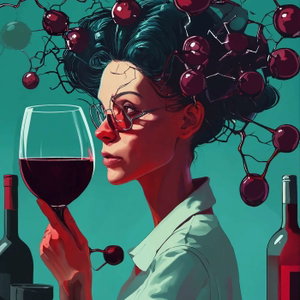
In this episode of The Wine Lab, we go inside the grape berry to explore the unusual fermentation science behind Beaujolais Nouveau. We’ll look at how intact Gamay grapes can begin producing alcohol before conventional yeast fermentation takes over, why carbonic and semi-carbonic maceration create such distinctive aromas and textures, and where those famous banana and bubblegum notes actually come from.
But Beaujolais Nouveau is also a remarkable cultural story. We travel from Philip the Bold’s 1395 attempt to ban Gamay from Burgundy to Lyon’s “third river,” the Beaujolais Nouveau races of the 1970s, a Harrier jump jet full of wine, Japanese wine baths, Michel Flanzy’s accidental discovery, and Jules Chauvet’s influence on modern natural wine.
Along the way, we separate carbonic maceration from whole-cluster fermentation, explore its effects on tannin and malic acid, and look at how winemakers now use the technique with Carignan, Grenache, Syrah, Cabernet Franc, Pinot Noir and even white grapes.
A young wine, an old tradition, and some very unusual grape biology.
The Wine Lab with Andreea Botezatu.
Stay curious, cheers.
Glossary
Beaujolais Nouveau — A young, early-release wine from the Beaujolais and Beaujolais-Villages appellations, made primarily from Gamay and released each year on the third Thursday of November. In 2026, release day is November 19.
Gamay / Gamay Noir à Jus Blanc — The principal red grape of Beaujolais. It is a natural cross between Pinot Noir and Gouais Blanc.
Carbonic maceration — A winemaking method in which intact grapes are placed in a carbon dioxide-rich, oxygen-depleted environment, allowing metabolism to begin inside the berries before conventional yeast fermentation.
Intracellular fermentation / intracellular metabolism — The biochemical activity occurring inside an intact grape berry under anaerobic conditions. The berry produces a small amount of ethanol and undergoes other metabolic changes before it ruptures and yeast fermentation takes over.
Semi-carbonic maceration — A related method in which grapes at the bottom of a tank release juice and begin conventional fermentation. The CO₂ produced creates anaerobic conditions around intact berries higher in the tank. This is closely associated with traditional Beaujolais winemaking. Decanter
Whole-cluster fermentation — Fermentation using entire grape bunches, stems included. Some intracellular fermentation may occur, but whole-cluster fermentation and carbonic maceration are not synonymous.
Isoamyl acetate — An ester strongly associated with banana-like aromas and one of the compounds linked with the distinctive aroma profile of some young Beaujolais wines.
Ester — A family of volatile aroma compounds responsible for many fruity and floral notes in wine.
Malic acid — One of the principal organic acids in grapes. A portion can be metabolized inside intact berries during carbonic maceration.
Beaujolais Villages — An appellation covering selected villages and vineyards in Beaujolais, generally producing wines with more concentration and structure than basic Beaujolais.
Cru Beaujolais — The ten named appellations at the top of the Beaujolais hierarchy: Brouilly, Côte de Brouilly, Chénas, Chiroubles, Fleurie, Juliénas, Morgon, Moulin-à-Vent, Régnié and Saint-Amour.
Morgon — A Beaujolais cru known for greater structure, depth and aging potential.
Fleurie — A Beaujolais cru often associated with aromatic, floral and elegant expressions of Gamay.
Moulin-à-Vent — One of the most structured and ageworthy Beaujolais crus.
Michel Flanzy — French scientist whose research beginning in the 1930s helped establish the modern understanding and application of carbonic maceration.
Jules Chauvet — Beaujolais négociant, winemaker and chemist whose work on fermentation, tasting and low-intervention winemaking influenced later producers associated with the natural-wine movement.
Les Sarmentelles — The annual Beaujolais Nouveau celebration in Beaujeu, held around the official November release.
Beaujeu — Historic capital of Beaujolais and the town from which the region takes its name.
Bouchon — A traditional Lyonnais restaurant associated with the food and wine culture of Lyon.
Support the show
For more detailed wine science checkout my YouTube channel here: https://www.youtube.com/@Enology_channel