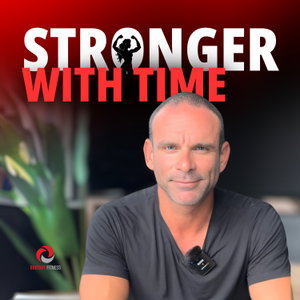
Professor Roger Enoka is one of the world’s leading authorities on the neuromuscular system and has spent more than four decades studying how the nervous system produces movement, strength and fatigue. He is the author of Neuromechanics of Human Movement, now in its sixth edition.
In this episode of Stronger With Time, we discuss why Type II muscle fibres are not simply high-threshold motor units, why light and heavy loads taken to failure can produce similar muscle growth despite differences in motor unit activity, and what can limit your ability to continue a set as you approach failure.
In this episode, we discuss:
What a motor unit is, and why muscle fibre type and recruitment threshold are not the same thing
How motor unit recruitment and rate coding change as force demands increase
Light versus heavy loads to failure, and the relationship between motor unit activity and muscle growth
Fatigue, fatigability and why the distinction matters when we talk about training to failure
How mechanical tension is generated and what we can measure in human muscle
Free weights versus machines, and how balance and stability change the demands on the nervous system
Lengthening contractions and the neural demands of controlling a load
Neuromechanical matching and regional hypertrophy
Motor neuron loss, rate coding and the role of resistance training as we age
Sex differences in fatigability and what they may mean for exercise prescription
Resistance training, balance and the role of impact exercise as we age
Timestamps
00:00 Introduction
00:52 What is a motor unit?
03:20 Recruitment thresholds and the size principle
04:11 Muscle fibre type versus motor unit type
05:50 Fatigue, fatigability and failure
14:13 Light versus heavy loads and muscle growth
17:55 Mechanical tension and what we can measure in humans
25:40 What happens from brain to muscle across a set
29:01 Free weights versus machines
30:58 Lengthening contractions
34:34 Neuromechanical matching and regional growth
38:15 Ageing and the nervous system
42:19 Sex differences
46:52 Resistance training, balance and impact exercise
49:00 Where to find Roger’s work
Resources
Professor Roger Enoka
University of Colorado Boulder: https://www.colorado.edu/iphy/people/faculty/roger-m-enoka
Neuromechanics of Human Movement, 6th Edition: https://us.humankinetics.com/products/neuromechanics-of-human-movement-6th-edition
The Science of Movement on Coursera: https://www.coursera.org/specializations/science-of-movement
Dr Tony Boutagy / Stronger With Time
Website: https://tonyboutagy.com/
Explore Tony’s courses: https://tonyboutagy.com/explore-the-courses-page
Instagram: https://www.instagram.com/tonyboutagy/
This episode is for general educational purposes only and is not intended as individualised exercise advice.