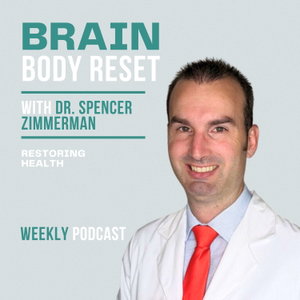
If you have POTS or another form of dysautonomia, you’ve probably been told to increase salt, push fluids, wear compression, and maybe try a medication or two. That advice isn’t wrong, but it’s compensation, not correction. And for most people, it’s a forever strategy.
In this episode, Dr. Spencer Zimmerman, a dual-licensed nurse practitioner and doctor of chiropractic, walks through the research on a system that is almost never evaluated in POTS, Long COVID, ME/CFS, or hypermobile EDS: the vestibular system.
Most people think of the vestibular system as balance and vertigo. But the gravity-sensing otolith organs feed directly into the brainstem’s cardiovascular centers. When you stand up, this vestibulosympathetic reflex fires before your blood pressure has a chance to drop, constricting blood vessels and activating the leg muscles that pump blood back to the heart. It responds roughly twice as fast as the baroreceptor reflex that most POTS models focus on. When that early-warning system isn’t working, blood pools, less returns to the heart and brain, and the heart races to compensate. That racing heart is the downstream effect, not the root problem.
Dr. Zimmerman connects this to a 2026 paper framing POTS, ME/CFS, and Long COVID as neuroimmune disorders, research showing brainstem inflammation in Long COVID near vagal and vestibular centers, a study showing otolith stimulation changes blood flow to the brain independent of blood pressure or breathing, and astronaut research where reduced gravity weakens the otoliths and produces POTS-like orthostatic intolerance on return to Earth.
He then gets practical: what testing should be done (and why video-recorded eye movement testing should be the minimum standard), why generic habituation-based vestibular rehab often makes this population worse, and what a complete plan looks like. That includes visual and vestibular work, cervical spine and proprioception, heart-rate-guided progression, and addressing “sabotagers” like mast cell activation, anemia, thyroid, hormones, and gut issues.
Key takeaways
- What triggers POTS (infection, surgery, injury) is different from what keeps it going
- The vestibular system directly regulates blood vessel tone, heart rate, the skeletal muscle pump, and blood flow to the brain
- Tachycardia in POTS is a compensation for upstream dysfunction, which is why rate-lowering medications rarely make people feel truly well
- Research shows reduced brain blood flow appears about two minutes before nausea sets in, which is why measuring physiology beats waiting for symptoms in sensitive patients
- “Normal” and “no pathology” are not the same thing; you can have intact balance and still have impaired vestibular function
- Standard vestibular rehab is built for conditions like BPPV and relies on pushing through symptoms, which backfires in dysautonomia
- The best outcomes come from treating vision, vestibular, cervical, proprioceptive, and whole-body factors together, not in isolation
Chapters
- 0:00 Why salt, fluids, and compression aren’t the full answer
- 1:23 Triggers vs. what keeps POTS going
- 3:46 The 2026 paper: POTS, ME/CFS, and Long COVID as neuroimmune disorders
- 4:47 How POTS is actually diagnosed
- 7:44 The vestibular system is more than your inner ear
- 9:22 The vestibulosympathetic reflex vs. the baroreceptor reflex
- 13:59 What likely breaks down in POTS
- 16:21 How the inner ear regulates blood flow to the brain
- 19:44 Blood flow drops before symptoms appear (and why we use fNIRS)
- 21:42 What astronauts teach us about POTS
- 24:12 What should be evaluated
- 26:07 The skeletal muscle pump and the vestibular connection
- 30:13 Brainstem inflammation and the self-perpetuating loop
- 33:12 Levels of vestibular testing: VNG, positional, caloric, rotary chair
- 37:27 Why generic vestibular rehab often makes people worse
- 39:58 What a thorough treatment plan looks like
- 44:08 The neck, upper cervical care, hypermobility, and CCI
- 47:03 The visual system and “central” dysfunction
- 48:23 What needs to change in the field
- 51:31 Research citations and where to learn more
Learn more: Peak Brain and Body, near Tampa, FL, serves patients traveling from across the country and around the world. Visit peakbrainandbody.com.