👉 Discover how Cambridge Spark helps organisations build the data and AI capabilities needed to turn strategy into measurable impact: cambridgespark.com
Large language models are surprisingly good at producing fluent, plausible text. So why do they still confidently get simple things wrong?
In this episode, Dr Jeremy Bradley is joined by Dr Vaishak Belle, Reader at the University of Edinburgh's School of Informatics, Alan Turing Institute Faculty Fellow and Director of Research and Innovation at the Bayes Centre. Vaishak has spent 16 years working at the intersection of logic, probability and machine learning and brings that lens to one of AI's most persistent problems: hallucination.
The conversation traces why scaling alone will not solve reliability, what neurosymbolic AI actually is and why tools like Claude Code quietly depend on it, how theory of mind is being engineered into language models, and where reinforcement learning fits into the future of AI reasoning.
If you work at the frontier of AI research or engineering, this is a grounded, technically rich conversation worth your time.
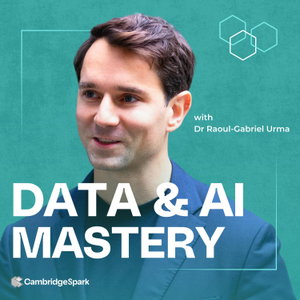
Follow Data & AI Mastery so you never miss an episode.
If you enjoyed this conversation, you might also like this episode featuring Dr Petar Veličković. Petar joined us on Data and AI Mastery to explore how graph neural networks bring structured reasoning into systems like Google Maps and how AI is being used as a genuine discovery partner in mathematics.
Apple: https://podcasts.apple.com/gb/podcast/bridging-ai-research-and-real-world-impact-dr-petar/id1779783413?i=1000734000576
Spotify: https://open.spotify.com/episode/7qA0AY9MlLS2L9PANqlXNi?si=37d8a8fb43c14cc9
YouTube: https://www.youtube.com/watch?v=GwMUSNidnvE
Glossary Terms
Neurosymbolic AI: an emerging field that merges the intuitive pattern recognition of neural networks with the logical, rule-based reasoning of symbolic AI.
Theory of Mind: refers to an AI’s capacity to attribute mental states to humans or other agents and understand that these states may differ from its own.
Confabulation: In AI, it is the generation of factually incorrect, distorted, or entirely fabricated information presented as absolute truth.
Delegation Module: a software component that allows users or systems to assign tasks, roles, or access rights to others.
Retrieval Augmented Graphs: an advanced AI framework that enhances large language models by grounding their responses in interconnected data networks, such as knowledge graphs.
Reinforcement Learning: a machine learning method where an AI agent learns to make decisions through trial and error.
Dynamic Pathway Analysis: a computational method used in systems biology and bioinformatics to model and simulate how biological processes change over time.
Chapter Markers
(00:00) - Why LLM hallucinations happen
(02:12) - The biggest shift in AI over the last 16 years
(07:42) - How logic and probability shaped Vaishak's path into AI
(10:11) - Introducing neurosymbolic AI
(11:27) - Claude Code, algebraic delegation and the theory of mind problem
(20:01) - Theory of mind in robotics and human computer interaction
(21:54) - Confabulation versus hallucination
(26:42) - Why AI errors are not the same as human dishonesty
(27:24) - Reinforcement learning, reward signals and learned behaviour
(32:36) - Syntax checks and the engineering behind reliable code
(37:52) - What happens to the software engineer's role
(40:49) - Advice for early career AI thinkers
Useful Links
Connect with Dr Vaishak Belle on LinkedIn: https://uk.linkedin.com/in/vaishakbelle
Learn more about Vaishak’s work here: https://www.vaishakbelle.org/
Read Vaishak's report on The Future of Neuro-Symbolic AI: https://ojs.aaai.org/index.php/AAAI/article/view/42130
For more AI insights follow Jeremy on LinkedIn: https://uk.linkedin.com/in/jeremy-bradley
Explore Cambridge Spark’s AI upskilling programmes at https://www.cambridgespark.com