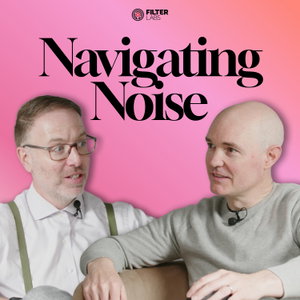
When Trump called a meeting with Xi Jinping "the G-2," he may have admitted something Washington has spent years avoiding: China is no longer a rising challenger. It's a near-peer. Foreign-policy analyst Ali Wyne returns to Navigating Noise to unpack how that admission happened almost by accident, and what it means for the most consequential relationship of the century.
Wyne, who works on U.S.–China at the International Crisis Group, makes a counterintuitive case: the goal between Washington and Beijing was never trust, and it shouldn't be. It should be empathy: a cold, dispassionate effort to understand an adversary you may never agree with. Along the way he and Jonathan Teubner dig into why young Americans are "China-maxing," why a generation of students has vanished from each other's countries, and why the popular story about China's all-seeing internet is mostly a bluff.
In this episode:
Why Trump's "G-2" comment was an accidental concession, not a strategy
The difference between empathy and sympathy, and why it decides foreign policy
Why genuine U.S.–China trust would actually be a red flag
"China-maxing" and the sadness driving young Americans toward Beijing
How student exchanges collapsed from ~15,000 to under 2,000
What the world gets wrong about dissent and censorship inside China
The college student's question that D.C. would dismiss and Wyne still can't answer
Subscribe to Navigating Noise for more conversations on how the world's biggest decisions get made.
Watch on YouTube, listen on Spotify and Apple Podcasts.
Podden och tillhörande omslagsbild på den här sidan tillhör
Filter Labs. Innehållet i podden är skapat av Filter Labs och inte av,
eller tillsammans med, Poddtoppen.