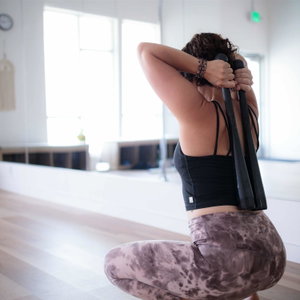
The third and final exercise from Spinal Intelligence is deceptively simple: move from hands and knees to seated, and pay attention to what your spine is doing along the way.
That’s it. No special equipment, no particular shape to achieve.
What makes it interesting is the middle part — where you get to try rounding your back through the transition, then arching it, then finding what feels easiest. Not to judge which one is “correct,” but to notice. Is one more fluid? More awkward? Does one feel like it requires more effort?
This kind of exploration is at the heart of what Spinal Intelligence is about. Your spine isn’t a column that needs to be held in the right position. It’s a responsive system that’s constantly taking in information and adapting. When you give it variations to work with — instead of a single instruction to follow — you start to develop a more nuanced relationship with how it actually moves.
The seated moment at the end, where you simply sense where your spine is in relation to your pelvis, matters more than it might look. That’s the practice: move, then feel. Not just move and move and move.
If these three exercises have been useful, the book goes much deeper — both the exercises themselves and the reasoning behind why this approach to movement works. You can find Spinal Intelligence at the link here.
This is a public episode. If you'd like to discuss this with other subscribers or get access to bonus episodes, visit jennpilotti.substack.com/subscribe
Podden och tillhörande omslagsbild på den här sidan tillhör
Jenn Pilotti. Innehållet i podden är skapat av Jenn Pilotti och inte av,
eller tillsammans med, Poddtoppen.