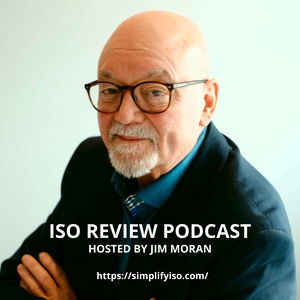
Welcome to another episode of the ISO Review Podcast, your trusted source for the latest updates on international standards and maximizing the value of your management systems. In today’s episode, Jim Moran and Howard Fox dive into the 2026 update of ISO 9001, which introduces a significant new requirement: the promotion of a quality culture and ethical behavior by top management.
Drawing from Jim Moran’s extensive experience and his "10 Building Blocks of a Quality Culture" framework, our Jim break down practical steps organizations can take to meet the new standard and improve their management systems. Whether you're a seasoned ISO professional or just starting out, this episode is packed with actionable insights to help you foster a culture of quality and stay ahead in compliance.
DISCUSSION
1. Overview of Today’s Episode
- Introduction of topic: new 2026 version of ISO 9001
- Highlighting new requirements for top management:
- Creating a quality culture
- Promoting ethical behavior
- Reference to Clause 5.1.1 (top management responsibilities)
- Mention of a free resource: “10 Building Blocks of a Quality Culture” available on simplifyasset.com
2. The 10 Building Blocks of a Quality Culture
Jim Moran outlines and explains each building block:
- 1. Put a High Value on Quality
- Not all organizations truly value quality
- The inconsistency between professed quality values and cost-cutting reward systems
- The financial impact of errors on profitability
- The necessity of rewarding quality-oriented behavior
- 2. Determination to Seek Quality
- The importance of persistent quality pursuit
- Concrete actions versus lip service
- Impact on customer relationship and advocacy
- Research on the disproportionate effect of negative versus positive comments
- 3. Understanding Processes and Interactions
- Reference to Deming's Plan-Do-Check-Act (PDCA) cycle
- Importance of auditing for results, risk management, and improvement
- The role of process understanding in internal auditing and improvement
- 4. Design Alternatives and Possibilities
- Need for flexible, non-rigid systems
- Avoiding cycles of nonconformances and corrective actions
- Use of a process-focused approach to anticipate and handle issues
- 5. Challenge and Discard Non-Value-Added Elements
- Reviewing management systems to remove unnecessary complexity
- Involving employees through internal audits for continual improvement suggestions
- Reference to the “lean” approach and mistake-proofing (Taiichi Ohno and The Toyota Production System)
- Importance for employee ease and support
- 6. Be Prepared to Start Over
- Recognizing when full process redesign is needed
- Cost versus benefit analysis of modifying vs. rebuilding processes
- Need for top management buy-in
- Reference to evaluation and auditing requirements in ISO 9001
- 7. Use Concepts—Seeing the Forest for the Trees
- Value of big-picture and lateral thinking (reference to Edward de Bono)
- Ensuring alignment with organizational strategic direction
- 8. Break Things Down into Smaller Units
- Applying the "one bite at a time" approach
- Benefits of making incremental versus radical changes
- Applying process mapping and objective analysis for improvement
- 9. Be Ready to Trade Off Other Values in Favor of Quality
- The "quality, price, timing: pick two" constraint
- Willingness to simplify processes if it maintains quality
- Focusing on measuring what matters and eliminating unnecessary metrics (reference to Goldblatt’s Theory of Constraints)
- The importance of customer feedback and engagement for meaningful improvement
- 10. Know For Whose Sake You’re Designing Quality
- Understanding "interested parties" in ISO 9001
- Meeting customer needs and expectations (explicit and implicit)
- Emphasizing empathy towards customer experience
3. Locating Quality Culture Requirements in the ISO 9001:2026 Standard
- Detailed references to where “quality culture” and related requirements appear:
- Clause 5.1.1 (leadership responsibilities, including ethical behavior)
- Clause 7.3 (awareness, ensuring people understand quality culture and ethical behavior)
- Clause 7.1.4 (environment for operation of processes, noting the influence of quality culture)
- Advice on integrating these concepts into orientation programs for employees and subcontractors
4. Registrar Expectations and Audit Focus
- What registrars will look for:
- Leadership interviews, patterns, and consistency over time
- Assessing awareness among frontline staff
- Communication trails reflecting the culture
- Note that documentation is not specifically required, but the organization’s environment should reflect a genuine pursuit of quality culture
5. Conclusion and Resources
- Recap of the 10 building blocks and their application
- Reference to availability and updates of the PDF download
- Note of external resources and organizational links:
- Simplify ISO website
- International Management System Institute (IMSIpro.org)
- LinkedIn and YouTube channels for both hosts
- Howard Fox’s coaching website
- Closing remarks, gratitude, and encouragement for listeners to access provided resources and continue exploring international standards
NEXT STEPS
We appreciate your likes & comments, and shares. Click here to visit the SimplifyISO website.
Link to Jim's FREE DOWNLOAD, '10 Building Blocks of a Quality Culture.'
Click here to learn about our new DIY ISO 9001 program using AI
Learn more about Jim on LinkedIn & YouTube.
LinkedIn
LinkedIn Articles
YouTube
Learn about Howard's Coaching and Podcast Services
Website: https://foxcoaching.com
LinkedIn: https://www.linkedin.com/in/foxcoachinginc/
Podcast Discovery Call: https://calendly.com/foxcoachinginc/podcast-discovery-call
KEYWORDS
Jim Moran, Information Security Management System, ISO 9011:2026, 10 Building Blocks of a Quality Culture, SimplifyISO, ISO Review Podcast, Podcast Interview
#JimMoran #InformationSecurityManagementSystem #ISO9001:2026 #SimplifyISO
#ISOReviewPodcast #PodcastInterview