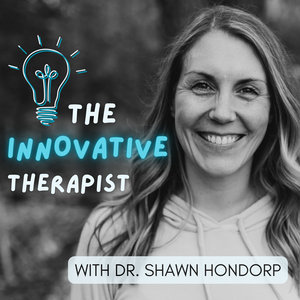
Episode 176 of The Innovative Therapist Podcast
If you struggle with binge eating or emotional eating, you have probably spent years trying to figure out how to get yourself to stop.
Stop turning to food when you’re stressed.
Stop starting over.
Stop knowing exactly what you “should” do and then doing something different.
But what if the deeper work isn’t about getting better at controlling yourself?
What if it’s about learning to trust yourself?
That’s one of the big ideas I explore in Episode 176 of The Innovative Therapist Podcast: Why Healing Binge & Emotional Eating Is Really About Learning to Trust Yourself.
Learning to trust and lead yourself through discomfort is very different than controlling yourself. And it’s also the thread connecting much of the work I do.
Ready for support with binge or emotional eating?
If you’re tired of knowing what you “should” do but still feeling stuck in cycles with food, I currently work 1:1 with people who want to heal their relationship with food, understand what’s underneath their patterns, and build deeper self-trust.
My approach integrates evidence-based psychology with IFS/parts work, somatic awareness, motivation science, and self-compassion.
[Learn more about working with me 1:1]
Or email me directly at info@drshawnhondorp.com to tell me a little about what you’re struggling with and learn more about how I might be able to help.
How Can We Use Our Motivation to Actually Help Us Stop Binge Eating?
One of the concepts I return to again and again is the difference between controlled motivation and autonomous motivation.
Controlled motivation sounds like:
I should do this.
I need to get myself together.
I have to stop eating this way.
What will people think?
I need to lose weight.
Autonomous motivation sounds like:
This matters to me.
This feels like who I am.
I genuinely want this.
I’m choosing this.
Even if this isn’t always easy, it feels right.
That distinction matters because many people who struggle with food have spent years trying to create change through pressure and control.
More rules. More monitoring. More shame after breaking the rules. Another attempt to “get back on track.”
And yet, the cycle continues.
The Part of You That Binges Is Trying to Help
This is where parts work and Internal Family Systems (IFS) have deeply influenced how I think about binge eating and emotional eating.
Instead of immediately asking:
How do I make this behavior go away?
We can become curious about it.
Maybe food helps a part of you find comfort.
Maybe it gives you relief when you’re overwhelmed.
Maybe eating is one of the few places where a highly controlled or perfectionistic part of you finally gets to rebel.
Maybe it helps you disconnect from emotions or sensations that feel difficult to stay with.
That doesn’t mean binge eating isn’t painful or that you can’t work toward changing it.
It means we stop treating the behavior as evidence that something is wrong with you and start trying to understand what function it has been serving.
This is one reason I incorporate both IFS/parts work and somatic awareness into my work.
Instead of staying entirely in our heads, we practice noticing what is happening internally and becoming a more compassionate witness to our own patterns.
From there, change can start to look very different.
Healing Your Relationship With Food Can Become Something Bigger
I’ve been recovered from my own eating disorder for well over a decade.
And one thing I’ve learned is that there are layers to this work.
First, you may need to get out of the diet-binge cycle.
You may need to rebuild trust with hunger, fullness, food, movement, and your body.
But eventually, bigger questions can emerge:
What do I actually want?
What feels like me?
Where am I still making decisions based on what I think I should want?
What parts of myself have I pushed down because they felt impractical, embarrassing, selfish, or too much?
This is where binge eating, motivation, creativity, and self-trust begin to intersect.
Because ultimately, healing isn’t only about having fewer food thoughts.
It’s about having more capacity to be present for your actual life.
From Controlling Yourself to Leading Yourself
Self-trust doesn’t mean that every impulse tells us exactly what we should do.
It also doesn’t mean abandoning structure or behavior change.
For me, it’s much closer to developing inner leadership.
Can I notice the part of me that wants to escape?
Can I notice the part demanding that I get everything right?
Can I feel what’s happening in my body instead of immediately trying to make the discomfort disappear?
Can I listen to those parts without allowing fear or shame to make every decision?
And can I still choose actions that support the person I want to become?
This is a skill.
I’ve developed much more self-trust around food and movement, but I still encounter places in my own life where my instinct is to control, worry, overthink, or look outside myself for the “right” answer.
The work keeps unfolding.
What Does Creativity Have to Do With Any of This?
Quite a bit.
As I’ve learned to trust myself more, I’ve also made more room for parts of myself that didn’t always have much room to breathe.
I’ve danced.
I’ve traveled internationally on my own.
I’ve experimented with my work.
I’ve played.
I’ve let myself want things without immediately needing to justify why they are productive.
Sometimes following what you deeply want involves discomfort. It might mean challenging yourself, risking failure, being seen, or doing something you’ve never done before.
But there’s an important difference between choosing discomfort because something deeply matters to you and chronically forcing yourself through life because you believe you should.
That distinction is at the heart of autonomous motivation.
And I think it’s also at the heart of becoming more fully yourself.
A Different Question to Ask After Emotional Eating or a Binge
If you’ve been caught in the binge-shame-control cycle, experiment with curiosity before immediately trying to fix what happened.
You might ask:
What was happening in my body before I ate?
What was I feeling or trying not to feel?
What did the part of me that wanted food hope it would give me?
Is there another part criticizing me right now?
What might I actually need?
You don’t need to uncover the perfect psychological explanation.
The shift itself matters.
You’re moving from:
What’s wrong with me?
to:
What’s happening inside of me?
And that’s a very different relationship to have with yourself.
Listen to Episode 176
🎧 Why Healing Binge & Emotional Eating Is Really About Learning to Trust Yourself
In this solo episode of The Innovative Therapist Podcast, I talk more about my own evolving relationship with food, work, creativity, parenting, play, and self-trust, and why I believe these seemingly separate parts of our lives are deeply connected.
Hi, I’m Shawn
I’m Shawn Hondorp, PhD, a clinical health psychologist. I help people recover from binge eating and emotional eating, build self-trust, and ultimately come more fully alive.
And for me, that work goes far beyond food.
If you follow me on Instagram, you’ll see me dancing, playing, traveling in ways that immerse me in other cultures, exploring creativity, and experimenting with what it means to build a life that actually feels like mine.
Those experiences have been an important part of my own healing and growth, and they’ve only deepened how I approach my 1:1 work.
Because ultimately, I don’t think healing your relationship with food is just about eating differently.
It’s about learning to listen to yourself, trust yourself, reconnect with your body and desires, and make more room for the parts of you that want to play, create, connect, and feel fully alive.
Looking for Help With Binge Eating or Emotional Eating?
If you feel like you already know a lot about food but still find yourself stuck in cycles of binge eating, emotional eating, guilt, restriction, or trying to “get back on track,” I’d love to connect.
My 1:1 work integrates evidence-based psychology with IFS/parts work, somatic awareness, motivation science, and self-compassion.
We aren’t simply trying to give you another set of rules to follow. We can get curious about what’s underneath these patterns, help you develop a different relationship with the parts of you driving them, and build deeper trust in yourself and your body.
[Learn more about working with me 1:1]
Or email me directly at info@drshawnhondorp.com. Tell me a little about what you’re struggling with, and we can explore how I might be able to help.