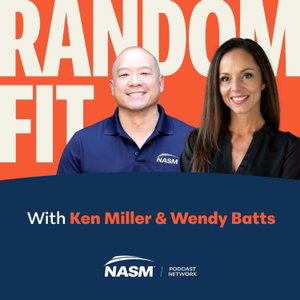
The main question this “Random Fit” answers is: "What do the most important fitness acronyms mean and how can you use them to improve your training goals, program design, recovery, and daily habits?" If you have ever been confused by acronyms like SMART, FITT, NEAT, PEACE & LOVE, or BEDS in fitness conversations or NASM courses, this episode provides clear definitions and practical tips for applying them to real-life situations.
Hosts Wendy Batts and Ken Miller break down five commonly used fitness acronyms, explaining how they relate to goal-setting, exercise routines, injury management, and healthy sleep. You will learn how to set realistic, achievable goals, structure your workouts effectively, stay active throughout your day, manage injuries with updated approaches, and create better sleep routines.
After listening, you will have concrete strategies for making your fitness plans actionable and sustainable, grounded in proven NASM frameworks and day-to-day trainer experience.
This discussion is ideal for personal trainers, fitness enthusiasts, or anyone looking to clarify and apply foundational concepts in their wellness journey.
Chapters:
[00:00:00] What are the main fitness acronyms trainers use and why do they matter?
[00:03:02] How do SMART goals help you set and achieve fitness objectives?
[00:11:24] What is the FITT principle and how can you use it in your workout plan?
[00:17:27] What is NEAT and how can daily activity outside the gym support your fitness?
[00:21:25] What does RICE mean and why is PEACE & LOVE a better approach for injuries?
[00:27:36] How can the BEDS acronym improve your sleep and recovery routine?
[00:31:12] What are some actionable takeaways for using fitness acronyms in everyday life?
Show References:
Dubois, B., & Esculier, J. F. (2020). Soft-tissue injuries simply need PEACE and LOVE. British Journal of Sports Medicine, 54(2), 72-73.
https://doi.org/10.1136/bjsports-2019-101253 Irish, L. A., Kline, C. E., Gunn, H. E., Buysse, D. J., & Hall, M. H. (2015). The role of sleep hygiene in promoting public health: A review of empirical evidence. Sleep Medicine Reviews, 22, 23–36. https://doi.org/10.1016/j.smrv.2014.10.001
Levine, J. A. (2004). Non-exercise activity thermogenesis (NEAT). Best Practice & Research Clinical Endocrinology & Metabolism, 18(2), 159-167. doi: 10.1053/beem.2002.0227 Riebe, D., Ehrman, J. K., Liguori, G., & Magal, M. (Eds.). (2018). ACSM's guidelines for exercise testing and prescription (10th ed.). Wolters Kluwer.
SMART Goals: NASM CPT 7th edition textbook: Chapter 4
If you like what you just consumed, leave us a 5-star review, and share this episode with a friend to help grow our NASM health and wellness community!
The content shared in this podcast is solely for educational and entertainment purposes. It is not intended to be a substitute for professional advice, diagnosis, or treatment. Always seek out the guidance of your healthcare provider or other qualified professional. Any opinions expressed by guests and hosts are their own and do not necessarily reflect the views of NASM.
Introducing NASM One, the membership for trainers and coaches. For just $35/mo., get unlimited access to over 300 continuing education courses, 50% off additional certifications and specializations, EDGE Trainer Pro all-in-one coaching app to grow your business, unlimited exam attempts and select waived fees. Stay on top of your game and ahead of the curve as a fitness professional with NASM One. Click here to learn more. https://bit.ly/4ddsgrm