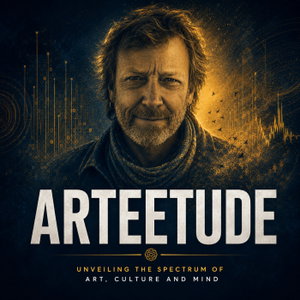
In Arteetude 340 – The Artist After the Upload, Detlef Schlich continues the philosophical arc that began in Arteetude 338 with The Law of Acceleration. After the reflective pause of Arteetude 339 at Gallery Emptiness with Felicitas, this new episode moves into the world of media, reproduction, AI, and artistic presence.
Together with his AI Co-Host Sophia, Detlef explores how Marshall McLuhan and Walter Benjamin can still help us understand what happens to art — and to the artist — after a work has been uploaded. McLuhan’s famous idea that the medium is the message becomes a personal question: how does podcasting, social media, AI, video, streaming, and digital distribution reshape the artist’s voice, rhythm, imagination, and nervous system?
Benjamin’s concept of aura opens another layer. If reproduction once seemed to threaten the unique presence of the artwork, what happens today when a work becomes file, stream, post, thumbnail, memory, comment, remix, and archive? Has aura disappeared — or has it migrated?
Through Detlef’s own concept of Multilayerism, the episode proposes that aura is not simply dead. It may now move through layers: physical, digital, emotional, historical, spiritual, technological, remembered, and misunderstood. But this movement is not automatically meaningful. Aura survives only where attention, imagination, and resonance still happen.
The episode closes with a new musical reflection by Los Inorgánicos: “Beneath the Digital Moon” — a small love song to the organic, to the body, to the voice, and to the warmth that remains after the upload.
About Detlef Schlich
Detlef Schlich is a rock musician, podcaster, visual artist, filmmaker, ritual designer, and media archaeologist based in West Cork, Ireland.
His artistic practice moves between performance, photography, painting, sound, installation, film, music, podcasting, and digital image-making. Across these fields, Schlich reflects on the human condition, the relationship between ritual and technology, and the changing role of the artist in digital culture.
As a media archaeologist, he explores how media shape perception, memory, culture, politics, and artistic expression. His work often uses the figure of the digital shaman as an alter ego — a method for navigating the space between ancient ritual structures, contemporary media, and technological transformation.
Research & Artistic Method
Detlef Schlich’s artistic research is rooted in his essay Shamanism, Art and Digital Culture: Cause and Effect, which investigates the relationship between ritual, artistic transformation, media, and digital culture.
Download here for free:
Shamanism, Art and Digital Culture: Cause and Effect
https://www.researchgate.net/publication/303749640_Shamanism_Art_and_Digital_Culture_Cause_and_Effect
Building on this foundation, Schlich developed Multilayerism: A New Paradigm in Contemporary Art – A Manifesto, an artistic method and conceptual framework for understanding contemporary art through layers of media, memory, technology, ritual, emotion, misunderstanding, and lived experience.
Read here:
Multilayerism: A New Paradigm in Contemporary Art – A Manifesto by Detlef Schlich
https://www.researchgate.net/publication/375665507_Multilayerism_A_New_Paradigm_in_Contemporary_Art_-_A_Manifesto_by_Detlef_Schlich
Together, these texts form the theoretical backbone of Schlich’s ongoing work as a visual artist, media archaeologist, ritual designer, musician, and host of the Arteetude podcast.
WEBSITE LINKS Music ProjectsWAW / Wild Atlantic Way
WAW is the music project by Detlef Schlich and Dirk Schlömer.
Official YouTube Channel:
https://www.youtube.com/@WAWBand
From the forthcoming WAW album The Stories of Nil Young
Two songs from WAW’s developing album project The Stories of Nil Young form part of a mythopoetic journey along the Nile, where river, memory, loss, cooperation, and hope flow into music.
AfricaSmile
AfricaSmile follows the Nile as an imagined journey from its sources to the Mediterranean Sea — a river of memory, movement, rhythm, and myth. The song turns the meeting of the White Nile and the Blue Nile into a fragile image of cooperation. It is not a naïve peace anthem, but a wounded musical hope: two different currents meeting, listening, and still moving forward together.
Watch here:
https://www.youtube.com/watch?v=LnQbsh01YWU
The Nile’s Bittersweet Song
The Nile’s Bittersweet Song is the first official single by WAW / Wild Atlantic Way — Detlef Schlich and Dirk Schlömer.
The song follows the Nile as a river of memory, beauty, loss, and contradiction: a life-giver, but also a force that can take away what it once nourished. Through the story of Kamau, it becomes a poetic reflection on childhood, fragile hope, and the emotional landscape carried by a river that is both kind and cruel.
Inspired by East African storytelling traditions and shaped along the Wild Atlantic Way in West Cork, The Nile’s Bittersweet Song is a mythopoetic musical journey about water, grief, resilience, and the deep human longing to keep moving with the current.
Watch here:
https://www.youtube.com/watch?v=33AWko4IkKI
WAW on Bandcamp
Silent Night
In a world shadowed by conflict and unrest, Dirk Schlömer and Detlef Schlich felt compelled to reinterpret Silent Night to reflect the complexities and contradictions of modern life.
https://studiomuskau.bandcamp.com/track/silent-night
Wild Atlantic Way
This song emerged from a trip to West Cork, Ireland, where the beautiful coastal Wild Atlantic Way stretches along the west coast.
https://studiomuskau.bandcamp.com/track/wild-atlantic-way
YouTube
Silent Night Reimagined – A Multilayered Avant-Garde Journey by WAW aka Dirk Schlömer & Detlef Schlich
https://www.youtube.com/watch?v=dAbytLSfgCw
Detlef Schlich
Instagram
Detlef Schlich
ArTEEtude
I love West Cork Artists
Facebook
Detlef Schlich
I love West Cork Artists Group
ArTEEtude
YouTube Channels
visual Podcast
ArTEEtude
Cute Alien TV
official Website
ArTEEtude
Detlef Schlich
Det Design
Tribal Loop
Support this podcast at — https://redcircle.com/arteetude-a-podcast-with-artists-by-detlef-schlich/exclusive-content