Dela
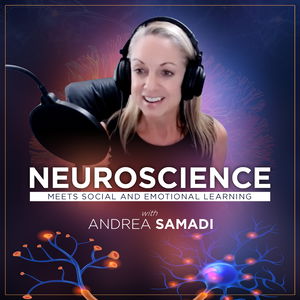
In this milestone episode (400), Andrea Samadi celebrates seven years of the Neuroscience Meets SEL Podcast with her husband Majid Samadi. They reflect on the journey of translating neuroscience into practical strategies for performance, learning, and well-being.
Together they review core lessons — everything begins with the brain, safety before performance, how thoughts shape biology, the power of movement, recovery as a performance strategy, and the central role of relationships and support. Majid also shares leadership insights from his decades in educational sales, including stress management, motivation, continuous learning, and the guiding motto: do the right thing.
They close by looking ahead to the next phase on movement, learning and cognition and invite listeners to subscribe for future episodes.
Sales Leadership Under Pressure: Applying the Neuroscience of High Performance to Real-World Leadership
Guest: Majid Samadi Listen to YouTube interview here https://youtu.be/SSZH3qwPqf8
Intro: Top 7 Lessons from the past 7 years
Guest: Majid Samadi (Interview begins at 10:16)
EP 400: Sales Leadership Under Pressure with Majid Samadi
In this milestone 400th episode, Andrea welcomes back her husband, Majid Samadi, who first appeared on Episode 1 when the podcast launched in 2019.
Together, they reflect on seven years, fifteen seasons, and 400 episodes of exploring the neuroscience behind achievement, leadership, learning, motivation, and human potential.
In this episode, we will cover:
✔ The Top 7 Lessons Learned from 7 Years and 400 Episodes
✔ Why understanding the brain changes the way we learn, lead, and perform
✔ The neuroscience of stress, self-regulation, and leadership under pressure
✔ How high-performing leaders sustain motivation without burning out
✔ The connection between movement, learning, cognition, and peak performance
✔ Why relationships are the foundation of leadership and long-term success
✔ The role trust plays in building high-performing teams
✔ Leadership lessons learned through organizational change, uncertainty, and growth
✔ How the definition of success evolves over a lifetime and career
✔ Why no meaningful achievement happens alone
As Andrea reflects on the lessons learned from hundreds of conversations with neuroscientists, educators, physicians, psychologists, business leaders, and peak performers, she shares the one lesson that stands above all the rest:
Behind every meaningful accomplishment is someone who believed in you enough to help you keep going.
Welcome back to Season 15 of the Neuroscience Meets Social and Emotional Learning Podcast. I'm Andrea Samadi, and on this podcast, we bridge the science behind social and emotional learning, emotional intelligence, and practical neuroscience so we can create measurable improvements in well-being, achievement, productivity, and results.
Over the past 399 episodes, we’ve explored the neuroscience behind performance, learning, stress, motivation, and human potential. For this milestone Episode 400, I wanted to do something different.
Instead of interviewing another neuroscientist, or reviewing past episodes, we’re going to explore what happens when these ideas are applied in the real world.
Joining me is someone listeners heard on EP 1[i] my husband, Majid Samadi, where we laid out the framework for future episodes, EP 200[ii] (Why we launched this podcast), and EP 300[iii] (a special episode with my Mom, Hazel MacPhail, where she taught us “how to live the good life”).
I’ll never forget EP 1, when I asked Majid if he would record with me to help me to launch this podcast thing I wanted to start. He had just come home from working LAUSD (in California) and he put his suit jacket on my desk, and sat down in front of the microphone. I showed him the questions I would ask him, and off we went. I learned that when you start something, it doesn’t have to be perfect. Just start.
What 15 Seasons Taught Me
Before we begin today's conversation, I wanted to take a moment to reflect on what I've learned over the past seven years and 400 episodes of the Neuroscience Meets Social and Emotional Learning Podcast. I had sketched out a framework, and had some ideas of what I wanted to cover on at least the first 50 episodes.
When I started this idea in 2019, I thought I was creating a platform to share neuroscience research (as it connected to Social and Emotional Learning).
What I didn't realize was that the journey would change me.
After hundreds of interviews with neuroscientists, physicians, educators, psychologists, business leaders, and peak performers, there are a few lessons that stand above all the rest. I’ll always say it took me 50 episodes to get started. I found it really difficult to ask questions and breathe at the same time.
Lesson #1: Everything begins with the brain.
Whether we're talking about achievement, learning, leadership, health, relationships, or performance, success starts with understanding how the brain works.
When we understand the brain, we stop fighting ourselves and start working with ourselves. We all have our own journey here. Mine started when an educator, Jeff Kleck, from EP 246[iv] challenged me to add neuroscience to my work. This was around 2014 when I had partnered with AZ Department of Education with a character ed/leadership program, and Jeff Kleck told me that I wouldn’t go wrong if I wrote a whole new book that focused on the brain and learning. That’s when I sat down, and started to study some of the leading researchers in this field.
I’ve heard similar stories from other authors like Dr. Doug Fisher, who told me that he sat in classes with medical students to unwrap how the brain learns best.
Lesson #2: Safety comes before performance.
One of the most important themes of Season 15 has been that a dysregulated nervous system cannot perform at its best.
Before growth, before learning, before leadership, the brain must feel safe.
This lesson applies in our homes, our schools, our workplaces, and our relationships.
I’ll never forget asking Dr. David Stephen on EP 388[v] about a situation where I was under unusual stress, and my eyesight (or ability to read) stopped working. He explained the neuroscience behind this example, that I’ll never forget and his solution to my problem that was to eat glucose before any important meeting or presentation.
Lesson #3: Our thoughts become biology.
Through experts like Dr. Caroline Leaf, Bob Proctor, Dawson Church, and many others, I learned that our thoughts are not just ideas.
They influence our chemistry, our attention, our habits, and ultimately our results.
What we repeatedly think becomes what we repeatedly do.
This one I’ve believed since my days working in the seminar industry with Bob Proctor. He would hammer this concept into everyone’s mind in every seminar. I just always thought this was something he really believed in, until I heard the SAME thing from Dr. Caroline Leaf, and Dr. Korotkov from Russia. It’s also behind Dr. Joe Dispenza’s work. To this day, I watch the words I think and say out loud.
Lesson #4: Movement changes the brain.
This lesson became personal.
The science is clear: movement improves attention, memory, mood, resilience, and learning.
But over the years, I experienced it firsthand through hiking, walking, strength training, and building daily movement into my life.
This is how I’ve always been. I remember putting on my rollerblades when I was 16 and rollerblading to the local YMCA that wasn’t really in my neighborhood.
Motivation got me moving.
Movement changed my brain.
And this is how I still find the energy to sit at my desk and write podcasts episodes every Saturday. I have to exercise (or move) first, and then I can create. Over time this has probably been my healthiest habits.
Lesson #5: Recovery drives performance.
For years I focused on doing more.
The neuroscience taught me something different.
Growth doesn't happen during effort.
Growth happens during recovery.
Sleep, stress regulation, recovery, and reflection are not luxuries—they are performance strategies.
This took me years to finally put into practice.
Lesson #6: Relationships change everything.
If there is one lesson that appears in every field of neuroscience, it is this:
We are wired for connection.
The quality of our relationships influences our health, happiness, resilience, leadership, and longevity.
And that brings me to perhaps the most important lesson of all.
Lesson #7: No meaningful achievement happens alone.
People often see the finished podcast episode.
They don't see the support system behind it.
For 400 episodes, there has been one person supporting this mission from behind the scenes.
My husband, Majid.
While I was researching, writing, recording, editing, and building this platform, Majid was encouraging me when things were difficult, celebrating the wins, offering perspective when I needed it, and helping me continue when the path wasn't always clear.
Many of these episodes were written because someone believed in me enough to keep me going.
The podcast may have my name on it, but it has always been supported by both of us.
As we celebrate Episode 400, that's the lesson I want to leave everyone with.
Achievement is rarely a solo journey.
Behind every meaningful accomplishment is a person, a mentor, a teacher, a spouse, a friend cheering you along the way from the sidelines, or a community that helped make it possible.
The neuroscience taught me how the brain works.
Life taught me that relationships are what make everything work.
And that's why there is no better person to join me for Episode 400 than Majid Samadi.
Welcome Majid! Thank you for taking the time to record this milestone episode with me. I know your time is limited. Before we get started, can you share what it is that you do when you are not being strong armed to record podcast episodes for me?
So, we have been covering 5 phases in Season 15, showing how the brain comes online and changes with each phase. So I’ve got some questions for you that will cover each phase. Does that sound good?
🧠 PHASE 1 REGULATION & SAFETY
Leading Through Stress
“We began Season 15 with a fundamental question: Is the brain safe enough to learn, think, and perform?”
Questions
1. You’ve led teams through growth, uncertainty, organizational change, and high-pressure environments. When stress is elevated, what do you notice first in yourself? How have you learned to shield this stress from those who report to you, or take the brunt of it off of them?
2. Looking back, have there been moments when pressure impacted your decision-making, and what did you learn from those experiences?
3. Many leaders spend years operating in “go mode.” How do you recognize when you’re pushing too hard? What advice have you given to your colleagues when you see them pushing too hard?
4. What habits help you reset your nervous system and regain perspective when demands are high?
5. If leadership performance begins with self-regulation, what advice would you give leaders who feel overwhelmed right now?
⚡ PHASE 2: MOTIVATION & DRIVE: Sustaining Performance Without Burning Out
“In Phase 2, we explored the Motivation Loop—meaning, belief, attention, action, reward, and recovery.”
Questions
6. What has motivated you throughout your career, and has that motivation changed over time?
7. When facing major challenges, what keeps you moving forward when results aren’t immediate?
8.What role does purpose play in maintaining motivation?
9. Have you ever achieved a goal that didn’t feel as rewarding as you expected?
10. What have you learned about balancing ambition with recovery/rest?
🚶♂️ PHASE 3: LEARNING, MOVEMENT & COGNITION
Staying Sharp in a Fast-Paced World
“Our next phase explores how movement, learning, and cognition work together to support performance.”
Questions
11. Leadership requires continuous learning. How do you continue growing while managing significant responsibilities?
12. When information is incomplete and decisions need to be made quickly, how do you approach decision-making?
13. What habits have helped you stay mentally sharp over the years?
14.How important has physical health been in supporting your professional performance?
15.What’s one lesson you’ve learned about the connection between health and leadership that you wish you understood earlier?
🤝 PHASE 4
SOCIAL INTELLIGENCE & RELATIONSHIPS: The Human Side of Leadership
“Some of the most important neuroscience research shows us that performance happens through relationships.” This is where I think you excel. I remember being at a meeting, that you would have been at, except you moved onto a new position with your promotion to where you are now. I can’t even tell you how many people approached me from Senior Leadership (top of the company) to people I had never even heard of, asking how you are.
Questions
16. When you think about the best leaders you’ve worked with, what qualities stand out?
17. How do you build trust within a team?
18. What have you learned about motivating different personalities?
19. How do you navigate difficult conversations while maintaining strong relationships?
20. Why do you think you made a lasting impact on so many people?
🧭 PHASE 5
INTEGRATION, INSIGHT & MEANING
Lessons from the Journey
“Our final phase focuses on integration—bringing everything together.”
Questions
21.
Looking back across your career, what leadership lesson took the longest to learn?
22. How has your definition of success evolved?
MILESTONE QUESTION
“If there was one principle that has guided you through leadership, business, family, setbacks, and success—what would it be?”
Majid, I want to thank you for taking the time out of your day off today when you could have been cleaning the garage, to record this episode with me. I want to thank you for supporting me with this podcast the past 7 years. I couldn’t have done this without you.
And next week, we’re taking the next step as we launch Phase 3 of our season on Movement, Learning, and Cognition.
Because once we understand how to regulate stress and sustain motivation, the next question becomes:
How do we optimize the brain to learn, think, adapt, and grow?
We’ll begin that journey in Episode 401 with Greg Hill, where we’ll explore one of the most important ingredients in high-performing teams: Trust.”
REFERENCES:
[i]Neuroscience Meets Social and Emotional Learning Podcast EPISODE 1 https://andreasamadi.podbean.com/e/the-why-behind-setting-up-a-social-and-emotional-learning-program-in-your-school-or-emotional-intelligence-training-for-your-workplace/
[ii]Neuroscience Meets Social and Emotional Learning Podcast EPISODE 200 https://andreasamadi.podbean.com/e/our-200th-milestone-episode-with-majid-samadi-returning-guest-from-episode-1-on-why-we-began-this-podcast/
[iii]Neuroscience Meets Social and Emotional Learning Podcast EPISODE 300 https://andreasamadi.podbean.com/e/my-mom-hazel-macphail-with-majid-samadi-on-leaving-a-legacy-how-to-live-the-good-life/
[iv]Neuroscience Meets Social and Emotional Learning Podcast EPISODE 246 https://andreasamadi.podbean.com/e/jeff-kleck-on-using-neuroscience-to-inspire-thinkers-in-schools-sport-and-the-workplace/
[v]Neuroscience Meets Social and Emotional Learning Podcast EPISODE 388 https://andreasamadi.podbean.com/e/the-glucose-protocol-how-fueling-your-brain-restores-clarity/
Avsnitt sparat!
Du hittar sparade avsnitt på Mina sidor.
Kunde inte spara avsnitt
Något gick fel. Försök igen.