Dela
So here's the thing. I know I talk a lot about reading. It's pretty important to me. But all week I've been trying to prepare a different podcast, one NOT about the uncrackable justification for choice reading. But recently I heard from several teachers over in CHSE about thriving reading programs they had going, only to get shut down by folks who felt like reading in class was a waste of time. And then I kind of ended up in a rabbit hole, as I am wont to do. It's like researching the justification for choice reading became my guilty pleasure, sucking up all my time. I listened to audiobooks on my walks, pored over research roundups and articles at the coffee shop, hit up the hammock with my Penny Kittle, and stared and stared and stared at the growing evidence mounting in my endless Google doc of notes.
The evidence is clear. The need for help for kids who don't read, don't like reading, and don't want to read is great. And yet STILL we are prioritizing reading snippets and drilling for tests to "improve" our readers' reading. I want you to have the information you need to fight. So here I am. Again. Despite my efforts to focus on something else this week. Let's dig deep.
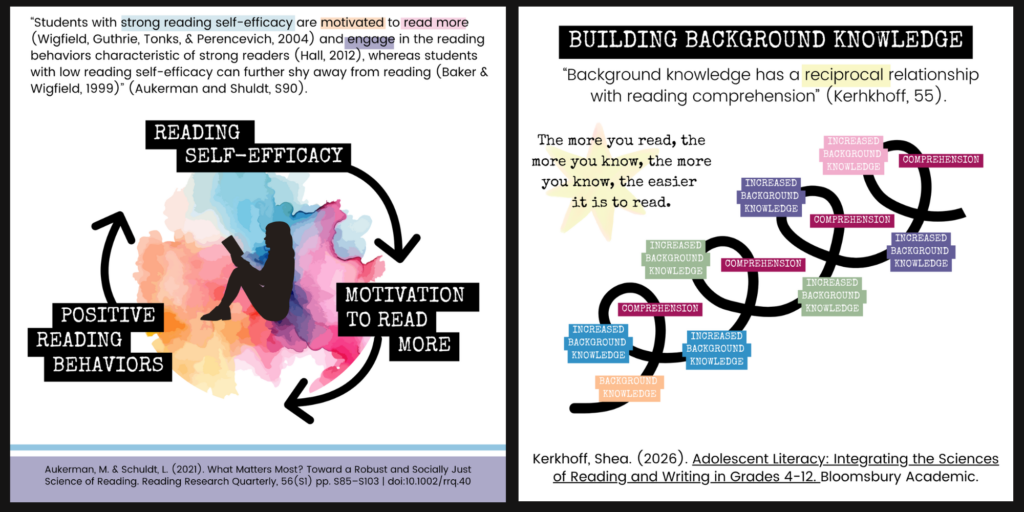
Illustration for The Cycles I share in this episode:
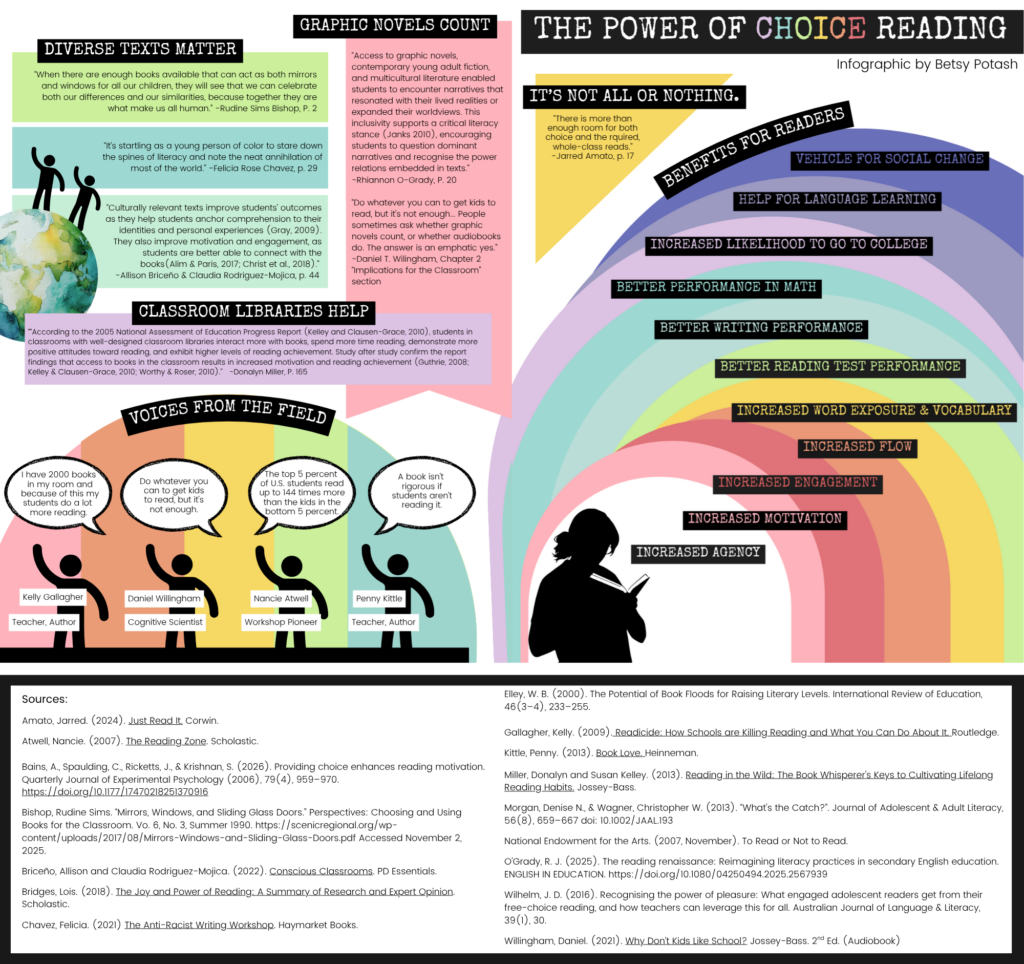
The Infographic I mentioned:
Go Further:
Explore alllll the Episodes of The Spark Creativity Teacher Podcast.
Launch your choice reading program with all my favorite tools and recs, and grab the free toolkit.
Join our community, Creative High School English, on Facebook.
Come hang out on Instagram.
Enjoying the podcast? Please consider sharing it with a friend, snagging a screenshot to share on the 'gram, or tapping those ⭐⭐⭐⭐⭐ to help others discover the show. Thank you!
Sources:
Amato, Jarred. (2024). Just Read It. Corwin.
Atwell, Nancie. (2007). The Reading Zone. Scholastic.
Aukerman, M. & Schuldt, L. (2021). "What Matters Most? Toward a Robust and Socially Just Science of Reading." Reading Research Quarterly, 56(S1) pp. S85–S103 | doi:10.1002/rrq.40
Bains, A., Spaulding, C., Ricketts, J., & Krishnan, S. (2026). Providing choice enhances reading motivation. Quarterly Journal of Experimental Psychology (2006), 79(4), 959–970. https://doi.org/10.1177/17470218251370916
Bishop, Rudine Sims. "Mirrors, Windows, and Sliding Glass Doors." Perspectives: Choosing and Using Books for the Classroom. Vo. 6, No. 3, Summer 1990. https://scenicregional.org/wp-content/uploads/2017/08/Mirrors-Windows-and-Sliding-Glass-Doors.pdf Accessed November 2, 2025.
Briceño, Allison and Claudia Rodriguez-Mojica. (2022). Conscious Classrooms. PD Essentials.
Bridges, Lois. (2018). The Joy and Power of Reading: A Summary of Research and Expert Opinion. Scholastic.
Chavez, Felicia. (2021) The Anti-Racist Writing Workshop. Haymarket Books.
Elley, W. B. (2000). The Potential of Book Floods for Raising Literary Levels. International Review of Education, 46(3–4), 233–255.
Gallagher, Kelly. (2009). Readicide: How Schools are Killing Reading and What You Can Do About It. Routledge.
Kerkhoff, Shea. (2026). Adolescent Literacy: Integrating the Sciences of Reading and Writing in Grades 4-12. Bloomsbury Academic.
Kittle, Penny. (2013). Book Love. Heinneman.
Miller, Donalyn and Susan Kelley. (2013). Reading in the Wild: The Book Whisperer's Keys to Cultivating Lifelong Reading Habits. Jossey-Bass.
Morgan, Denise N., & Wagner, Christopher W. (2013). "What's the Catch?" Journal of Adolescent & Adult Literacy, 56(8), 659–667 doi: 10.1002/JAAL.193
National Endowment for the Arts. (2007, November). To Read or Not to Read.
O'Grady, R. J. (2025). The reading renaissance: Reimagining literacy practices in secondary English education. ENGLISH IN EDUCATION. https://doi.org/10.1080/04250494.2025.2567939
Wilhelm, J. D. (2016). Recognising the power of pleasure: What engaged adolescent readers get from their free-choice reading, and how teachers can leverage this for all. Australian Journal of Language & Literacy, 39(1), 30.
Willingham, Daniel. (2021). Why Don't Kids Like School? Jossey-Bass. 2nd Ed. (Audiobook)
Avsnitt sparat!
Du hittar sparade avsnitt på Mina sidor.
Kunde inte spara avsnitt
Något gick fel. Försök igen.